
I. Overview of Aluminum Scrap Melting Equipment
1.1 Definition of Aluminum Scrap Melting Equipment
Aluminum scrap melting equipment is the core system of aluminum recycling production lines. It is designed to melt various types of aluminum scrap—such as waste aluminum profiles, aluminum cans, and aluminum chips—into molten aluminum at high temperatures, while simultaneously removing impurities and improving metal quality.
Operating under controlled temperature fields and furnace atmospheres, this equipment enables efficient melting and purification of aluminum scrap, serving as the critical link between aluminum scrap recycling and secondary aluminum production.
1.2 Importance of Aluminum Recycling in Modern Industry
Under increasing global resource constraints and environmental pressure, aluminum recycling has become a key pillar of sustainable industrial development. Compared with primary aluminum production, secondary aluminum requires only 5–8% of the energy and produces approximately 10% of the CO₂ emissions.
Aluminum recycling significantly conserves natural resources, reduces greenhouse gas emissions, minimizes landfill and incineration pollution, and enhances the security of the non-ferrous metal supply chain. Currently, recycled aluminum accounts for over 40% of global aluminum output, with the proportion continuing to rise.
1.3 Role of Melting Equipment in Aluminum Recycling Lines
Melting equipment serves as the central hub of aluminum scrap recycling lines. Its performance directly determines production efficiency, product quality, and overall economic returns.
Its core functions include:
- Converting solid aluminum scrap into molten aluminum
- Refining molten aluminum through precise temperature control and flux treatment
- Ensuring stable and continuous aluminum supply for downstream processing
High-efficiency equipment can reduce metal loss, increase recovery rates, lower energy consumption, and minimize emissions, thereby enhancing the comprehensive competitiveness of recycling operations.
II. Types of Aluminum Scrap Melting Equipment
2.1 Aluminum Induction Melting Furnace
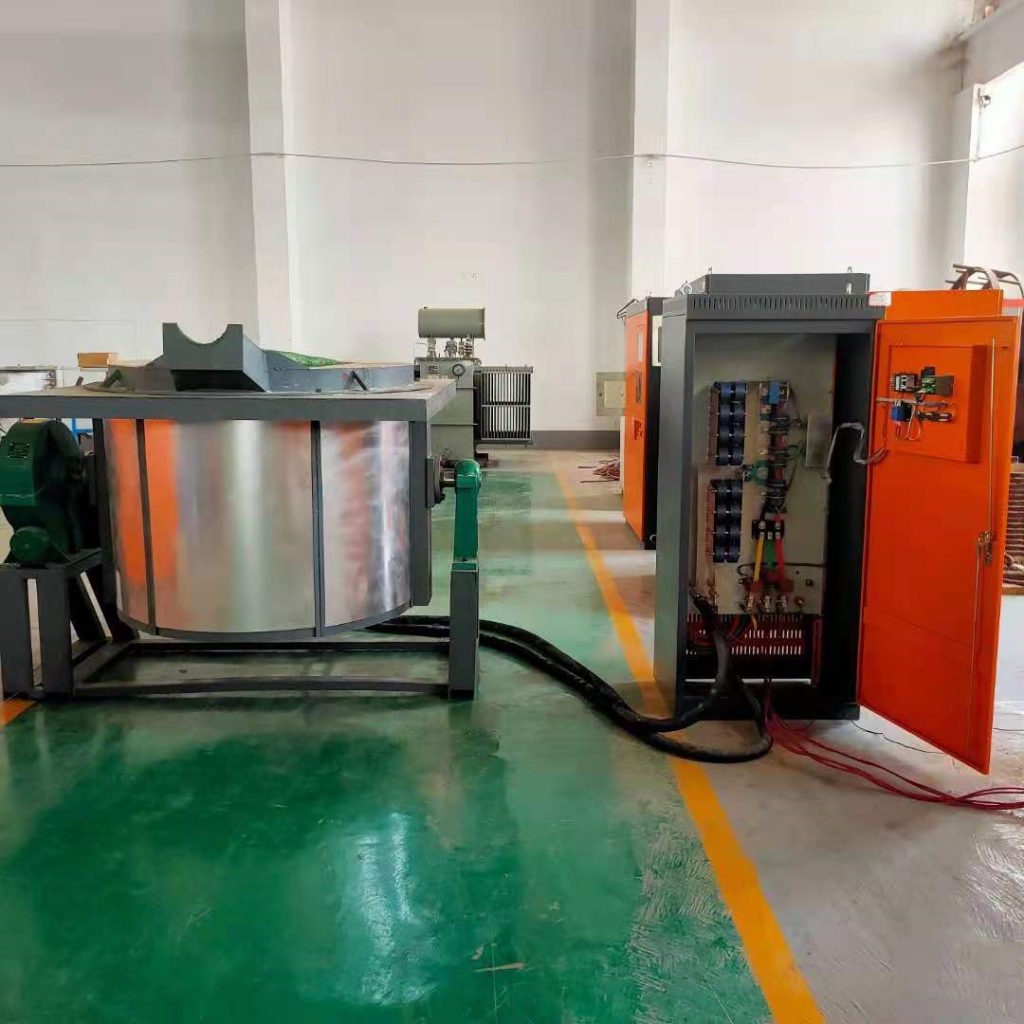
Aluminum induction melting furnaces operate based on electromagnetic induction. Key components include induction coils and crucibles.
They achieve melting efficiencies of 70–85%, offering 15–30% energy savings compared with traditional fuel-fired furnaces. Temperature control accuracy reaches ±5°C, with uniform molten aluminum mixing and low metal loss (1–3%).
These furnaces are particularly suitable for clean aluminum scrap and are widely used in small- to medium-scale recycling plants and precision casting operations. Among power-frequency, medium-frequency, and high-frequency designs, medium-frequency induction furnaces are the most widely applied due to balanced efficiency and cost.
2.2 Gas-Fired Aluminum Melting Furnaces
Gas-fired aluminum melting furnaces use natural gas or similar fuels and are among the most common solutions in the recycling industry. They are mainly divided into direct-fired and regenerative types.
- Direct-fired furnaces feature simple structures and low investment costs, suitable for small enterprises.
- Regenerative furnaces achieve thermal efficiencies of 60–75%, with over 30% energy savings and low NOx emissions, making them suitable for medium- and large-scale production lines.
These furnaces offer wide capacity ranges—from several tons to dozens of tons—but typically have lower temperature control accuracy and higher metal loss (3–5%) than induction furnaces.
2.3 Aluminum Scrap Reverberatory Furnaces
Reverberatory furnaces melt aluminum scrap through radiant and convective heat transfer from high-temperature flue gases. Their large furnace chambers allow batch processing of mixed scrap.
They feature simple construction, low capital cost, and easy maintenance. However, thermal efficiency is relatively low (30–50%), energy consumption is high, metal loss reaches 5–8%, and emissions are significant.
Due to tightening environmental regulations, their application has become increasingly limited and is now mainly confined to small, less-intensive recycling operations.
2.4 Rotary Furnaces for Contaminated Aluminum Scrap
Rotary furnaces feature a rotating, inclined furnace body and are specifically designed for processing highly contaminated aluminum scrap containing oil, paint, or coatings, such as automotive aluminum components.
As the furnace rotates, scrap continuously tumbles and is uniformly heated, allowing organic contaminants to thermally decompose. These furnaces offer strong pollution-handling capabilities and support continuous production.
However, they involve complex structures, higher investment costs, lower thermal efficiency, and require advanced flue-gas treatment systems.
2.5 Crucible Furnaces for Small-Scale Operations
Crucible furnaces are compact aluminum melting units that use crucibles to contain scrap while being heated externally by electricity or gas.
They are characterized by simple structures, small footprints, low initial investment, and operational flexibility, making them suitable for small enterprises, laboratories, and low-volume production.
However, their melting efficiency is limited, capacity is small, metal loss ranges from 4–6%, and crucibles require frequent replacement, resulting in higher maintenance costs.
Table 1: Comparison of Aluminum Scrap Melting Equipment Types
| Furnace Type | Suitable Scrap | Efficiency | Metal Loss | Investment Level | Typical Application |
|---|---|---|---|---|---|
| Induction Furnace | Clean scrap | High | 1–3% | Medium | Precision casting, clean recycling |
| Gas-Fired Furnace | Mixed scrap | Medium | 3–5% | Medium | Medium-large recycling lines |
| Reverberatory Furnace | Mixed bulk scrap | Low | 5–8% | Low | Small traditional plants |
| Rotary Furnace | Highly contaminated scrap | Medium | 4–6% | High | Automotive scrap recycling |
| Crucible Furnace | Small-batch scrap | Low | 4–6% | Low | Small workshops, labs |
III. Aluminum Scrap Melting Process
3.1 Scrap Sorting, Crushing, and Preheating
Scrap pretreatment directly affects melting efficiency and product quality. Sorting methods include manual sorting, magnetic separation, eddy-current separation, and optical analysis for complex scrap.
Crushing increases surface area and melting speed, while preheating (typically 100–300°C) removes moisture and oils, reduces splashing and oxidation loss, and lowers overall energy consumption. Waste heat recovery is commonly used for preheating.
3.2 Melting and Temperature Control
Pure aluminum melts at 660°C, while aluminum alloys melt between 580–650°C. Practical melting temperatures are usually controlled at 700–750°C to ensure complete melting while minimizing oxidation loss.
Modern systems use thermocouples and infrared sensors integrated with automatic control systems to maintain stable temperatures.
3.3 Flux Treatment, Degassing, and Impurity Removal
Fluxes (chlorides and fluorides) are added to capture non-metallic impurities. Degassing is commonly performed using rotary inert-gas injection, removing dissolved hydrogen from molten aluminum. Ceramic filters may also be used for fine impurity removal.
3.4 Slag Removal and Molten Aluminum Tapping
Slag is removed manually or mechanically to prevent contamination. After quality inspection, molten aluminum is transferred through tapping spouts or channels to downstream processes. Automated tapping systems enhance safety and process stability.
IV. Application Scenarios and Suitable Scrap Types
Table 2: Scrap Type vs. Recommended Furnace
| Scrap Type | Characteristics | Recommended Furnace |
|---|---|---|
| Clean aluminum scrap | High purity, low contamination | Induction furnace |
| Painted / oily scrap | Organic contamination | Rotary furnace |
| Aluminum chips | High oxidation risk | Induction furnace (with compaction) |
| Aluminum cans | Lightweight, bulky | Gas or induction furnace |
| Automotive aluminum scrap | Complex composition | Rotary furnace |
V. Key Features and Technical Advantages
5.1 High Efficiency and Low Metal Loss
Advanced furnaces significantly improve melting speed and reduce oxidation loss through optimized heating and precise control.
5.2 Energy-Saving and Environmental Design
Regenerative burners, high-performance insulation, waste-heat recovery, and advanced flue-gas treatment systems reduce energy use and emissions.
5.3 Advanced Temperature and Atmosphere Control
PLC-based systems and inert-gas protection ensure stable molten aluminum quality and minimize defects.
5.4 Automation, Safety, and Ease of Operation
Modern systems integrate automated feeding, temperature control, slag removal, and comprehensive safety protection to reduce labor intensity and operational risk.
VI. How to Select the Right Aluminum Scrap Melting Equipment
Table 3: Capacity-Based Equipment Selection
| Daily Output | Recommended Equipment |
|---|---|
| 1–5 tons | Small induction or crucible furnace |
| 5–20 tons | Medium-frequency induction or regenerative gas furnace |
| 20+ tons | Large induction, regenerative gas, or rotary furnace |
Selection should also consider energy availability, operating cost, environmental regulations, and supplier technical capability and after-sales service.
VII. Conclusion: Optimizing Aluminum Recycling Efficiency
7.1 Matching Equipment with Scrap Characteristics
Precise matching between scrap type and furnace technology is the foundation for maximizing efficiency and minimizing loss.
7.2 Improving Aluminum Recovery Rate and Product Quality
Advanced equipment and optimized processes enhance metal recovery, stabilize quality, and reduce defects.
7.3 Long-Term Economic and Environmental Benefits
Efficient recycling systems deliver sustained economic returns while supporting environmental protection, resource conservation, and global carbon-reduction goals.