
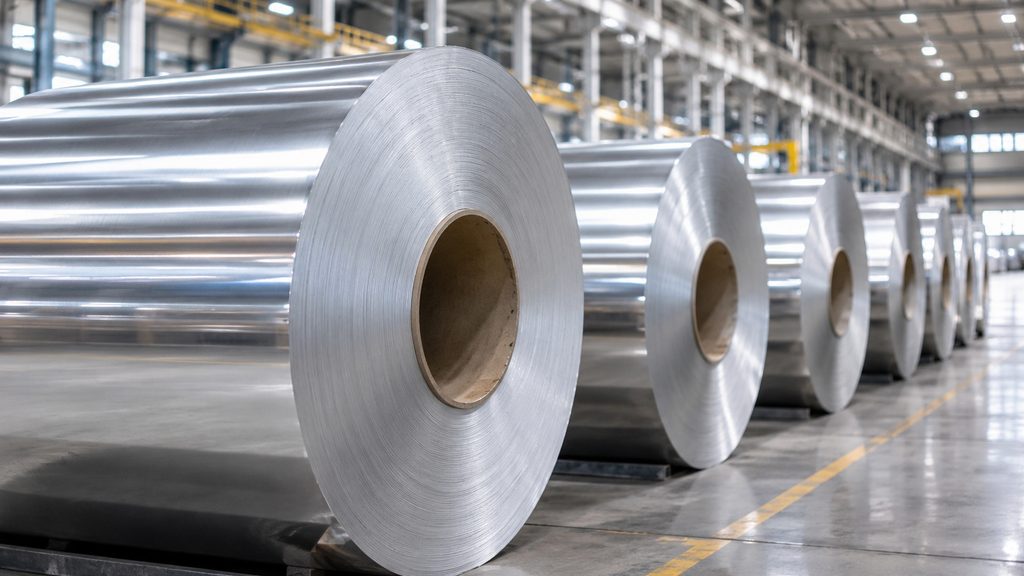
Aluminum foil manufacturing requires a series of controlled rolling and finishing operations to reduce aluminum stock into thin, uniform material. The aluminum foil manufacturing process involves preparing suitable foil stock, reducing its thickness through successive rolling passes, controlling strip tension and surface quality, and completing the necessary finishing operations before the material is delivered as finished foil rolls.
Unlike ordinary aluminum sheet production, foil manufacturing requires specialized rolling equipment capable of handling very thin strip without compromising thickness consistency, flatness, or surface quality. The rolling schedule, lubrication conditions, coil handling system, and downstream finishing process all affect the final product.
For manufacturers planning an aluminum foil production line, understanding how these stages work together is essential for selecting suitable equipment. Companies exploring industrial metal processing equipment should first understand the relationship between upstream aluminum processing and dedicated foil rolling operations.
1. How Aluminum Foil Stock Is Produced
Before foil rolling begins, aluminum must be processed into semi-finished coils known as foil stock. The preparation route depends on the plant's casting and rolling configuration.
Two main production routes are commonly used.
Conventional Casting and Hot Rolling
In the conventional route, molten aluminum is cast into large slabs or rolling ingots. After casting and the necessary metallurgical preparation, the slabs are heated and passed through hot rolling mills to produce thinner coils.
The hot-rolled material then enters cold rolling operations, where its thickness is further reduced to the range required for foil production.
This route involves several stages of thickness reduction. The quality of the incoming foil stock depends on the alloy composition, casting condition, hot rolling schedule, and subsequent heat treatment.
Continuous Casting and Rolling
An alternative route uses continuous casting to convert molten aluminum directly into a continuous strip.
In a twin-roll casting process, molten aluminum is distributed through a nozzle into the gap between two internally cooled rotating rolls. Heat is extracted through the rolls, allowing the aluminum to solidify and undergo deformation as it passes through the roll gap.
The resulting cast strip is coiled and subsequently processed through cold rolling mills to produce foil stock.
This route bypasses the conventional slab casting and hot rolling stages, although further rolling and heat treatment may still be necessary before the material is suitable for foil production.
For manufacturers using this production route, aluminum casting and rolling equipment provides the upstream processing stage for converting molten aluminum into cast-rolled material.
The two routes produce semi-finished materials with different processing histories. Their suitability depends on the aluminum alloy, strip quality, required foil properties, and the equipment available in the plant.
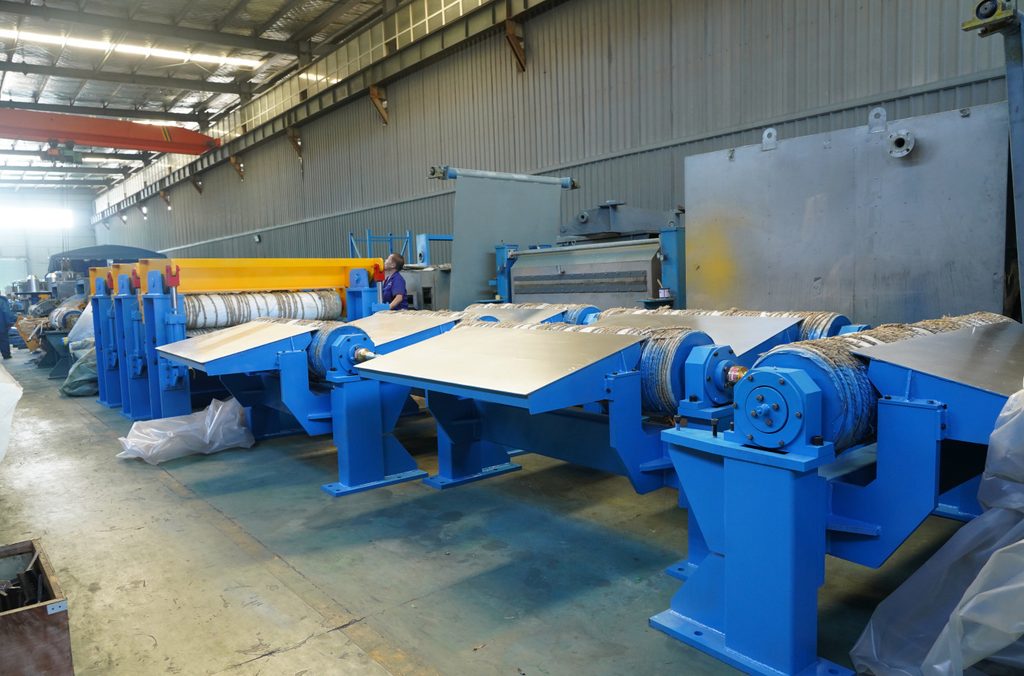
2. Foil Stock Inspection and Preparation
The condition of the incoming foil stock has a direct influence on the stability of subsequent foil rolling operations.
Before loading a coil onto the mill, manufacturers should check several material characteristics.
Alloy and temper: The alloy composition and initial temper determine how the material responds to deformation and whether intermediate annealing may be required.
Incoming thickness: The initial gauge must fall within the working range of the selected foil mill. A mismatch between incoming thickness and the planned reduction schedule can create unnecessary passes or make the intended final gauge impractical.
Strip width and edge condition: Width variations, damaged edges, and edge cracks can affect strip tracking and may contribute to breaks during rolling.
Surface quality: Inclusions, embedded particles, oxide residues, scratches, and other surface defects can become more problematic as the aluminum is reduced to a thinner gauge.
Coil condition: Coil geometry, winding tightness, and damage during handling should be checked before the material enters the production line.
Incoming inspection is particularly important for thin foil because small material defects can become visible as pinholes, surface marks, or strip breaks after further rolling.
3. Aluminum Foil Rolling Process
Foil rolling is the main thickness-reduction stage in aluminum foil manufacturing.
The aluminum strip passes between rotating work rolls under controlled pressure. The reduction in thickness causes the strip to elongate, while the mill controls the roll gap, rolling force, strip tension, and speed to maintain stable operation.
Depending on the incoming gauge and target foil thickness, the production schedule may involve rough rolling, intermediate rolling, and finishing rolling.
Rough Rolling
Rough rolling performs the initial major reduction of foil stock.
The incoming coil is mounted on the uncoiler and fed into the rolling mill. Entry guiding and tension control help position the strip and maintain stable movement as it enters the roll gap.
The work rolls apply compressive force to reduce the material thickness. The strip is then guided toward the outlet and wound onto the recoiler.
The main objectives of rough rolling are to:
- Reduce the incoming foil stock to a thinner gauge.
- Establish a suitable intermediate thickness for subsequent rolling.
- Maintain consistent strip tracking and coil formation.
- Avoid excessive deformation or unstable tension that could cause strip damage.
The amount of reduction in each pass depends on the incoming material, alloy properties, mill capability, rolling force, and the required downstream gauge.
Intermediate Rolling
Intermediate rolling continues reducing the material after rough rolling.
At this stage, the strip becomes thinner and the importance of process stability increases. Changes in material strength, strip tension, lubrication, and roll conditions can affect thickness accuracy and surface quality.
Intermediate rolling schedules may also include coil annealing when the material has become too work-hardened for further reduction under the planned conditions.
The purpose of intermediate annealing is to restore the required ductility for subsequent rolling. Whether it is needed depends on the alloy, temper, total reduction, and final foil specification.
Finishing Rolling
Finishing rolling brings the aluminum foil to its required final gauge and surface condition.
As the material becomes extremely thin, controlling roll gap and strip tension becomes increasingly demanding. Small variations in rolling conditions can cause noticeable changes in the finished material.
Important control factors include:
- Rolling force and roll gap stability.
- Entry and exit strip tension.
- Rolling speed and pass schedule.
- Work-roll surface condition.
- Lubricant cleanliness and distribution.
- Thickness variation across the strip width.
- Strip flatness and winding quality.
The final rolling arrangement must be matched to the required foil thickness, alloy, width, and production output.
4. Aluminum Foil Rolling Mill Structure and Operation
An aluminum foil rolling mill is more than a pair of work rolls. Its coil handling, guiding, tensioning, rolling, and recoiling systems work together to maintain stable strip movement throughout the process.
MFMelt's Aluminium Foil Mill is designed for the foil roughing stage, processing sheet material from an upstream cold rolling mill.
The equipment is configured to reduce the incoming material from 0.5 mm to 0.012 mm. The downstream rolling arrangement can then be matched to the target foil gauge and finishing requirements.
The main operating sequence consists of the following components.
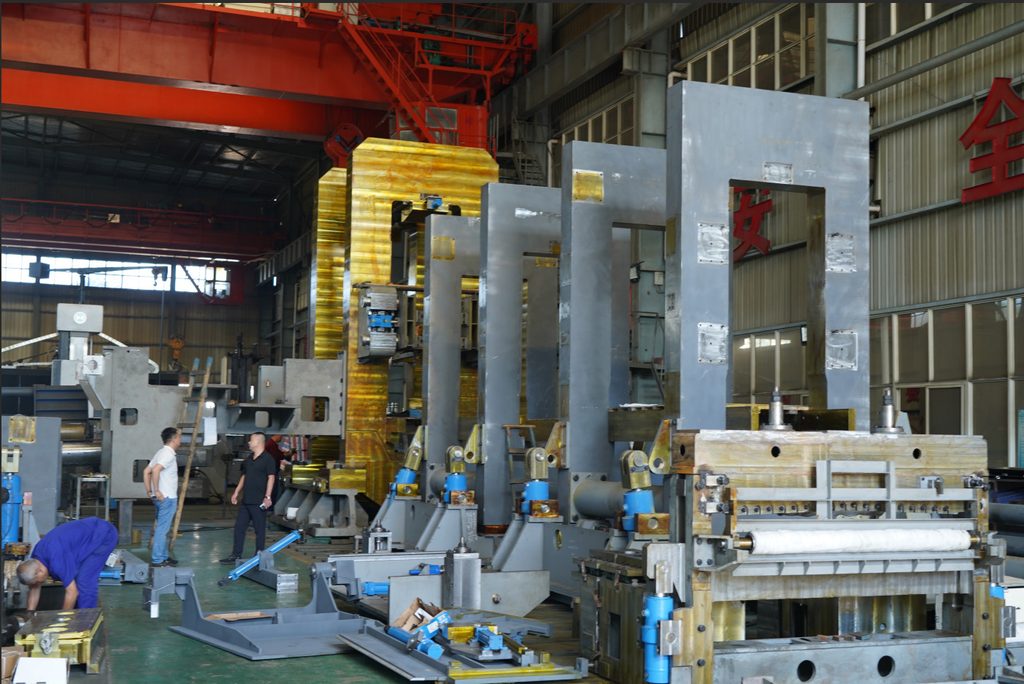
Coil Trolley and Coil Support
The incoming coil is placed on the coil support and transported toward the uncoiler by a coil trolley.
The trolley supports coil handling and positioning, allowing the material to be loaded onto the uncoiling side of the mill. Correct alignment is important because an incorrectly positioned coil can cause problems during strip threading and rolling.
After a pass is completed, the finished coil can be transferred to the outlet coil support for removal and subsequent handling.
Uncoiler
The uncoiler holds the incoming coil and releases the aluminum strip into the rolling line.
It must provide controlled and stable unwinding so that the strip enters the mill without excessive slack, sudden pulling, or lateral deviation.
Stable unwinding also helps the tension system maintain consistent strip movement throughout the rolling process.
Entry Deflector Roll and Tension Roll
The entry deflector roll guides the strip along the correct pass line toward the work rolls.
The inlet tension roll helps establish the required strip tension before the material enters the rolling zone.
Correct entry alignment and tension are important for reducing strip wandering, uneven loading, and instability at the roll bite.
Work Rolls and Thickness Reduction
The work rolls directly contact the aluminum strip and apply the rolling force required to reduce its thickness.
As the strip passes through the roll gap, the material undergoes plastic deformation and becomes thinner.
The actual reduction depends on the roll gap, rolling force, material condition, and pass schedule. These factors must be coordinated to avoid excessive deformation or unstable strip behavior.
Outlet Tension Roll and Flattening Roll
After leaving the work rolls, the strip passes through the outlet tension roll and flattening roll before reaching the recoiler.
The outlet tension roll helps maintain the required tension on the delivery side. The flattening roll supports the strip path and helps maintain stable winding conditions.
These components are particularly important when processing thin material, where poor tension or unstable winding can lead to wrinkles, uneven coil formation, and handling difficulties.
Recoiler and Coil Handling System
The recoiler winds the rolled aluminum strip into a finished coil.
After winding is completed, the coil is transferred to the outlet coil support. The sleeve handling device removes the sleeve from the uncoiler and positions it for the next rolling cycle.
The complete coil handling system coordinates loading, uncoiling, rolling, tension control, recoiling, and coil removal.
For repeated rolling passes, the coil is prepared for the next reduction according to the production schedule.
5. Double Rolling for Thin Aluminum Foil
For very thin aluminum foil, two layers may be rolled together during the final rolling stage. This method is known as double rolling or pack rolling.
Instead of passing one extremely thin strip through the mill alone, two layers are placed together and rolled simultaneously.
Rolling lubricant is applied between the layers to help control friction and allow the material to be separated after rolling.
This process produces a characteristic difference between the two foil surfaces:
- The outer surface in contact with the work roll becomes bright.
- The inner surface in contact with the other foil layer becomes matte.
After the final pass, the two layers are separated and processed into individual foil products.
Double rolling is not required for every aluminum foil product. Whether it is used depends on the target gauge, alloy, rolling mill capability, and required surface characteristics.
The separation stage must be carefully controlled because extremely thin foil is sensitive to tearing, wrinkling, and edge damage.
6. Annealing and Slitting in Aluminum Foil Production
After rolling, aluminum foil may require annealing, separation, and slitting before it reaches its final dimensions and temper.
The exact order of these operations depends on the product specification, lubrication condition, and manufacturing route.
Annealing
Repeated cold rolling increases work hardening in aluminum. As deformation accumulates, the material can become harder and less ductile.
Annealing is used to adjust the mechanical condition of the foil and achieve the required temper.
During annealing, controlled heating allows the material to undergo recovery and recrystallization as required by the specified thermal cycle. The operation can also remove residual rolling lubricant from the foil surface.
Some production schedules use intermediate annealing before further rolling, while others use final coil annealing after the rolling and slitting operations.
Annealing temperature, holding time, and cooling conditions must be selected according to the alloy, foil thickness, and required mechanical properties. A single universal annealing schedule is not suitable for all aluminum foil products.
Slitting
Slitting converts wide master coils into narrower coils according to customer requirements.
The foil passes through slitting knives that trim the material to the specified width. Edge trimming may also remove damaged or irregular edges.
Slitting accuracy affects finished width, edge quality, and winding consistency.
For double-rolled foil, separation and slitting may be performed together on dedicated finishing equipment. The sequence depends on the product and production arrangement.
Separation and Rewinding
When two layers have been rolled together, a separator system separates them into individual foil webs.
Each web is then wound onto its own core under controlled tension.
Incorrect separation or rewinding conditions can result in wrinkles, tears, telescoping coils, and other quality problems.
The separation and rewinding stages therefore need to be coordinated with the foil gauge, width, surface condition, and coil specification.
7. Quality Control in Aluminum Foil Manufacturing
Aluminum foil quality is influenced by the entire production route, not just the final rolling pass.
Defects introduced during casting, slab preparation, cold rolling, foil rolling, and finishing can carry through to the final product.
The following quality characteristics deserve particular attention.
| Quality characteristic | What needs to be controlled | Potential production impact |
|---|---|---|
| Thickness consistency | Roll gap, rolling force, pass schedule, and gauge measurement | Uneven material thickness |
| Flatness | Strip tension, roll profile, and deformation distribution | Waves, wrinkles, or unstable winding |
| Pinholes | Incoming stock cleanliness, inclusions, and rolling conditions | Reduced barrier performance |
| Surface condition | Roll cleanliness, lubrication, and material handling | Scratches, stains, and surface marks |
| Edge quality | Strip alignment, edge condition, and slitting operation | Edge cracks and tearing |
| Coil quality | Recoiling tension and winding alignment | Telescoping, loose winding, or handling problems |
| Mechanical properties | Alloy, cold reduction, and annealing schedule | Incorrect temper or material performance |
Pinholes and Surface Defects
Pinholes are among the important quality concerns in thin aluminum foil production.
They may be associated with non-metallic inclusions, particles, material impurities, scratches, or defects originating in upstream casting and rolling processes.
Because the foil becomes increasingly thin during rolling, small material imperfections can develop into through-holes or cause strip breaks.
Rolling oil cleanliness is also important. Suspended particles and contamination in the lubrication system can affect the surface condition of the foil.
Thickness and Flatness Problems
Thickness deviations may result from unstable rolling conditions, variations in incoming stock, roll gap changes, or fluctuations in strip tension.
Flatness problems can appear when deformation is not uniform across the strip width. Uneven tension, roll profile, and inappropriate rolling conditions can contribute to waves or wrinkles.
Accurate inspection and consistent process control are therefore required throughout the rolling stages.
8. How to Select an Aluminum Foil Production Line
An aluminum foil production line should be designed around the incoming material and the required finished product. Selecting a rolling mill without considering upstream and downstream operations can create production bottlenecks or make the desired product range difficult to achieve.
The following factors should be evaluated before equipment selection.
Incoming Foil Stock Specifications
The incoming coil thickness, width, alloy, temper, and surface condition determine whether the selected rolling mill can process the material effectively.
Manufacturers should provide actual foil stock specifications rather than relying on general descriptions such as aluminum sheet or aluminum coil.
For plants that also need to process thicker aluminum coils, an aluminum sheet cold rolling machine may be considered as part of the upstream material preparation arrangement. Its compatibility with a foil mill must be assessed against the actual incoming and outgoing thickness requirements.
Target Foil Thickness and Product Range
The required final gauge is one of the most important factors in selecting an aluminum foil rolling mill.
A production line intended for thicker foil products may require a different mill arrangement from one designed for very thin packaging or capacitor foil.
The required rolling passes, use of double rolling, and downstream finishing operations should all be considered.
Rolling Mill Configuration
The mill configuration needs to match the required thickness reduction, strip width, rolling force, and production schedule.
Important items to evaluate include:
- Work-roll arrangement and roll dimensions.
- Rolling force and roll gap adjustment.
- Entry and exit tension control.
- Thickness measurement and control.
- Roll surface condition and cooling.
- Lubrication supply and filtration.
- Uncoiling, recoiling, and coil handling.
These functions should be confirmed for the actual machine configuration rather than assumed to be included in every foil mill.
Production Capacity and Product Mix
The required output should be evaluated together with the intended product mix.
A plant producing several foil gauges and widths may need a more flexible rolling schedule than a facility producing a limited range of standardized products.
Coil changeover time, pass requirements, finishing operations, and material handling all influence practical production planning.
Downstream Finishing Requirements
The rolling equipment must be compatible with the finishing operations required by the final product.
These may include annealing, separation, slitting, inspection, and packaging.
The plant layout should provide suitable space and material transfer arrangements between the rolling mill and downstream equipment.
Manufacturers planning a new facility can review MFMelt's metal processing equipment range when evaluating the required upstream and downstream machinery.
9. Production Flow from Aluminum Stock to Finished Foil
A typical aluminum foil manufacturing route can be summarized as follows:
Aluminum Slab or Molten Aluminum → Hot Rolling or Continuous Casting → Cold Rolling → Foil Stock Preparation → Foil Rough Rolling → Intermediate and Finishing Rolling → Separation and Slitting → Annealing → Inspection and Packaging
Not every facility follows exactly the same sequence. A manufacturer purchasing ready-made foil stock may begin directly with foil rolling, while an integrated aluminum plant may carry out casting, hot rolling, cold rolling, and foil production within the same facility.
The important point is that each stage must produce material suitable for the next operation. The incoming coil specification, rolling reduction schedule, foil gauge, mechanical properties, and finishing requirements determine the overall equipment arrangement.
Conclusion
The aluminum foil manufacturing process depends on controlled thickness reduction, stable strip handling, and appropriate finishing operations. Starting with suitable foil stock, manufacturers use successive rolling passes to reach the required gauge, followed by operations such as double rolling, annealing, slitting, and separation when the product specification requires them.
An aluminum foil rolling mill is a central part of this process. Its rolling system, tension control, coil handling arrangement, and operating capabilities must match the incoming material and target foil specifications.
MFMelt supplies aluminum foil rolling equipment and industrial production solutions. For manufacturers planning a new aluminum foil production line or upgrading existing rolling operations, equipment selection should be based on the actual foil stock, required final thickness, strip width, and production schedule.
Please contact our team to discuss your aluminum foil rolling requirements and equipment configuration.