
A vacuum induction furnace melts metal by electromagnetic induction inside a controlled vacuum or inert-gas environment. It is not simply a standard induction furnace with a vacuum pump added. The chamber, sealing, pumping system, gas control, power supply, refractory, cooling, pouring arrangement and downstream casting equipment must work together.
The technology is most relevant when the project requires tighter control of atmosphere, volatile elements, contamination or alloy chemistry than an open-air melt can provide. It is therefore a specialist equipment decision for defined alloys and products, not a universal replacement for a conventional induction melting furnace.
MFMelt’s current Vacuum Furnace product page describes a vacuum melting and single-roll low-temperature cooling system used for thin-ribbon production, including NdFeB and hydrogen-storage materials. It publishes model-specific information for a standard 500 kg/furnace capacity, up to 600 kg/furnace, a typical 1,450°C melting temperature with a 1,550°C maximum, and vacuum indicators measured under stated conditions. Those values belong to the published equipment and test conditions; they should not be generalized to every vacuum induction furnace project.
This guide explains the process, the project questions that determine whether VIM is appropriate, and the information a buyer should put into an equipment inquiry.
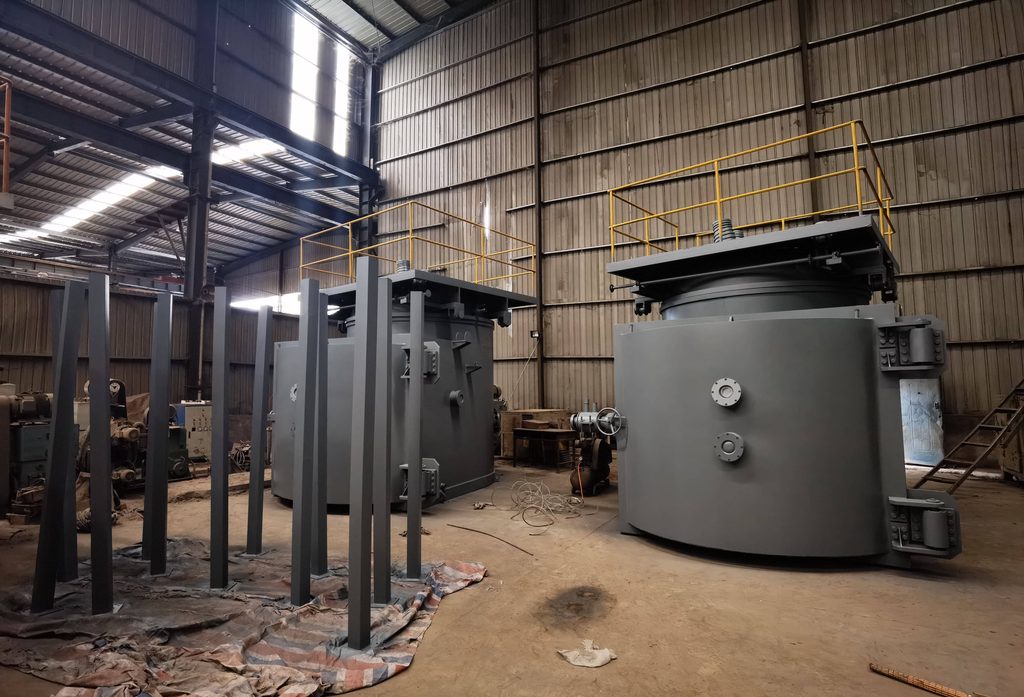
What Is a Vacuum Induction Furnace?
A vacuum induction furnace is a melting system in which an induction coil heats a conductive charge while the melting chamber is evacuated or filled with a controlled inert gas. The vacuum environment changes the interaction between the molten metal and the surrounding atmosphere. It can help reduce unwanted gas exposure and provide a controlled route for specialty alloy processing, but the result depends on the vacuum level, leak tightness, charge condition, refractory, temperature, holding time and operating procedure.
The system normally includes:
- A sealed melting chamber and access arrangement;
- Induction coil, crucible or refractory system;
- Medium-frequency or other matched power supply;
- Vacuum pumps, valves, gauges and pressure controls;
- Inert-gas supply and backfill controls where required;
- Water-cooling circuit for the coil, cables and power components;
- Temperature, power and process controls;
- Tilting, pouring, tundish or casting arrangement;
- Data logging, alarms and protective interlocks.
The exact configuration varies with alloy, batch size, product form and casting method. A buyer should not compare a laboratory VIM furnace, a production vacuum melting line and a vacuum strip-casting furnace as though they were the same equipment.
How Vacuum Induction Melting Works
The process begins with a prepared charge placed in the crucible or melting vessel. The chamber is closed and evacuated to the process condition specified for the equipment. The induction power then creates the electromagnetic field that heats the metal. Depending on the alloy and the process, the furnace may operate under vacuum for part of the cycle and under a controlled inert-gas pressure for another part.
A typical project sequence includes:
- Inspect and load the approved charge;
- Close and seal the melting chamber;
- Evacuate the chamber and check the pressure response;
- Introduce power according to the approved heat-up procedure;
- Melt, stir and monitor the charge;
- Add alloying materials or treatment agents only through the defined method;
- Sample or verify the melt as required;
- Adjust vacuum or inert-gas conditions for pouring;
- Transfer or cast the molten metal;
- Complete cooling, venting and post-cycle inspection.
The sequence is not a generic recipe. Vacuum level, pressure-rise acceptance, power ramp, holding time, gas backfill and pouring conditions must be established for the furnace, refractory, alloy and product. MFMelt’s product page, for example, reports a limit vacuum below 0.5 Pa after degassing in an empty furnace and a working range limited to inert gas; those are product-specific published indicators, not universal VIM limits.
When Is a Vacuum Induction Furnace Justified?
Vacuum is valuable when it solves a defined metallurgy or product problem. It also adds pumps, seals, instrumentation, controls, maintenance and cycle time. The business case should therefore identify what the controlled atmosphere is expected to improve.
A VIM project may be considered when the plant needs:
- Controlled melting of specialty alloys;
- Reduced exposure to air during melting and pouring;
- Better control of volatile or reactive constituents;
- A defined atmosphere for magnetic, aerospace, energy or high-performance materials;
- Repeatable chemistry and process records;
- Integration with a controlled casting or rapid-solidification route;
- Development or production of materials that cannot be processed reliably in an open furnace.
It may not be the right first choice when the project only needs to melt clean, common scrap for ordinary castings and does not have a defined atmosphere or quality requirement. In that case, a conventional induction melting system may be easier to operate and maintain. MFMelt’s induction melting furnace guide covers the broader open induction-melting context; the vacuum article should remain focused on controlled-atmosphere process requirements.
Vacuum Induction Furnace Applications
The application determines the furnace architecture. A system for producing thin magnetic-alloy ribbon has different discharge and cooling needs from a system that pours a conventional ingot or cast bar.
Specialty and magnetic materials
MFMelt’s published Vacuum Furnace page identifies NdFeB and hydrogen-storage materials as application areas and describes single-roll rotating low-temperature cooling for thin ribbons. This is a specific process route in which the casting or cooling interface is part of the product-quality system.
Reactive or atmosphere-sensitive alloys
A vacuum or inert-gas environment may be selected to control exposure during melting and pouring. The project must define the alloy, volatile constituents, target chemistry, acceptable inclusions and sampling method. “Vacuum” by itself does not prove that a system will deliver the required alloy quality.
High-temperature alloys
Where the melt temperature is high, the chamber, coil, refractory, thermocouples, cooling and pouring system need to be evaluated together. MFMelt publishes a melting temperature range for its current product page, but a new alloy or higher-duty cycle needs a separate engineering review.
Research, pilot and production plants
A pilot furnace may prioritize flexibility, small batches and data collection. A production system may prioritize uptime, repeatable loading, cycle time, maintenance access and integration with casting. Capacity, automation and service expectations should be stated before the furnace is selected.
Vacuum Furnace vs Conventional Induction Furnace
Both systems use electromagnetic induction when the design is induction-based. The main difference is the process atmosphere and the equipment required to control it.
| Project factor | Conventional induction furnace | Vacuum induction furnace |
|---|---|---|
| Atmosphere | Open or locally controlled atmosphere | Evacuated chamber and/or controlled inert gas |
| Main equipment addition | Furnace, power, refractory and cooling | Chamber, seals, pumps, gauges, gas controls and interlocks |
| Typical decision driver | Melting productivity, flexibility and cost | Atmosphere control, specialty alloy quality and repeatability |
| Charging | Often simpler and faster | Must be compatible with chamber loading and sealing |
| Pouring | Open or protected transfer depending on project | Must preserve the defined atmosphere or transition procedure |
| Maintenance | Furnace, coil, lining, power and cooling | All conventional systems plus vacuum, seals, valves and instrumentation |
| Best comparison method | Output, cycle, power, lining and total scope | Same items plus pressure performance, leak rate, gas control and casting route |
The comparison should be made against the product specification. A vacuum system is not automatically better if the product does not benefit from the additional atmosphere control.
How to Specify the Melting Chamber and Vacuum System
The vacuum system should be specified by process condition, not by pump name alone. The buyer needs to know the required pressure range, chamber volume, empty-furnace test condition, pressure-rise acceptance, evacuation time and gas backfill method.
Ask the supplier to identify:
- Chamber working volume and access dimensions;
- Empty-furnace limit vacuum and test method;
- Working pressure range and permitted gas;
- Pressure-rise or leak-test method;
- Pump type and pumping speed;
- Isolation valves and roughing/high-vacuum arrangement;
- Pressure gauges and measurement locations;
- Inert-gas purity, pressure and flow requirements;
- Venting and backfill sequence;
- Maintenance access for seals, valves and gauges;
- Alarm, interlock and emergency-vent logic.
MFMelt’s public product page reports a pressure-rise indicator below 3.0 × 10⁻³ Pa·m³/s in an empty-furnace state and a working vacuum range limited to inert gas. A buyer should request the full test method and acceptance boundary before treating these figures as a contractual guarantee.
Charge, Refractory and Melt Chemistry
Vacuum cannot compensate for a poor charge. The material grade, surface condition, oil, moisture, oxides, previous storage, alloy additions and volatile elements should be documented. Unknown or contaminated material can create pressure, outgassing and chemistry problems inside the chamber.
The refractory or crucible system must be compatible with the alloy and temperature. Ask how the lining is installed, dried, inspected and released for the first heat. Confirm whether the refractory is supplied with the furnace, whether it is replaceable on site, and which signs require a controlled shutdown.
The chemistry plan should explain:
- Which elements are charged initially;
- Which additions are made during the cycle;
- How samples are taken under the process atmosphere;
- How volatile constituents are controlled;
- How slag, oxides or residues are handled;
- Which final chemistry range is required;
- What records are retained for each heat.
These details are more useful than a general statement that vacuum melting “improves purity.” The claimed benefit must be tied to the alloy, process conditions and measurement method.
Cooling, Electrical Power and Process Protection
A vacuum induction furnace still needs the same basic protections as other induction equipment, but the controlled chamber adds more interfaces. The coil, power supply, water-cooling circuit, vacuum system, gas circuit, chamber and pouring equipment need coordinated alarms and safe states.
The project specification should cover:
- Power rating, frequency and operating range;
- Coil and crucible arrangement;
- Cooling-water flow, pressure, temperature and quality limits;
- Pump and heat-exchanger arrangement;
- Overcurrent, overvoltage and phase protection;
- Chamber-pressure alarms and interlocks;
- Cooling failure response;
- Loss of power or loss of vacuum response;
- Emergency venting and safe access;
- Data logging for pressure, power, temperature and cycle events.
Do not copy a cooling or electrical limit from another induction furnace. The correct values belong to the selected configuration and the component manufacturer’s documentation. The same principle applies to the vacuum chamber and gas circuit. A pump may reach a pressure on an empty test vessel but perform differently after the charge, crucible, fixtures and vapor load are introduced. Define the measured condition, the instrument location, the stabilization time and the response expected if pressure, water flow or power moves outside the approved range. These details become part of commissioning and operator training, not just a line in the sales quotation.
Casting and Rapid-Solidification Options
The casting route is often the point at which two apparently similar vacuum furnaces differ most. A system that pours into an ingot mold needs a different transfer arrangement from a system that feeds a tundish, continuous caster or single-roll rapid-solidification unit.
MFMelt’s product page describes single-roll rotating low-temperature cooling for thin-ribbon production. If the buyer needs a conventional cast product instead, the inquiry should state the mold or casting arrangement, output dimensions, transfer time, pouring temperature, atmosphere during transfer and post-casting handling.
The downstream equipment may include:
- Ingot molds and extraction equipment;
- Tundish or protected pouring system;
- Continuous casting machine;
- Single-roll rapid-solidification unit;
- Cooling and collection equipment;
- Heat treatment or rolling equipment.
For a downstream forming route, MFMelt also supplies a continuous rolling mill and other process equipment. That link does not mean every VIM project needs a rolling mill; it provides a verified route for buyers whose material specification requires further forming.
Vacuum Induction Furnace RFQ Checklist
A useful RFQ should allow the supplier to decide whether the project is a standard vacuum melting system, a specialty casting system or a larger integrated line.
| RFQ category | Information to provide |
|---|---|
| Alloy | Grade, chemistry range, reactive/volatile elements and final product |
| Charge | Form, size, mass per heat, cleanliness and additions |
| Capacity | Working batch, maximum batch and required output |
| Temperature | Target melt, pour and casting temperatures |
| Atmosphere | Required vacuum, inert gas, pressure cycle and acceptance method |
| Chamber | Available loading size, access, layout and maintenance space |
| Casting | Ingot, billet, ribbon, rod, tundish or another product |
| Cycle | Charge, evacuation, melt, hold, pour and cooling times |
| Utilities | Electrical supply, cooling water, gas, ventilation and floor loading |
| Controls | Data logging, alarms, interlocks and remote support requirements |
| Scope | Furnace, power, vacuum, gas, cooling, casting, installation and training |
Send drawings, representative charge photographs, current melt records and the intended product standard where available. If a value is unknown, mark it as “to be confirmed.” An honest open item is more useful than an assumed vacuum or capacity.
How to Compare Vacuum Furnace Quotations
Compare the boundary of supply before comparing price. One quotation may include the furnace chamber, induction power, vacuum pumps, cooling and controls; another may exclude pumps, gas equipment, installation, refractory, molds or commissioning.
Ask each supplier to state:
- Guaranteed and non-guaranteed data;
- Test conditions for vacuum, pressure rise, temperature and melting time;
- Included pumps, valves, gauges and gas equipment;
- Included cooling equipment and utility interfaces;
- Refractory or crucible supply and replacement method;
- Casting or rapid-solidification equipment scope;
- Installation, commissioning and operator training;
- Spare parts and response time;
- Required buyer-supplied utilities and civil work;
- Acceptance test procedure and documentation.
MFMelt’s contact page can be used for a project-specific review. Include the alloy, batch size, target product, desired atmosphere, casting route and site utilities so the discussion is based on an actual process rather than a generic “vacuum furnace” request.
FAQ: Vacuum Induction Furnaces
What is a vacuum induction furnace used for?
It is used to melt selected metals and alloys by induction under a controlled vacuum or inert-gas environment. The application is normally defined by a need for atmosphere control, chemistry repeatability or a controlled casting route. It is not automatically the best choice for every ordinary scrap-melting project.
What is the difference between a VIM furnace and a conventional induction furnace?
Both may use an induction coil to generate heat, but a VIM furnace adds a sealed chamber, vacuum system, pressure measurement, gas controls and related interlocks. The additional equipment is justified only when the alloy or product benefits from controlled atmosphere processing.
Does a vacuum furnace remove all impurities?
No. Vacuum can affect gas exposure and volatile constituents, but it does not replace charge sorting, correct refractory selection, alloy control, sampling or refining. The achievable result depends on the material and the complete process.
What vacuum level does a VIM furnace need?
There is no single value for every furnace or alloy. The required pressure range and acceptance test depend on chamber volume, equipment design, charge outgassing, alloy, refractory and process route. Use the selected supplier’s documented test method and operating limits.
What information should I send for a VIM quotation?
Send the alloy, charge form and mass, target product, temperature, atmosphere requirements, batch and output, chamber access, casting method, site utilities and required controls. Drawings, charge photographs and existing melt records help the supplier define the correct scope.
Request a Vacuum Induction Furnace Review from MFMelt
If your project involves specialty alloys, controlled-atmosphere melting, NdFeB or hydrogen-storage materials, or a defined vacuum casting route, send MFMelt the material specification, product form, batch size, target cycle, atmosphere requirement and site utility information.
Use the MFMelt contact page to request an engineering review. Ask for the proposed vacuum test condition, pressure-rise method, power and cooling limits, refractory scope, casting arrangement and acceptance documentation. The final recommendation should be based on the actual alloy and product route, not on a generic VIM label.
For an existing installation, attach the furnace model, chamber photographs, recent pressure and power records, alarm history, refractory condition and the point in the cycle where the problem appears. For a new project, add the alloy specification, charge photographs, required batch size, target product, site layout, available utilities and the intended casting or cooling route. Separating confirmed data from open engineering questions allows MFMelt to define whether the request is for a replacement furnace, a pilot system, a production unit or an integrated melting-and-casting line.