
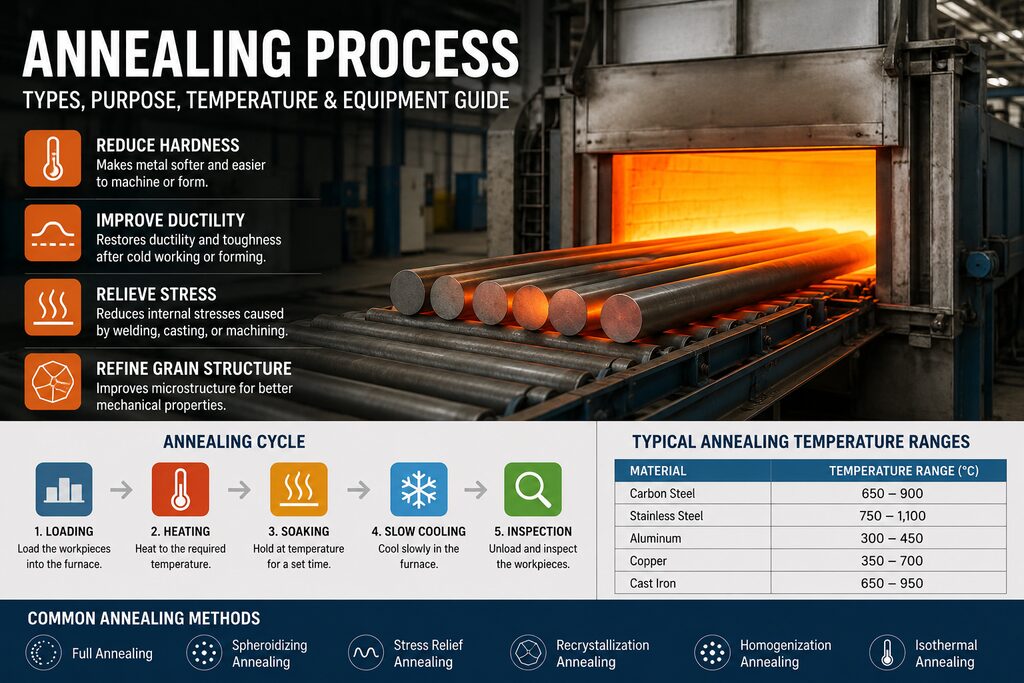
The annealing process is a widely used heat treatment method for improving the mechanical and metallurgical properties of metals. By heating a material to a specific temperature, holding it for a controlled period, and then cooling it slowly, annealing can reduce hardness, improve ductility, relieve internal stress, and make metal easier to machine or form.
The correct annealing cycle depends on the material, component size, alloy composition, and required properties. This guide explains what annealing is, why it is used, common annealing methods, typical temperature ranges, the annealing cycle, and how to choose suitable annealing equipment.
What Is Annealing?
Annealing is a heat treatment process in which a metal is heated to a specified temperature, held at that temperature for a certain period, and then cooled slowly under controlled conditions. The purpose is to change the material's microstructure and obtain desired mechanical properties.
A typical annealing process consists of three fundamental stages:
Heating → Soaking → Slow Cooling
During heating, the material is brought gradually to the required temperature. During soaking, it remains at that temperature long enough for the entire workpiece to reach a relatively uniform temperature and for the required metallurgical transformation to occur. The material is then cooled slowly, often inside the furnace, to reduce hardness and improve ductility.
Annealing differs from other common heat treatment processes. Quenching uses rapid cooling to increase hardness, while normalizing generally uses air cooling to produce a finer and more uniform structure. Tempering is normally performed after hardening to reduce brittleness and adjust hardness and toughness.
Why Annealing Is Used
The main purpose of annealing is to modify the internal structure of a metal so that it becomes more suitable for subsequent processing or service.
Reduce Hardness
Annealing can reduce the hardness of many metals, making them easier to cut, machine, drill, or form. This is particularly useful after casting, forging, or cold working.
Improve Ductility
Cold working and other manufacturing processes can reduce ductility. Annealing restores ductility by allowing the material's microstructure to change under controlled heating and cooling conditions.
Relieve Internal Stress
Residual stresses can develop during welding, casting, machining, forming, and uneven cooling. Stress-relief annealing reduces these stresses and helps improve dimensional stability.
Refine or Modify Grain Structure
Depending on the material and annealing method, controlled heating can refine or modify the grain structure. This can improve the consistency and mechanical behavior of the finished material.
Common Annealing Methods
Different materials and production requirements require different annealing methods. The most common types include:
Full Annealing
Full annealing is commonly used for carbon and alloy steels. The material is heated above a suitable critical temperature, held for sufficient time, and then cooled slowly, typically inside the furnace. It produces a relatively soft and ductile structure.
Spheroidizing Annealing
Spheroidizing annealing is mainly used for high-carbon steels and tool steels. It promotes the formation of spheroidal carbide particles, reducing hardness and improving machinability and formability.
Stress Relief Annealing
Stress relief annealing is performed at a temperature below the material's major phase transformation range. It is used to reduce residual stresses caused by welding, casting, machining, forging, or forming without significantly changing the overall microstructure.
Recrystallization Annealing
Recrystallization annealing is commonly applied to cold-worked metals. Heating above the recrystallization temperature allows new strain-free grains to form, restoring ductility and reducing the effects of cold working.
Homogenization Annealing
Homogenization annealing is mainly used for cast alloys. The material is heated to a relatively high temperature for an extended period to reduce chemical segregation and improve compositional uniformity.
Isothermal Annealing
In isothermal annealing, the material is cooled from the heating temperature to a selected intermediate temperature and held there until the desired transformation occurs. It can provide more consistent microstructures and reduce the overall cycle time compared with some conventional full-annealing processes.
Temperature Ranges by Material
Annealing temperature varies considerably according to alloy composition, material grade, component size, and the desired metallurgical result. The following values are general reference ranges rather than universal processing specifications.
| Material | Typical Annealing Temperature Range* | Main Purpose |
|---|---|---|
| Carbon steel | 650–900°C | Soften material and improve ductility |
| Stainless steel | 750–1,100°C | Relieve stress and modify microstructure |
| Aluminum | 300–450°C | Restore ductility and relieve stress |
| Copper | 350–700°C | Improve ductility and reduce work hardening |
| Cast iron | 650–950°C | Reduce stress and modify microstructure |
*Actual annealing temperatures should be determined according to the specific alloy grade, chemical composition, thickness, and applicable heat treatment standard. Some materials require significantly different temperature ranges or cooling procedures.
How the Annealing Cycle Works
A typical industrial annealing cycle can be divided into five basic steps.
1. Loading
The workpieces are loaded into the annealing furnace with sufficient spacing to promote uniform heat transfer and avoid excessive thermal gradients.
2. Heating
The furnace temperature is increased according to a controlled heating schedule. Heating rate should be selected according to the material, workpiece size, and risk of thermal stress or distortion.
3. Soaking
Once the target temperature is reached, the material is held for a specified period. The soaking stage allows the workpiece to reach a relatively uniform temperature and provides enough time for the required microstructural changes.
4. Slow Cooling
The workpiece is cooled at a controlled and sufficiently slow rate. For many annealing applications, furnace cooling is used to prevent excessive thermal stress and obtain the desired structure.
5. Unloading and Inspection
After the material has cooled to a suitable temperature, it is removed from the furnace and inspected. Typical checks include hardness, dimensional stability, surface condition, and, when necessary, metallographic structure.
Choosing an Annealing Furnace
The right furnace depends on material type, workpiece dimensions, production volume, required temperature, atmosphere, and cooling requirements.
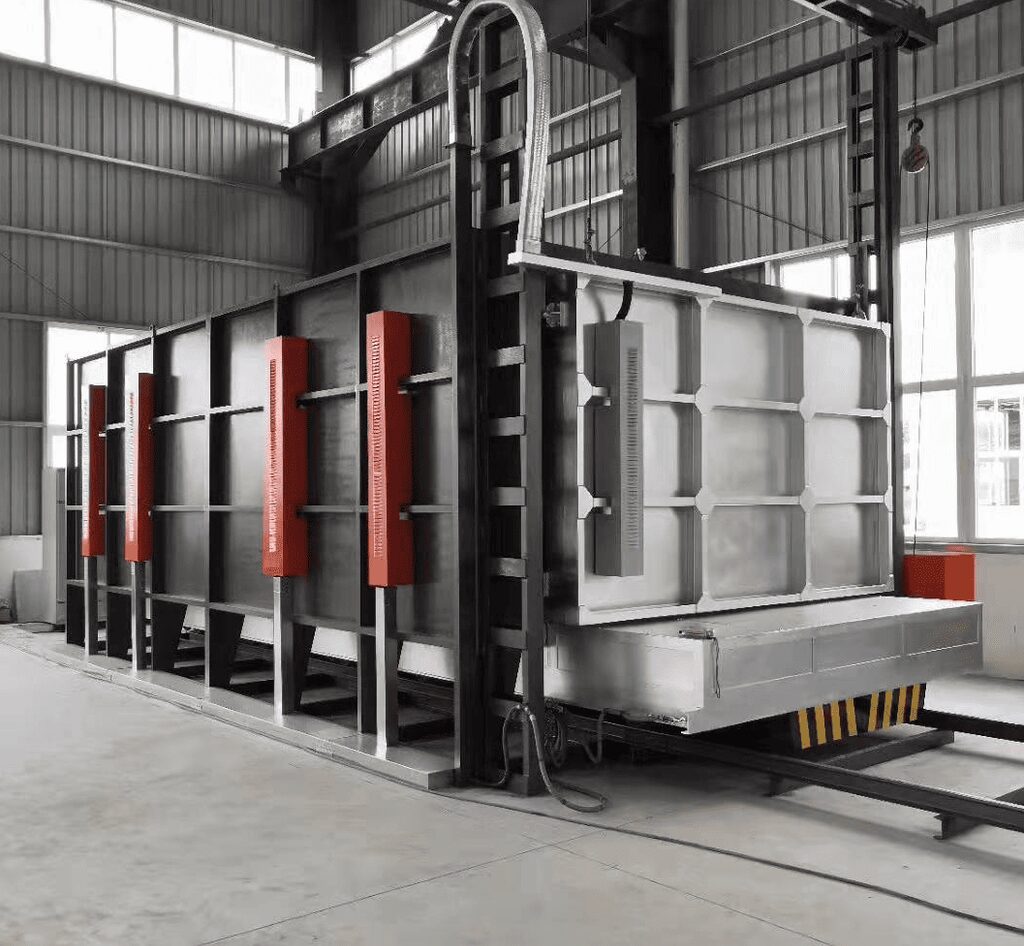
Car Bottom Furnace
A car bottom furnace is suitable for large and heavy workpieces that are difficult to load into a conventional chamber furnace. The movable hearth makes loading and unloading easier and is widely used for heavy industrial components.
Bell-Type Furnace
A bell-type furnace is commonly used for coils, sheets, strips, and other products that require controlled heating and cooling. Its design can provide good temperature uniformity and controlled processing conditions.
Pit Furnace
A pit furnace is installed below or partially below floor level and is suitable for long or vertically loaded components. It can be used for heat treatment of shafts, tubes, rods, and other tall workpieces.
Vacuum Furnace
A vacuum furnace provides a controlled low-pressure environment that minimizes oxidation and contamination during heat treatment. It is suitable for applications requiring clean surfaces and precise atmospheric control.
Key Factors for Furnace Selection
When selecting an annealing furnace, consider:
- Material and alloy composition
- Maximum annealing temperature
- Workpiece size and weight
- Required production capacity
- Temperature uniformity
- Heating and cooling cycle
- Atmosphere requirements
- Energy efficiency and operating cost
- Automation and temperature control
For industrial production, furnace capacity alone is not enough. Temperature uniformity, controllability, cooling performance, and compatibility with the material are equally important.
Common Problems and Fixes
Even when the furnace reaches the required temperature, an improperly controlled annealing cycle can produce inconsistent results.
Hardness Remains Too High
Possible causes: insufficient soaking time, incorrect annealing temperature, or cooling that is too fast.
Solution: verify the actual workpiece temperature, adjust the soaking time according to section thickness, and use an appropriate controlled cooling rate.
Excessive Deformation
Possible causes: uneven heating, improper loading, excessive thermal gradients, or insufficient support for large workpieces.
Solution: improve workpiece positioning, control the heating and cooling rates, and use suitable fixtures or supports where necessary.
Oxidation or Surface Scaling
Possible causes: excessive exposure to oxygen at high temperature, unsuitable furnace atmosphere, or an excessively long heating cycle.
Solution: optimize the furnace atmosphere and cycle time, and consider protective or controlled-atmosphere heating when surface quality is critical.
Conclusion
The annealing process combines controlled heating, soaking, and slow cooling to modify metal properties and improve processability. Depending on the material and application, full annealing, spheroidizing, stress relief, recrystallization, homogenization, or isothermal annealing may be selected.
Choosing the right annealing furnace is equally important. Material type, temperature requirements, workpiece dimensions, production capacity, temperature uniformity, atmosphere, and cooling conditions should all be considered before selecting equipment.
If you are looking for an annealing furnace for steel, aluminum, copper, or other metal applications, the furnace should be designed around your specific material and production requirements rather than based on temperature alone.
Frequently Asked Questions
What are the three stages of annealing?
The three basic stages are heating, soaking, and cooling. The material is first heated to the required temperature, held for a specified period, and then cooled slowly under controlled conditions. The exact temperature and cooling rate depend on the material and desired properties.
Does annealing soften or harden?
Annealing generally softens metal and improves ductility. For many materials, slow cooling after heating reduces hardness and makes the material easier to machine or form. However, the final result depends on the material, annealing method, and complete heat treatment cycle.
What is the main purpose of annealing?
The main purposes are to reduce hardness, improve ductility, relieve residual stress, and modify the microstructure. Annealing can also improve machinability and prepare materials for subsequent forming or machining operations.
What are the downsides of annealing?
Annealing can require significant energy and relatively long processing times, especially when large or heavy workpieces must be heated and slowly cooled. Some materials may also experience oxidation, scaling, dimensional changes, or excessive softening if the process is not properly controlled.
Looking for a Reliable Annealing Furnace?
The right annealing equipment should match your material, workpiece size, production capacity, temperature requirements, and heat treatment cycle. A properly designed furnace can provide stable temperature control, uniform heating, and reliable annealing results.
Contact our engineering team to discuss your application and get a suitable annealing furnace solution for your production requirements.