
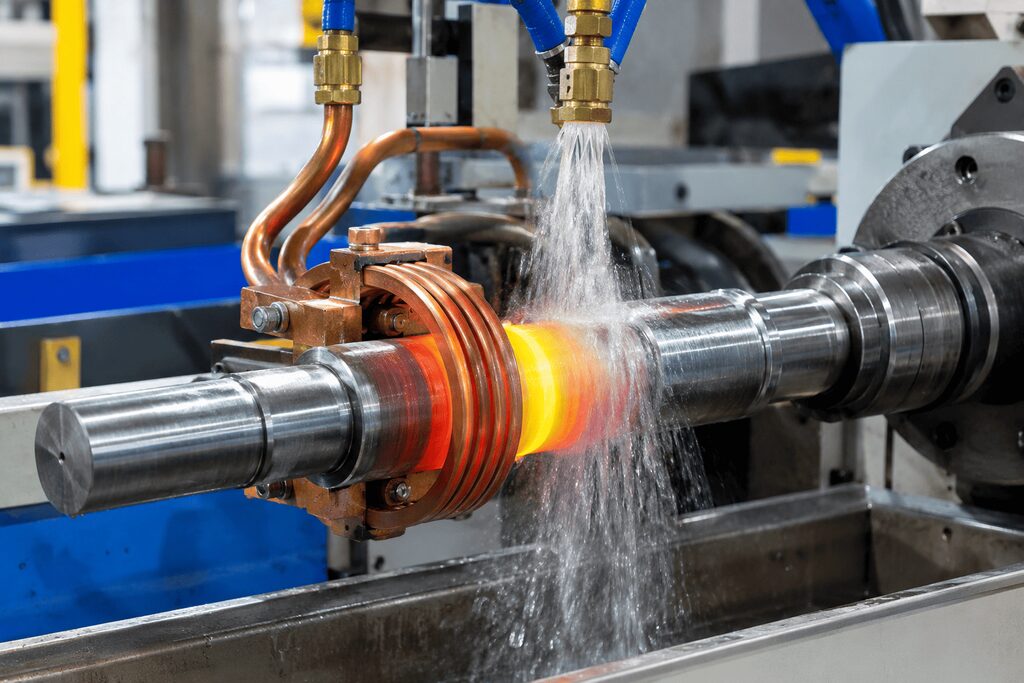
Induction hardening is a surface heat treatment process that uses electromagnetic induction to rapidly heat the surface of a metal component, followed by controlled quenching to increase surface hardness and wear resistance. Unlike conventional hardening, it can harden a selected surface layer while keeping the core relatively tough and ductile.
If you are searching for what is induction hardening process, the key is to understand how electromagnetic heating, rapid cooling, and material transformation work together. This guide explains the induction hardening principle, process steps, main types, critical parameters, applications, and the equipment required for industrial production.
How Does Induction Hardening Work?
Induction hardening works by using an alternating electrical current in an induction coil to create a rapidly changing electromagnetic field around the workpiece. When a suitable conductive metal component is placed inside this field, electrical currents called eddy currents are induced near its surface.
The electrical resistance of the workpiece converts these currents into heat. The surface temperature is raised rapidly to the appropriate austenitizing range for the material, normally above its critical transformation temperature. The heated layer is then rapidly quenched, transforming the austenitized surface into martensite, which provides high hardness and wear resistance.
The depth of heating depends strongly on induction frequency. Higher frequencies generally concentrate heating closer to the surface, while lower frequencies allow electromagnetic energy to penetrate more deeply. However, actual hardened depth also depends on power density, heating time, material composition, coil design, and quenching conditions.
Induction hardening therefore produces a hardened surface while retaining a comparatively softer and tougher core. The hardened depth is not a fixed 0.5–5 mm range; depending on the application and process design, it can be shallower or considerably deeper.
Compared with conventional furnace hardening, induction hardening is much more localized and can heat only the area that needs to be hardened. This reduces unnecessary heating of the entire component and makes the process particularly suitable for automated, high-volume production.
For a broader understanding of heat treatment processes, see our annealing process guide.
Induction Hardening Process Step by Step
A typical induction hardening process consists of five main stages:
1. Workpiece Preparation
The component is cleaned and inspected before treatment. Its material grade, dimensions, initial hardness, and required hardened depth should be confirmed because these factors determine the heating and quenching parameters.
2. Clamping and Positioning
The workpiece is accurately positioned relative to the induction coil. Consistent coil-to-workpiece spacing is important because even small changes in coupling can affect heating uniformity.
3. Induction Heating
The induction power supply generates high-frequency or medium-frequency alternating current in the coil. The electromagnetic field rapidly heats the selected surface area to the required austenitizing temperature.
Power, frequency, heating time, and coil geometry must be properly matched to the component. Excessive heating can cause grain growth, distortion, or surface damage, while insufficient heating may produce an inadequate hardened layer.
4. Rapid Quenching
Immediately after or during heating, the hot surface is cooled using a suitable quenching medium, such as water, polymer solution, or another engineered quench system. The cooling rate must be high enough to promote martensitic transformation.
5. Low-Temperature Tempering
Depending on the material and required properties, a low-temperature tempering operation may be performed after hardening. Tempering can reduce residual stresses and improve dimensional stability while retaining most of the required surface hardness.
The main process parameters are induction power, frequency, heating time, power density, coil design, and quenching conditions. These parameters should be established through process trials rather than selected from a universal setting.
Main Types of Induction Hardening
Different induction hardening methods are used depending on component geometry, hardened area, production volume, and required case depth.
| Type | Process Characteristics | Typical Applications |
|---|---|---|
| Surface induction hardening | Heats and hardens a selected surface area | Shafts, gears, wear surfaces |
| Scan hardening | Coil or workpiece moves progressively through the heating and quenching zones | Long shafts, rails, guideways |
| Overall or through induction hardening | Induction heating is designed to harden a large portion or most of the cross-section | Smaller components requiring relatively uniform hardness |
| Single-tooth hardening | Individual gear teeth are heated and quenched selectively | Gears, sprockets and specialized toothed components |
Surface Induction Hardening
Surface hardening concentrates heat in the required surface region while leaving the interior comparatively tough. It is widely used where high surface hardness and wear resistance are required without sacrificing core toughness.
Scan Hardening
In scan hardening, the induction coil and/or workpiece moves along the component while heating and quenching occur in a controlled sequence. It is particularly useful for long components such as shafts, rails, and machine guideways.
Overall or Through Induction Hardening
For some smaller components, the induction system can be designed to heat a larger portion of the component rather than only a narrow surface zone. This method is selected when the required mechanical properties call for more extensive hardening.
Single-Tooth Hardening
Single-tooth hardening selectively treats individual teeth of a gear. It allows the hardened zone to follow the geometry of the tooth and can be used when the tooth surface requires high wear resistance while the remaining material retains greater toughness.
The appropriate method depends on the component geometry and required hardness profile rather than simply the desired hardness value.
Key Parameters That Affect Results
Four parameters have a particularly strong influence on induction hardening results: frequency, power density, heating time, and quenching method.
Frequency affects the electromagnetic penetration depth. Higher frequencies generally concentrate heating closer to the surface, making them suitable for shallow hardened layers. Lower frequencies generally provide deeper heating and are often used when a deeper hardened layer is required. The final hardened depth, however, cannot be determined by frequency alone.
Power density determines how quickly the surface temperature rises. Excessive power can cause overheating, distortion, or surface defects, while insufficient power may prevent the required austenitizing temperature from being reached.
Heating time controls how much heat is introduced into the component. Short heating times are one of the major advantages of induction hardening, but the time must still be sufficient to obtain the required temperature and transformation depth.
Quenching conditions determine whether the heated layer transforms correctly. Quench temperature, flow rate, concentration, coverage, and timing all influence hardness and distortion.
For this reason, induction hardening parameters should be optimized together rather than treating frequency or power as an independent setting.
Common Applications
Induction hardening is widely used for components that require a hard, wear-resistant surface combined with a tougher core.
In the automotive industry, common applications include crankshafts, camshafts, gears, axle shafts, and other drivetrain components. These parts experience repeated contact, friction, bending, or torsional loads, making surface hardness and fatigue resistance important.
In construction and engineering machinery, induction hardening is commonly applied to pins, shafts, hydraulic cylinder rods, and other high-wear components.
The process is also used for machine-tool guideways, selected tooling components, sprockets, bearings and industrial shafts, depending on material and design requirements.
Induction hardening is particularly attractive for mass production because heating is fast, localized, repeatable, and readily integrated with automated loading, positioning, heating, and quenching systems.
For other industrial thermal processing requirements, explore our heat treatment equipment solutions.
Induction Hardening Equipment
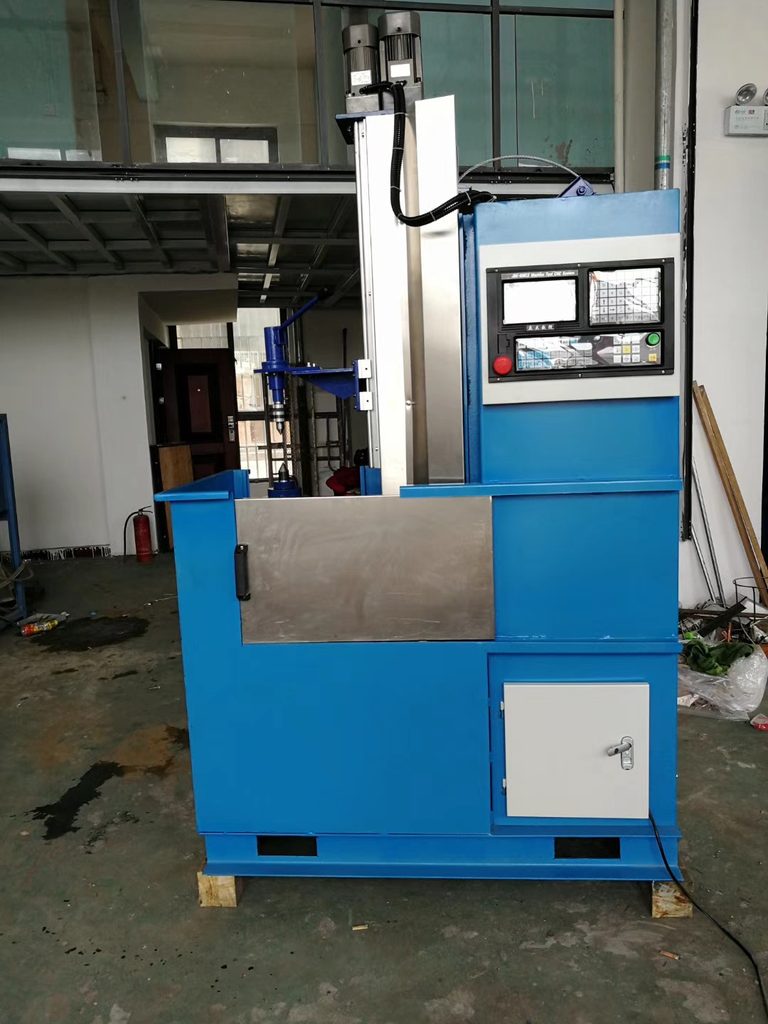
A complete induction hardening system normally includes several coordinated components:
- Induction power supply — converts electrical power into the required alternating current and operating frequency.
- Induction coil — transfers electromagnetic energy to the workpiece. Coil geometry is normally customized according to the component.
- Cooling and quenching system — controls the temperature of the power electronics, induction coil, and workpiece during the process.
- Workpiece movement mechanism — rotates, scans, feeds, or positions the component according to the selected hardening method.
- PLC control system — coordinates heating time, power, movement, quenching, and other process parameters.
For components requiring localized or continuous surface treatment, a medium-frequency system can be configured according to the workpiece and production requirements. You can also learn more about our induction heating furnace solutions for industrial heating applications.
When selecting equipment, three factors should be considered first: component dimensions, production volume, and required hardened depth/profile. Material grade, component geometry, available electrical capacity, automation requirements, and quenching method should then be evaluated.
A properly designed system should be matched to the actual component rather than selected only according to nominal furnace power.
Common Problems and Solutions
1. Hardened Layer Is Too Shallow
If the hardened depth is insufficient, the heating profile may not penetrate deeply enough or the component may not reach the required austenitizing temperature at depth. Depending on the specific process, using a lower frequency, adjusting power density, or increasing heating time can help increase effective heating depth.
However, these changes should be validated through temperature measurement and metallographic or hardness testing rather than applied blindly.
2. Surface Cracking
Surface cracks can result from excessive heating, excessive thermal gradients, unsuitable material conditions, or overly severe quenching. The solution may include optimizing heating parameters, improving temperature uniformity, and selecting or controlling a more appropriate quenching condition.
3. Uneven Hardness
Uneven hardness is often associated with inconsistent coil-to-workpiece spacing, poor coil design, non-uniform heating, unstable workpiece movement, or inconsistent quenching. Optimizing the induction coil, workpiece positioning, scanning speed, and quench coverage can significantly improve uniformity.
In production, hardness testing and case-depth measurements should be used to verify that the process consistently meets the required specification.
Conclusion
Induction hardening is a localized heat treatment process that combines rapid induction heating with controlled quenching to produce a hard, wear-resistant surface while retaining greater toughness in the core.
Its fast heating speed, localized treatment, repeatability, and automation potential make it particularly suitable for high-volume production of shafts, gears, automotive components, pins, and machine parts.
The correct induction frequency, power, heating time, coil design, and quenching system must be selected according to the material, geometry, production rate, and required hardened profile.
If you need help selecting an induction hardening system, our engineers can evaluate your workpiece and production requirements and recommend a suitable configuration.
Contact our engineer →
Frequently Asked Questions
What is induction hardening process?
Induction hardening is a surface heat treatment process in which electromagnetic induction rapidly heats the surface of a metal component to the required austenitizing temperature, followed by rapid quenching. The heated layer transforms primarily into martensite, increasing surface hardness and wear resistance while the core remains comparatively tough.
Induction hardening vs conventional hardening: What is the difference?
The main difference is how the component is heated. Conventional hardening typically heats the entire component in a furnace before quenching, while induction hardening uses electromagnetic induction to heat a selected area rapidly.
Induction hardening provides better control over the hardened location and can reduce unnecessary heating. It is also well suited to automated and high-volume production. Conventional furnace hardening, however, remains useful when uniform through-hardening or batch treatment of entire components is required.
What frequency is used for induction hardening?
There is no single frequency suitable for every induction hardening application. Higher frequencies generally produce shallower heating, while lower frequencies generally provide deeper electromagnetic penetration.
The appropriate frequency depends on the required hardened depth, workpiece material, dimensions, geometry, coil design, heating time, and available power supply. In practical applications, frequency should therefore be selected together with the required heating profile rather than as an isolated parameter.
What materials can be induction hardened?
Induction hardening is most commonly applied to ferrous alloys that can form sufficient martensite during quenching, particularly medium-carbon steels and suitable alloy steels.
Typical examples include many grades used for shafts, gears, crankshafts, camshafts, pins, and other wear-resistant components. The exact material grade and carbon content are important because not every steel responds equally well to induction hardening.
Need an Induction Hardening Solution?
Every component has different requirements for hardened depth, hardness, heating area, production rate, and automation.
Our engineers can evaluate your workpiece material, dimensions, required hardened depth, production capacity, and process requirements to recommend a suitable induction heating and surface hardening system.