
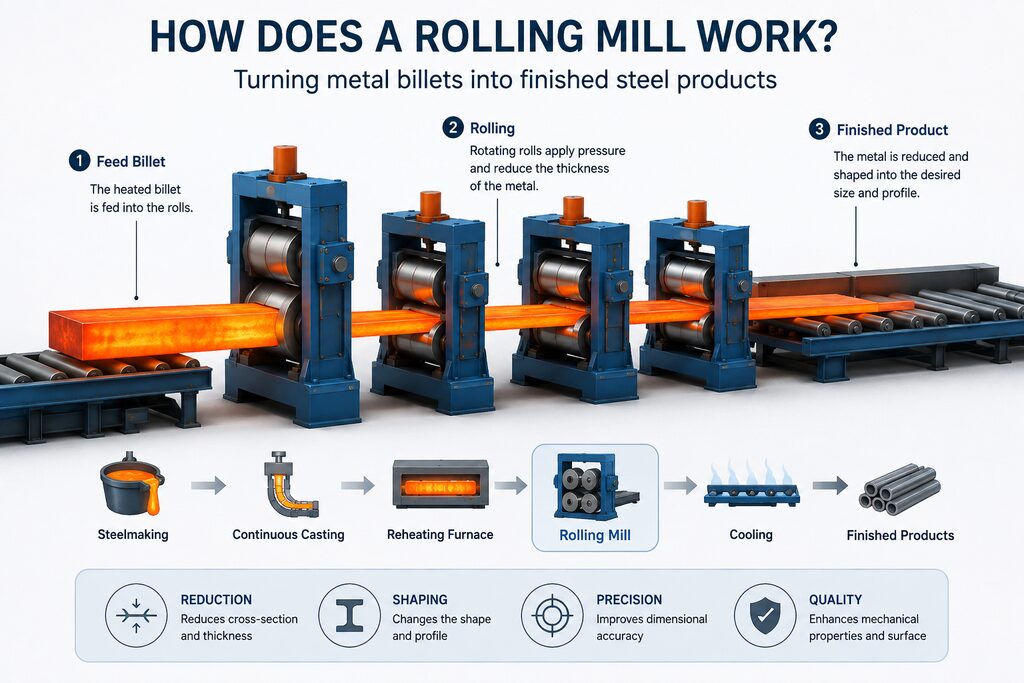
A rolling mill is one of the most important pieces of equipment in modern metal processing. It is used to reduce the cross-section of metal, change its shape, improve dimensional accuracy, and produce finished products such as rebar, wire rod, structural sections, plates, and sheets.
For anyone planning a steel or metal production project, understanding the rolling mill working principle is essential. The right mill configuration depends on the product, required production capacity, billet size, automation level, and available budget. Choosing the wrong equipment can result in unnecessary investment, low production efficiency, or difficulty meeting the required product specifications.
So, how does a rolling mill work? What are the main types of rolling mills? What equipment is included in a rolling line? And how much does a rolling mill cost?
This guide explains the rolling process, major components, different mill configurations, applications, cost factors, and the key points to consider when selecting a rolling mill.
What Is a Rolling Mill in a Steel Plant?
A rolling mill is a metal processing machine that uses rotating rolls to apply compressive forces to a metal workpiece. As the workpiece passes between the rolls, its thickness or cross-section is reduced while its shape and dimensions are changed.
In a steel plant, a rolling mill is normally located downstream of steelmaking and casting and upstream of the finished-product stage. A typical production sequence can be summarized as:
Steelmaking → Continuous Casting → Reheating → Rolling → Cooling → Cutting / Collecting → Finished Steel Products
The rolling process performs several important functions:
- Reduction: Reduces the thickness or cross-sectional area of the metal.
- Shaping: Changes billets or slabs into specific product profiles.
- Dimensional control: Produces products with controlled dimensions and tolerances.
- Surface improvement: Helps achieve the required surface characteristics.
- Microstructure improvement: Hot rolling can refine the metal's internal structure and influence its mechanical properties.
For example, a continuously cast steel billet cannot normally be sold directly as finished rebar. The billet is first reheated to the required rolling temperature and then passed through a series of rolling stands to gradually transform its square cross-section into the final ribbed rebar profile.
In simple terms:
Continuous casting produces the billet → the reheating furnace prepares the billet → the rolling mill transforms it into the finished product.
How Does a Rolling Mill Work? Working Principle
The Basic Rolling Process
The basic rolling mill working principle is relatively straightforward.
A metal billet, slab, bar, or other workpiece is fed between two rotating rolls. The rolls rotate in opposite directions and pull the metal into the roll gap. As the workpiece passes through the gap, the rolls apply compressive force and plastically deform the metal.
The result is a reduction in thickness or cross-sectional area and an increase in length.
For most rolling processes, the basic relationship can be understood through the principle of volume conservation. Since the volume of the metal remains approximately constant during plastic deformation, reducing the cross-sectional area causes the material to elongate.
For example:
Billet → Roll Gap → Reduced Cross-Section → Increased Length
The amount of reduction achieved during one pass is called the reduction per pass or draft. The allowable reduction depends on factors such as:
- Material grade and temperature
- Material strength and plasticity
- Roll diameter
- Rolling force
- Mill stand capacity
- Motor power
- Roll strength
- Required final dimensions
A single pass is usually not enough to achieve the required product size. Instead, industrial rolling lines use multiple passes. Each pass gradually reduces and reshapes the material until the final dimensions are reached.
For example, in a rebar production line, a square billet may pass through several rolling stands. The early stands perform larger reductions, while later stands progressively form the final diameter and rib pattern.
Key Components of a Rolling Mill
Although rolling mills differ significantly in design, most systems contain several essential components.
Rolls
Rolls are the components that directly contact the metal. They apply the rolling force and determine the shape of the workpiece.
Roll design is particularly important because roll diameter, material, surface condition, and groove design affect production efficiency and product quality.
In section and bar rolling, grooved rolls are commonly used to gradually form the required profile.
Roll Housing / Stand
The roll housing, also called the mill stand, supports the rolls and other components. It must withstand substantial rolling forces without excessive deformation.
The rigidity of the stand directly affects dimensional stability and rolling accuracy.
Drive System
The drive system supplies the torque and rotational speed required by the rolls.
A typical system may include:
- Electric motor
- Gearbox or reducer
- Couplings
- Drive shafts
- Mechanical transmission components
The required motor power depends on factors such as material size, reduction, rolling speed, product type, and production capacity.
Screw Down / Gap Adjustment
The screw-down or roll-gap adjustment system controls the distance between the rolls.
Correct roll-gap adjustment is essential for maintaining the required product dimensions. Modern mills may use hydraulic or automatic control systems to improve adjustment accuracy and response speed.
Guide System
Guides direct the workpiece into and out of the rolling stands.
Proper guiding is particularly important in bar and rebar rolling because the material must enter each pass at the correct position and orientation. Poor guiding can cause dimensional problems, twisting, cobbles, or production interruptions.
Cooling & Lubrication
Cooling systems help control the temperature of rolls and other equipment. Lubrication reduces friction and wear between moving components.
Depending on the rolling process, water cooling may also be used to control the temperature of the rolled product.
Control System
Modern rolling mills commonly use PLC-based control systems to coordinate motors, rolling stands, guides, cooling systems, cutting equipment, and other components.
The control system can monitor and regulate parameters such as:
- Rolling speed
- Roll gap
- Product temperature
- Motor operation
- Cooling conditions
- Production sequence
- Safety interlocks
Automation improves production consistency and reduces the amount of manual intervention required.
Hot Rolling vs Cold Rolling
Hot rolling is performed at elevated temperatures, generally above the material's recrystallization temperature. The material becomes easier to deform, allowing larger reductions and high production rates. Hot rolling is widely used for rebar, structural sections, wire rod, plates, and other products.
Cold rolling is performed at or near room temperature. It provides better dimensional accuracy, improved surface finish, and can increase strength through work hardening. It is commonly used for thin sheets and strips.
The choice between the two depends on the required product properties and manufacturing process.
Types of Rolling Mills: Classification & Applications
Rolling mills can be classified according to rolling temperature, product shape, and mill configuration.
By Rolling Temperature
Hot Rolling Mill
A hot rolling mill processes metal at elevated temperatures after the billet or slab has been reheated.
Hot rolling is widely used to produce:
- Rebar
- Structural sections
- Wire rod
- Plates
- Bars
Because the material has lower deformation resistance at high temperatures, hot rolling is suitable for high-throughput production.
Cold Rolling Mill
A cold rolling mill processes material without reheating it to the temperatures used in hot rolling.
Cold rolling is commonly used for:
- Thin sheets
- Strip steel
- Precision metal products
- Foil and other thin-gauge materials
Cold rolling provides excellent dimensional control and surface quality.
Warm Rolling
Warm rolling takes place between conventional hot and cold rolling temperatures.
It is used for certain materials and applications where a combination of lower deformation resistance and improved dimensional or material properties is required.
By Product Shape
Bar / Section Mill
Bar and section mills produce products with specific cross-sectional profiles, including:
- Rebar
- Round bars
- Angle steel
- Channel steel
- I-beams
- H-beams
These mills often use grooved rolls and multiple rolling passes.
Wire Rod Mill
Wire rod mills produce long, continuous coils of wire rod.
They generally contain multiple rolling stands arranged in sequence and operate at high speeds to achieve high production capacity.
Plate / Sheet Mill
Plate and sheet mills are designed for flat products. They use roll configurations suitable for controlling thickness and flatness.
Typical products include:
- Steel plate
- Sheet
- Strip
- Aluminum sheet
- Copper strip
Tube / Pipe Mill
Tube and pipe rolling equipment is used to produce tubular products. Different processes and mill configurations are used depending on whether the product is seamless or welded.
Specialty Mill
Specialized rolling mills are designed for specific products or applications. Examples include ring rolling mills and equipment for producing specialized profiles or components.
By Mill Configuration
2-High Mill
A 2-high mill uses two rolls positioned above and below the workpiece. Its simple structure makes it suitable for basic rolling operations, small production systems, and certain initial rolling applications.
4-High Mill
A 4-high mill uses two smaller work rolls supported by two larger backup rolls.
The backup rolls reduce roll bending and help maintain better control over the strip or plate thickness. This configuration is widely used in flat-product rolling.
Cluster Mill / Sendzimir Mill
Cluster mills use multiple rolls to support relatively small work rolls.
A common configuration is a 20-high mill, which provides excellent control for very thin strip and precision rolling applications.
Universal Mill
A universal mill combines horizontal and vertical rolls. This configuration allows more comprehensive control of the cross-section and is commonly associated with the production of structural products such as H-beams.
Continuous Mill
A continuous or tandem rolling mill contains multiple rolling stands arranged in sequence. The material passes continuously from one stand to the next, with each stand performing part of the required reduction.
This configuration is highly suitable for high-volume production.
What Are the Three Main Types of Rolling Mills?
The three commonly discussed types are:
1. 2-High Rolling Mill
A 2-high mill has two main rolls. It is one of the simplest rolling mill configurations and can be used for basic rolling operations, smaller production systems, and certain bar or section applications.
2. 4-High Rolling Mill
A 4-high mill contains two smaller work rolls and two larger supporting rolls. The supporting rolls help prevent excessive work-roll deflection, making the configuration particularly suitable for plate and strip rolling.
3. Continuous / Tandem Rolling Mill
A continuous rolling mill uses multiple stands arranged in sequence. The workpiece passes through each stand and receives a portion of the total reduction.
This arrangement provides high productivity and is widely used for large-scale production of products such as wire rod, bars, rebar, and flat products.
However, these are not the only types of rolling mills. Actual mill selection depends heavily on the product, material, production capacity, dimensions, and required finishing accuracy.
Rolling Mill Applications in Metal Processing
Rolling mills are widely used throughout the steel and non-ferrous metal industries.
In the steel industry, rolling mills can produce:
- Rebar
- Wire rod
- Round bars
- Angle steel
- Channel steel
- I-beams
- H-beams
- Steel plates
- Steel sheets
In the non-ferrous metal industry, rolling equipment can process materials such as aluminum, copper, and brass into sheets, strips, rods, and other products.
A typical steel production route can look like this:
Scrap Steel → Induction Furnace → Continuous Casting → Steel Billet → Reheating Furnace → Rolling Mill → Cooling → Cutting → Rebar
In this process, the induction furnace melts the raw material, the continuous casting system produces billets, and the reheating furnace raises the billet temperature before it enters the rolling mill.
For a complete production project, the rolling mill therefore needs to work together with upstream and downstream equipment. The design of the entire production line is often more important than selecting the rolling mill alone.
How Much Does a Rolling Mill Cost?
The answer to “How much does a rolling mill cost?” depends heavily on the mill type, production capacity, product specifications, automation level, and included equipment.
A small standalone rolling machine and a complete automated rebar rolling line can have completely different investment requirements.
Factors That Determine Rolling Mill Price
Production Capacity and Specifications
Capacity is one of the biggest factors affecting price.
A system designed for approximately 10,000 tons per year requires substantially less equipment and power than a line designed for 300,000 tons or more per year.
Mill Type
A basic 2-high rolling mill generally costs much less than a complete continuous rolling production line.
The number of stands, rolling speed, motor power, and auxiliary equipment all influence the investment.
Automation Level
Manual or semi-automatic equipment generally has a lower initial investment.
A modern PLC-controlled production line requires additional control equipment, sensors, automation systems, and electrical components, but it can provide better production consistency and efficiency.
Supporting Equipment
The quoted price may or may not include equipment such as:
- Reheating furnace
- Flying shear
- Cooling bed
- Straightening equipment
- Bundling and collecting equipment
- Water cooling system
- Electrical control system
Therefore, two apparently similar quotations can represent very different project scopes.
Materials and Brands
The quality of rolls, motors, bearings, electrical components, reducers, and control systems also affects the total cost.
Price Range by Mill Type
The following ranges are rough reference values rather than fixed market prices:
| Rolling Mill Type | Approximate Cost |
|---|---|
| Small experimental / teaching mill | $10,000 – $50,000 |
| Small production mill, 0.5–20,000 tons/year | $50,000 – $300,000 |
| Medium continuous rolling line, 50,000–150,000 tons/year | $300,000 – $1,500,000 |
| Large fully continuous rolling line, 200,000+ tons/year | $1,500,000 – $5,000,000+ |
Actual pricing can vary substantially depending on the required product, billet dimensions, production speed, automation, auxiliary equipment, installation requirements, and supplier configuration.
For this reason, a rolling mill should not be selected based only on the equipment's purchase price.
Hidden Costs to Consider
The initial equipment quotation is only one part of the total project investment.
Additional costs may include:
- Installation and commissioning
- Civil construction and foundations
- Electrical capacity upgrades
- Water and cooling infrastructure
- Operator training
- Spare parts
- Maintenance
- Transportation
- Production-line integration
Installation and commissioning can sometimes represent around 10–20% of the equipment investment, depending on project complexity.
Power consumption should also be considered because rolling mills can require significant electrical capacity. For large production lines, the electrical infrastructure and utility systems can become important parts of the overall project budget.
How to Choose the Right Rolling Mill
Choosing the right rolling mill starts with the finished product rather than the machine itself.
First, determine exactly what you plan to produce. A rebar mill, wire rod mill, section mill, and plate mill require different configurations.
Then evaluate the following factors:
1. Product Type
Determine whether the final products are rebar, wire rod, bars, sections, plates, sheets, or another product.
2. Annual Production Capacity
Define your target production in tons per year as well as the required hourly output.
3. Billet Size and Material
The billet dimensions, steel grade, material temperature, and incoming condition directly influence the rolling process.
4. Available Site and Power
Check the available factory space, electrical capacity, cooling water, foundation requirements, and material-handling conditions.
5. Future Expansion
If production is expected to increase, consider future capacity when selecting the mill layout and auxiliary systems.
6. Supplier Capability
For a complete production project, it is useful to work with a supplier capable of providing not only the rolling stands but also the associated equipment and production-line integration.
The right supplier should be able to evaluate your product requirements, production capacity, billet specifications, and site conditions before recommending a configuration.
Frequently Asked Questions
What are the three types of rolling mills?
The three commonly discussed rolling mill configurations are 2-high mills, 4-high mills, and continuous or tandem mills. A 2-high mill uses two rolls, while a 4-high mill uses two work rolls supported by two backup rolls. A continuous mill uses multiple stands arranged in sequence for high-volume production.
How much does a rolling mill cost?
A rolling mill can range from around $50,000 for a small production mill to more than $5 million for a large, fully integrated rolling line. The actual price depends on production capacity, product type, number of stands, automation level, auxiliary equipment, and project requirements.
What is the difference between hot rolling and cold rolling?
Hot rolling is performed at elevated temperatures, normally above the material's recrystallization temperature. It reduces deformation resistance and is suitable for high-volume production. Cold rolling is performed at or near room temperature and provides better surface finish and dimensional accuracy.
What is a rolling mill used for?
A rolling mill is used to plastically deform metal by passing it between rotating rolls. It can reduce the cross-sectional area and transform billets, slabs, or other metal stock into products such as rebar, wire rod, structural sections, plates, sheets, and strips.
How does a continuous rolling mill work?
A continuous rolling mill uses multiple rolling stands arranged in sequence. The metal passes from one stand to the next, with each stand performing part of the required reduction. This allows several rolling passes to be completed continuously and provides high production efficiency.
What is the rolling mill's main function?
The main function of a rolling mill is to apply compressive force through rotating rolls to produce controlled plastic deformation. This reduces the metal's cross-section, changes its shape, and can also influence its surface quality, dimensional accuracy, internal structure, and mechanical properties.
Conclusion
So, how does a rolling mill work? The fundamental process is simple: rotating rolls apply compressive force to metal, causing controlled plastic deformation that reduces its cross-section and changes its shape.
Industrial rolling systems, however, can be highly sophisticated. Different products require different roll configurations, numbers of stands, drive systems, guides, cooling systems, and automation levels.
The most important factors when selecting a rolling mill are product type, required production capacity, billet specifications, available site and power, automation requirements, and total project budget.
For a small production project, a simple rolling mill may be sufficient. For high-volume rebar, wire rod, or section production, a continuous rolling line can provide the productivity and automation required for large-scale manufacturing.
If you are planning a new rolling mill project and need help selecting the right configuration, production capacity, or supporting equipment, contact us for a rolling mill solution and a free quotation.