
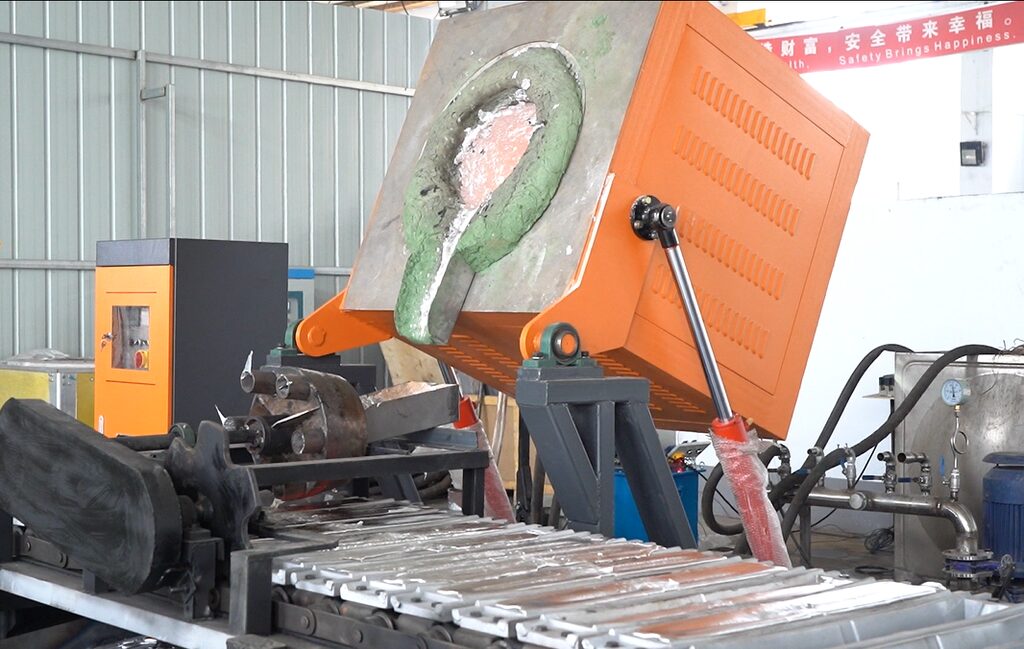
Casting aluminum ingots is a common step in secondary aluminum production and metal recycling. The basic process involves melting aluminum scrap or other feedstock, preparing the molten metal, and casting it into a controlled shape for storage, transport, remelting, rolling, extrusion, or other downstream processing.
The process is more than simply pouring molten aluminum into a mold. Alloy composition, melt cleanliness, pouring conditions, mold design, and solidification all affect the quality of the finished ingot. Different products also require different casting methods.
This guide explains how aluminum ingots are cast, what equipment is used, which factors affect ingot quality, and how to select an appropriate aluminum ingot casting machine for a recycling or metal-processing operation.
What Is Aluminum Ingot Casting?
Aluminum ingot casting is the process of converting molten aluminum into a solid ingot with a defined shape and size. The molten aluminum may come from primary aluminum production or from recycled scrap that has been sorted, melted, and treated.
In secondary aluminum production, scrap is first separated according to alloy and material type before entering a melting furnace. The resulting molten aluminum can then be held in the liquid state or cast into products such as ingots and billets. The Aluminum Association identifies melting, alloying, and casting as key stages in secondary aluminum production.
The term "ingot" covers several different product forms. Remelt ingots are produced for later melting, while larger aluminum ingots can be used as feedstock for processes such as rolling. Billets are generally used for extrusion and other downstream processes. ASM International distinguishes remelt ingots, billets, rolling ingots, and other ingot forms when discussing aluminum production.
Therefore, the required casting equipment depends on the intended product rather than simply the fact that the material is aluminum.
Aluminum Ingot Casting Process
A typical aluminum ingot casting process can be divided into several stages:
Aluminum scrap or raw material → Sorting and preparation → Melting → Alloy adjustment → Molten metal treatment → Pouring → Casting and solidification → Cooling → Ingot handling
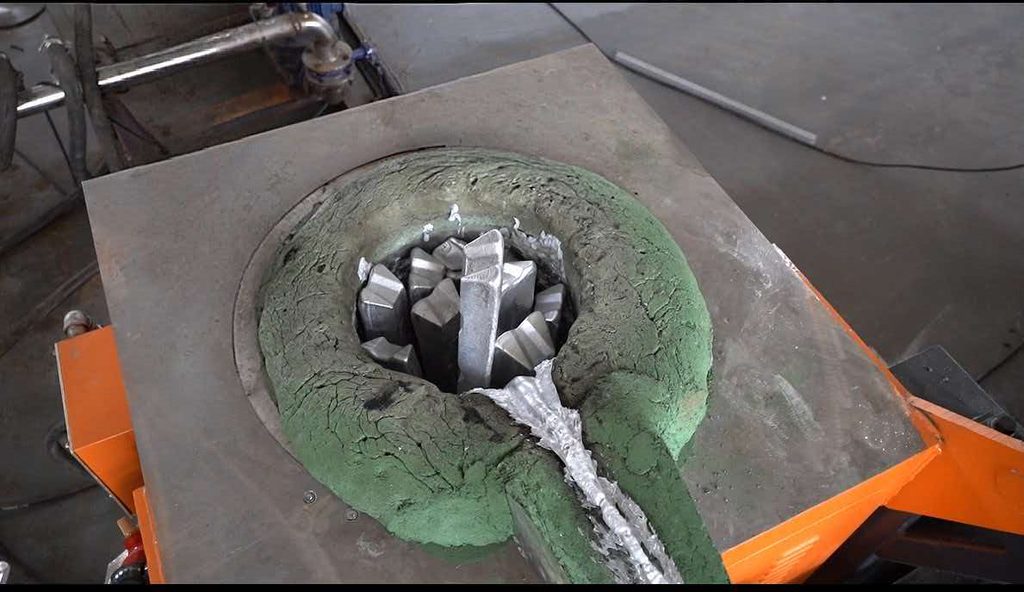
The exact sequence varies between plants and products, but the main stages are closely related to the quality of the final metal.
1. Prepare the Aluminum Feedstock
For recycled aluminum, the first step is preparing the scrap for melting.
Different scrap streams can contain different alloys, coatings, moisture, oils, and non-metallic materials. Sorting scrap according to alloy and removing unwanted materials helps reduce contamination and makes the final chemical composition easier to control.
This is particularly important when producing aluminum ingots for a specified alloy rather than simply producing general-purpose remelt material.
The Aluminum Association notes that scrap separated by chemical composition retains higher value, while mixed-alloy scrap and contaminated material are more difficult to process efficiently.
2. Melt the Aluminum
Prepared material is charged into an aluminum melting furnace, where it is heated until the metal becomes fully molten.
Pure aluminum melts at approximately 660°C, but an industrial melting operation does not simply operate at the melting point. The required temperature depends on the alloy, furnace design, charge material, melt treatment, and subsequent casting operation.
For secondary aluminum production, the Aluminum Association gives a typical furnace temperature range of approximately 1300–1400°F (about 704–760°C) for converting scrap into molten aluminum. This should not be interpreted as a universal pouring-temperature specification for every aluminum alloy or casting machine.
Maintaining appropriate temperature control is important because excessive superheat can increase oxidation and energy consumption, while insufficient temperature can create problems with metal flow and filling.
3. Adjust the Alloy Composition
When a specific aluminum alloy is required, alloying elements may be added to the molten metal before casting.
The purpose is to bring the melt within the required chemical composition range. The exact additions depend on the target alloy and the composition of the incoming scrap or primary metal.
This stage is particularly important in recycling because scrap from different products may have different alloy compositions. Simply melting a mixed scrap charge does not guarantee a consistent final alloy.
4. Treat the Molten Aluminum
Molten aluminum may contain dissolved hydrogen, oxide films, and other inclusions. These can affect the quality of the resulting ingot and downstream products.
Industrial molten-metal treatment can include processes for controlling hydrogen and inclusions, together with filtration or other melt-cleaning operations. ASM's technical literature identifies molten-metal treatment, inclusion control, and grain refinement as important parts of aluminum casting practice.
The treatment requirements depend heavily on the final product. A simple remelt ingot does not necessarily require the same melt-quality controls as an ingot intended for demanding rolling or extrusion applications.
5. Transfer and Pour the Molten Aluminum
After melting and treatment, the molten aluminum is transferred to the casting system.
The pouring system must deliver the metal consistently into the molds or casting zone. Unstable pouring can contribute to inconsistent filling, splashing, oxidation, or variations in the casting process.
For an automated production line, the relationship between the furnace, transfer system, pouring system, molds, and cooling section becomes especially important.
6. Cast and Solidify the Ingots
The molten aluminum enters the casting molds and begins to solidify.
As heat is removed from the metal, a solid shell forms and the remaining liquid gradually freezes. The rate and direction of solidification influence the internal structure and potential defects of the ingot.
ASM research on aluminum alloy ingots identifies phenomena such as microsegregation, macrosegregation, hydrogen porosity, grain structure, and surface defects as important aspects of aluminum ingot solidification.
This is why casting quality cannot be evaluated only by looking at the external shape of an ingot. The solidification conditions can also affect its internal structure and suitability for later processing.
Aluminum Ingot Casting Methods
There is no single casting method for every aluminum ingot.
ASM International describes several major approaches, including open-mold casting, direct chill (DC) casting, and continuous casting processes.
Open-Mold Ingot Casting
In open-mold casting, molten aluminum is introduced into individual molds and allowed to solidify.
This approach can be suitable for certain remelt ingots and other products where individual ingot geometry is required. The mold arrangement, pouring system, cooling conditions, and handling system determine how the casting line operates.
An ingot casting machine can automate the movement of molds through the pouring and cooling stages, reducing the amount of manual handling required.
Direct Chill Casting
Direct chill (DC) casting is widely used for producing larger aluminum ingots, including products that later enter rolling or other metalworking operations.
In DC casting, solidification is controlled using water cooling as the ingot is formed. The process is more complex than simply filling an individual mold, and control of heat transfer and solidification is important to the resulting ingot structure.
ASM identifies DC casting as one of the major technologies used for producing aluminum alloy ingots for downstream manufacturing.
Continuous Casting
Continuous casting provides another route for producing aluminum products directly from molten metal. Depending on the process, technologies include twin-roll strip casting and other continuous casting systems.
These processes are different from conventional individual-ingot casting and should not be treated as interchangeable equipment. The appropriate system depends on the required product shape, dimensions, production rate, and downstream process.
What Equipment Is Used for Casting Aluminum Ingots?
A complete aluminum ingot production system may include several types of equipment:
- Aluminum melting furnace for melting scrap or primary aluminum
- Molten-metal treatment equipment for controlling melt quality
- Transfer and pouring equipment
- Ingot casting machine for forming individual ingots
- Cooling equipment
- Ingot handling and conveying equipment
- Control and automation systems
The equipment configuration should be selected according to the material, ingot dimensions, production capacity, degree of automation, and required product quality.
For recycled aluminum, the furnace and casting machine also need to work as a coordinated system. A high-capacity melting furnace does not automatically result in high casting output if the downstream casting system cannot handle the molten-metal flow.
Aluminum Ingot Casting Machine for Metal Recycling
An aluminum ingot casting machine is designed to receive molten non-ferrous metal and cast it into repeatable ingot shapes.
For recycling operations, the machine is commonly connected with a melting system so that the overall process can move from scrap preparation and melting to casting with less manual handling.
Our ingot casting equipment is designed for recycling and melting non-ferrous metals such as aluminum, copper, and zinc and casting the molten metal into ingots. The machine uses a heavy welded steel structure consisting of the head frame, tail frame, middle frame, pouring-system frame, and track.
The reinforced structure is intended to provide stability during normal casting operation and reduce deformation and vibration of the machine structure.
For a complete aluminum melting and casting system, the casting machine can therefore be considered as the downstream equipment following the melting stage rather than as a replacement for the melting furnace itself.
What Affects Aluminum Ingot Quality?
Several factors can affect the quality of cast aluminum ingots.
Alloy Composition
The chemical composition needs to match the requirements of the target alloy. Mixed or poorly sorted scrap can make composition control more difficult.
Melt Cleanliness
Oxides, inclusions, and dissolved hydrogen can affect the quality of aluminum products. Melt treatment becomes increasingly important when the ingot will be used for demanding downstream applications.
Pouring Conditions
Pouring temperature, flow stability, and the way molten metal enters the mold all influence the casting operation.
The correct temperature is not simply the highest possible temperature. Excessive heating increases energy use and can contribute to oxidation, while insufficient temperature can interfere with metal flow.
Solidification and Cooling
The way heat is removed from the molten metal affects the resulting solidification structure.
For large aluminum alloy ingots, solidification can influence segregation, porosity, grain structure, and cracking behavior.
Mold and Machine Condition
The condition of the molds, casting track, pouring system, and supporting structure can affect dimensional consistency and stable operation.
Regular inspection is particularly important for continuously operating casting equipment because mechanical wear can eventually affect alignment and casting performance.
Can Aluminum Scrap Be Used to Make Ingots?
Yes. Producing secondary aluminum ingots from scrap is an established industrial recycling route.
The basic route is:
Aluminum scrap → Sorting → Melting → Melt treatment/alloying → Casting → Secondary aluminum ingot
The Aluminum Association reports that secondary aluminum production is approximately 95% less energy intensive than primary aluminum production, although the exact energy savings depend on the production route and system boundaries used for comparison.
Scrap quality still matters. Clean, well-sorted scrap is easier to process and provides better control over the final alloy composition than mixed scrap containing multiple alloys or significant contaminants.
For this reason, an efficient recycling plant should consider the entire material flow rather than focusing only on the melting furnace or casting machine.
How to Choose an Aluminum Ingot Casting Machine
When selecting an ingot casting machine, several practical factors should be considered:
| Factor | Why It Matters |
|---|---|
| Metal type | Aluminum, copper, zinc and other metals have different melting and casting requirements |
| Ingot size | Determines mold dimensions and casting-machine configuration |
| Production capacity | Must match the output of the melting system |
| Pouring system | Affects consistency and automation |
| Cooling system | Influences solidification and cycle time |
| Machine structure | Needs to withstand repeated thermal and mechanical loading |
| Automation | Determines the amount of manual handling required |
| Material handling | Important for removing and transporting finished ingots |
| Maintenance | Access to molds, tracks, bearings and other wear components affects long-term operation |
One of the most common mistakes is selecting the casting machine separately from the furnace.
The melting capacity, pouring rate, mold cycle, cooling time, and ingot removal system should be considered together. For a recycling plant, the target output should be based on the complete process rather than the rated capacity of a single machine.
Conclusion
Casting aluminum ingots connects aluminum melting and recycling with downstream metal processing. While the basic concept is straightforward—melt aluminum and solidify it into ingots—the actual process involves material preparation, alloy control, molten-metal treatment, pouring, solidification, cooling, and handling.
For recycled aluminum, aluminum melting equipment and the casting system need to be properly matched. The appropriate casting method also depends on whether the product is a small remelt ingot, a large rolling ingot, a billet, or another aluminum product form.
For plants processing aluminum, copper, zinc, or other non-ferrous metals, an ingot casting machine can provide a practical way to convert molten metal into consistent ingots while reducing manual handling. The right configuration depends on the metal, ingot dimensions, production requirements, and overall plant layout.
If you are planning an aluminum recycling or ingot production project and need to match the melting capacity with an appropriate casting system, contact us to discuss your material, required ingot size, and production requirements.