
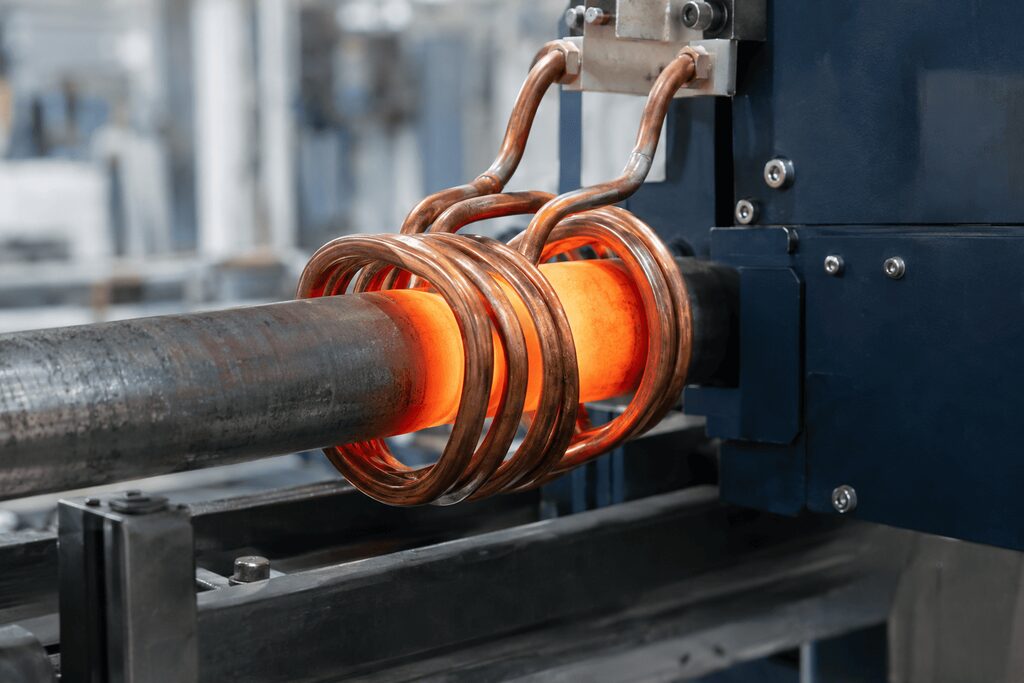
An induction heating coil is the part of an induction heating system that creates the alternating electromagnetic field used to heat a metal workpiece. Unlike a conventional resistance heating element, the coil normally does not act as the primary source of useful heat. Instead, alternating current flows through the coil, producing a changing magnetic field that induces electrical currents in the workpiece. The electrical resistance of the workpiece then converts this induced energy into heat.
The actual heating result depends on more than the coil current alone. Coil geometry, operating frequency, the gap between the coil and workpiece, material properties, and cooling all affect how efficiently energy is transferred and where heat is generated.
What Is an Induction Heating Coil?
An induction heating coil, also called an induction coil or work coil, is a conductive coil used to generate the electromagnetic field required for induction heating.
Industrial induction coils are commonly made from copper because copper has high electrical conductivity, which helps reduce resistive losses while carrying the high alternating currents required by the process. In practical systems, the coil is also generally water-cooled to control its temperature during operation.
The coil does not normally need to touch the workpiece. The workpiece is positioned inside, around, or adjacent to the coil depending on the heating application and coil design.
This makes induction heating a non-contact process and allows heat to be concentrated in a controlled area of the workpiece.
For an overview of the complete process, see our guide to industrial induction heating.
How Does an Induction Heating Coil Work?
The working process can be simplified into five stages:
AC power supply → alternating current in the coil → alternating magnetic field → induced current in the workpiece → heat generation
1. Alternating Current Flows Through the Coil
The induction power supply converts incoming electrical power into alternating current at the required operating frequency.
This current is delivered to the induction coil. Because the current changes direction continuously, the electromagnetic field around the coil also changes continuously.
The power supply, resonant circuit, and coil form an electrical system whose characteristics must be matched to the workpiece and the required heating process.
The operating frequency is one of the key parameters in an induction heating system because it affects how the induced current is distributed inside the workpiece.
2. The Coil Creates an Alternating Magnetic Field
When alternating current passes through the coil, it generates an alternating magnetic field in and around the coil.
When a conductive workpiece is placed within this field, the changing magnetic flux produces an induced electromotive force in the workpiece according to Faraday's law of electromagnetic induction.
This is the point where the coil transfers energy without direct electrical contact with the metal.
The coil therefore acts as an electromagnetic energy-transfer component rather than simply functioning as a conventional heating element.
3. The Magnetic Field Induces Currents in the Workpiece
The induced electromotive force drives circulating electrical currents inside the workpiece. These are commonly referred to as eddy currents.
The shape and distribution of these currents are influenced by the coil geometry, workpiece geometry, material properties, frequency, and electromagnetic coupling between the coil and workpiece.
For example, the coil used for a long steel billet must create a different field distribution from a coil designed to heat only a small local section of a component.
This is one reason why steel billet induction heating requires a coil configuration matched to billet size, heating length, production rate, and target temperature.
4. Eddy Currents Generate Heat
The induced currents encounter the electrical resistance of the workpiece.
As a result, electrical energy is converted into thermal energy through resistive or Joule heating.
In simplified form:
P = I²R
where:
- P is electrical power converted into heat
- I is the induced current
- R is the electrical resistance of the material
A more complete electromagnetic model describes the local heating power as a volumetric heat source within the workpiece.
The important point is that the useful heating occurs primarily in the workpiece rather than because the copper coil itself becomes the heating element.
5. Heat Is Conducted Through the Workpiece
The electromagnetic process produces heat where the induced current is concentrated. The resulting temperature distribution then changes as heat conducts from hotter regions toward cooler regions.
Therefore, the final temperature profile depends on both electromagnetic heating and thermal conduction.
This distinction is important in industrial applications. A process may require surface heating, localized heating, or relatively uniform through-heating, and the induction system must be designed accordingly.
This principle is also important in induction hardening, where the objective is to heat a selected surface region to the required temperature before quenching.
What Determines How an Induction Heating Coil Works?
An induction coil cannot be evaluated separately from the workpiece and power supply. Its performance is determined by the interaction between several parameters.
Coil Geometry
Coil geometry determines how the electromagnetic field is distributed around the workpiece.
Important design variables include:
- Number of turns
- Coil diameter
- Coil length
- Conductor dimensions
- Turn spacing
- Coil shape
- Position relative to the workpiece
A multi-turn helical coil, for example, can surround a cylindrical workpiece for relatively uniform heating over a defined length. A single-turn or specially shaped coil may be more suitable when heat must be concentrated in a specific section.
Industrial induction coils are therefore usually designed around the geometry and heating requirement of the workpiece rather than selected as a universal component.
Coil-to-Workpiece Distance
The distance between the coil and workpiece is commonly called the coupling gap.
It has a direct effect on electromagnetic coupling. When the coil is brought closer to the workpiece, the magnetic field can couple more strongly into the material. However, the smallest possible gap is not automatically the correct design.
The actual gap must provide sufficient coupling while allowing for:
- Workpiece tolerances
- Mechanical movement
- Thermal expansion
- Safe operation
- Coil cooling
- Uniform heating
In industrial systems, coil position is therefore optimized according to the process rather than simply minimized.
Operating Frequency
Frequency is one of the most important factors controlling how induction energy is distributed in the workpiece.
At higher frequencies, induced current tends to be concentrated closer to the surface. At lower frequencies, current can penetrate more deeply into the material.
This behavior is associated with the skin effect. A simplified expression for skin depth is:
δ = √(2ρ / ωμ)
where:
- δ is skin depth
- ρ is electrical resistivity
- ω is angular frequency
- μ is magnetic permeability
The equation shows why penetration is not determined by frequency alone. Material resistivity and magnetic permeability also matter.
For this reason, higher frequency is not automatically better. The correct frequency depends on whether the process requires surface heating, localized heating, or deeper heating throughout the workpiece.
For readers comparing frequency choices, our article on induction heating frequency provides additional technical background.
Workpiece Material
Different metals respond differently to induction heating.
Electrical resistivity, magnetic permeability, temperature, and physical dimensions all influence the induced current and heating behavior.
Ferromagnetic materials such as carbon steel can experience both eddy-current and hysteretic heating below the Curie region. As temperature increases toward the Curie temperature, magnetic permeability changes significantly, which changes the electromagnetic response of the material.
Non-ferrous metals such as aluminum and copper can also be heated by induction, but their electrical and magnetic properties require different process conditions.
Therefore, the same coil and power setting cannot be assumed to produce the same heating result for every material.
Why Does Induction Coil Design Matter?
Two induction systems can use similar power supplies and still produce very different heating results because their coils are different.
Coil design determines where the magnetic field is concentrated and how effectively that field couples into the workpiece.
Poorly matched coil geometry can lead to:
- Uneven temperature distribution
- Insufficient heating depth
- Excessive surface heating
- Unwanted heating outside the target area
- Poor energy transfer
- Higher coil losses
- Longer heating cycles
This is why industrial induction heating coils are normally designed around the actual workpiece dimensions and process requirements.
For example, a coil for heating a long steel billet is fundamentally different from a coil designed to heat only the surface of a gear tooth or the end of a bar.
In a production line, coil design must also be considered together with the induction heating furnace, power supply, cooling system, and material handling equipment.
What Are the Common Types of Induction Heating Coils?
The exact coil configuration depends on the heating area and workpiece geometry.
Helical or Solenoid Coils
A helical coil surrounds a cylindrical or similarly shaped workpiece with multiple turns.
It is commonly used when a relatively large section of the workpiece needs to be heated.
Single-Turn Coils
A single-turn coil can concentrate electromagnetic energy over a specific region.
It can be useful when localized heating is required or when the workpiece geometry makes a multi-turn design unnecessary.
Pancake Coils
A pancake-type coil is generally used for heating relatively flat or localized areas.
The geometry allows the magnetic field to be concentrated over a selected surface region.
Custom-Shaped Coils
Many industrial applications require coils specifically designed for irregular workpieces.
The coil may be formed around a particular geometry to control the heating zone and improve temperature uniformity.
Induction-hardening systems can also use stationary single-shot coils or scanning configurations depending on the required heating pattern.
Why Are Induction Heating Coils Water-Cooled?
Industrial induction coils carry high alternating current, so the conductor itself experiences electrical losses.
The coil is also exposed to heat radiated or conducted from the workpiece.
For this reason, induction coils are commonly manufactured as water-cooled copper conductors. Continuous water circulation removes heat from the conductor and helps keep the coil within its allowable operating temperature.
Cooling is not simply an accessory. Insufficient cooling can increase coil temperature, accelerate material degradation, and eventually damage the coil.
The cooling system must therefore be matched to the coil design, electrical load, operating cycle, and production conditions.
In larger industrial systems, the cooling circuit is normally designed as part of the overall equipment package rather than added separately.
Induction Heating Coil vs. Heating Element
An induction heating coil is sometimes confused with a conventional resistance heating element because both are used for heating.
The main difference is where the useful heat is generated.
A resistance element generates heat primarily within the element itself and transfers that heat to another material by conduction, convection, or radiation.
An induction coil instead creates an electromagnetic field. The workpiece receives the induced electrical energy and generates heat through electrical losses within the material.
This difference explains why induction heating can provide rapid, localized, and non-contact heating without physically touching the workpiece.
Where Are Induction Heating Coils Used?
Induction heating coils are used in a wide range of industrial processes, including:
- Steel billet heating
- Bar and rod heating
- Forging preheating
- Induction hardening
- Annealing
- Brazing
- Shrink fitting
- Localized metal heating
- Preheating before forming or welding
In billet heating, the coil is designed to heat the required length and cross-section of the billet while maintaining the temperature profile needed by the following process.
For industrial applications, induction heating coils are part of a complete system rather than an isolated component. The power supply, resonant circuit, cooling system, coil, material handling system, and process control must work together.
How to Choose an Induction Heating Coil
The correct induction heating coil should be selected according to the process rather than only the nominal dimensions of the coil.
The main factors include:
Workpiece material: Determine electrical resistivity, magnetic behavior, and temperature requirements.
Workpiece geometry: Diameter, thickness, length, and shape determine how the magnetic field should be applied.
Heating area: Define whether the application requires surface, localized, or through-heating.
Target temperature: The required temperature affects power demand and heating time.
Heating depth: This influences the required frequency and coil configuration.
Production rate: A continuous production line may require a different coil and power arrangement from a batch process.
Coil-to-workpiece gap: The coupling gap must balance electromagnetic transfer, mechanical clearance, and process stability.
Cooling requirements: The coil conductor and operating conditions determine the required water-cooling capacity.
A suitable coil therefore cannot be specified correctly from the coil diameter alone. It should be designed together with the power supply and the workpiece.
Frequently Asked Questions
Does an induction heating coil heat the metal without touching it?
Yes. Induction heating transfers electromagnetic energy from the coil to the conductive workpiece without direct electrical contact.
Does the induction coil itself get hot?
The coil does generate some heat because of its electrical losses and exposure to the process. This is why industrial coils are commonly water-cooled. The useful process heating, however, occurs primarily in the workpiece through induced electrical currents.
Does a higher frequency always heat faster?
No. Frequency affects current distribution and heating penetration, but heating rate also depends on power, material properties, coil design, coupling, workpiece geometry, and required temperature.
Why does the coil shape have to match the workpiece?
Because coil geometry affects the magnetic-field distribution and therefore where electrical energy is induced in the workpiece. A coil designed for one geometry may produce poor heating uniformity or inefficient coupling when used on a different workpiece.
Conclusion
An induction heating coil works by converting electrical current into an alternating electromagnetic field. That field induces electrical currents in the conductive workpiece, and the electrical resistance of the material converts those currents into heat.
The basic principle is straightforward, but industrial coil performance depends on much more than electromagnetic induction itself. Coil geometry, operating frequency, coupling gap, workpiece material, heating depth, and cooling all influence how energy is transferred and where heat is generated.
For this reason, an induction heating coil should be designed as part of the complete heating system rather than treated as a standard off-the-shelf component.
Contact Us
Choosing the right induction heating coil depends on the workpiece material, dimensions, heating area, target temperature, frequency, production rate, and required heating depth. If you are planning an induction heating system or need a coil designed for a specific application, Contact Us with your process requirements. Our team can help evaluate the heating conditions and recommend a suitable induction heating configuration.