
In aluminum casting, casting temperature is one of the most critical process parameters. It directly affects solidification behavior, microstructure evolution, and the formation of casting defects.
In actual production, many quality issues—such as cracking, porosity, and segregation—are closely related to improper casting temperature control rather than a single isolated factor.
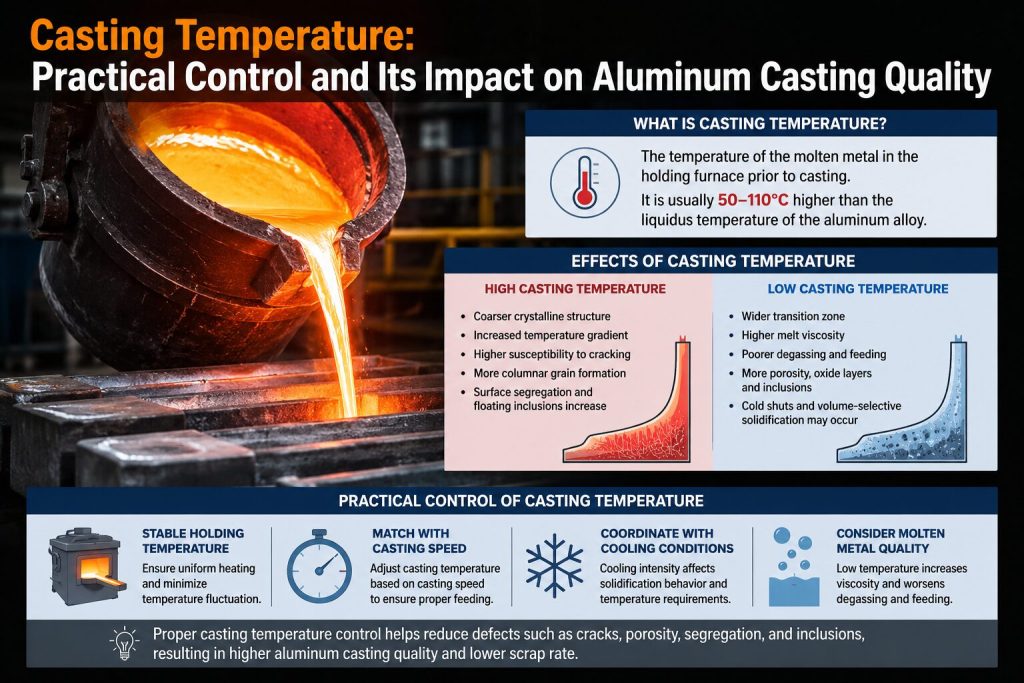
What Is Casting Temperature?
Casting temperature typically refers to the temperature of molten metal in the holding furnace before pouring or casting.
For aluminum alloys, the casting temperature is generally controlled within a range above the liquidus temperature. This range must be carefully selected based on alloy characteristics, casting method, and cooling conditions.
Mechanism: How Casting Temperature Influences Structure and Defects
The following content explains the relationship between casting temperature, microstructure, and defects.
The casting temperature typically refers to the temperature of the molten metal in the holding furnace prior to casting.
The temperature of the molten metal in the holding furnace is usually 50–110°C higher than the liquidus temperature of the aluminum alloy.
In general, a higher casting temperature results in a coarser crystalline structure, an increased temperature gradient across the solidification cross-section of the ingot, and a higher susceptibility to cracking, making the ingot more prone to cracking.
For alloys with a high tendency to form intermetallic compounds, the casting temperature should be appropriately increased; for flat ingots of the 7A04 (LC4) alloy, which has a very high susceptibility to cracking, the casting temperature may be appropriately reduced.
Increasing the casting temperature deepens the liquid pool.
In practice, for every 30°C increase in casting temperature, although the average temperature within the liquid pool rises by only 1–2°C, the impact on the ingot microstructure and defects is significant.
This increases the tendency for columnar grain formation, typically leading to more cracked scrap and exacerbating the degree of surface segregation and floating inclusions in the ingot.
Lowering the casting temperature, under the same cooling conditions, reduces the temperature gradient across the solidification front of the ingot, widening the transition zone (two-phase region); it increases melt viscosity, worsens degassing and feeding conditions, and leads to an increase in defects such as porosity, oxide layers, and inclusions.
Excessively low casting temperatures promote the formation of cold shuts on the ingot surface and increase their depth.
They may also lead to volume-selective solidification, resulting in significant microstructural heterogeneity and reduced mechanical properties.
Practical Understanding of Casting Temperature in Production
In real production environments, casting temperature must be evaluated together with process conditions rather than treated as an independent variable.
Several practical observations:
- When casting temperature is too high, the liquid pool becomes deeper, solidification is delayed, and columnar grains develop more easily. This often leads to cracking and segregation problems.
- When casting temperature is too low, melt fluidity decreases, feeding becomes insufficient, and defects such as porosity and inclusions increase.
- Small changes in casting temperature can produce disproportionately large changes in defect formation, especially in alloys with narrow solidification ranges.
This is why stable and consistent casting temperature control is more important than simply targeting a specific value.
Casting Temperature vs. Defect Formation
| Casting Temperature Condition | Structural Characteristics | Typical Defects | Process Impact |
|---|---|---|---|
| High casting temperature | Coarse grains, strong columnar growth | Cracks, segregation, inclusions | Increased scrap rate |
| Proper casting temperature | Balanced grain structure | Minimal defects | Stable production |
| Low casting temperature | Wider solidification zone | Porosity, inclusions | Reduced density |
| Excessively low casting temperature | Poor fluidity, unstable solidification | Cold shuts, oxide layers | Severe quality issues |
Key Factors in Casting Temperature Control
1. Stability of the Holding Stage
Fluctuation in holding furnace temperature directly leads to instability in casting temperature. Even small variations can result in inconsistent microstructure and defect distribution.
2. Coordination with Casting Speed
Casting temperature must be matched with casting speed:
- Higher speed requires relatively higher temperature to maintain feeding
- Lower speed requires reduced temperature to avoid overheating and segregation
Mismatch between these parameters often leads to internal defects.
3. Interaction with Cooling Conditions
Cooling intensity determines how casting temperature translates into solidification behavior:
- Strong cooling can offset slightly higher casting temperatures
- Weak cooling requires tighter control to avoid coarse structures
4. Influence on Melt Quality
At lower casting temperature:
- Melt viscosity increases
- Degassing efficiency decreases
- Inclusion removal becomes more difficult
This directly increases the risk of internal defects.
FAQ: Casting Temperature
What is the typical casting temperature range for aluminum alloys?
In most cases, casting temperature is controlled at 50–110°C above the liquidus temperature, depending on alloy type and casting conditions.
Why does high casting temperature increase cracking risk?
Because it increases thermal gradients and promotes columnar grain growth, which raises internal stress during solidification.
Can lowering casting temperature eliminate defects?
No. Lowering casting temperature may reduce cracking, but it increases the risk of porosity, inclusions, and cold shuts.
What is the most important aspect of casting temperature control?
Stability. Maintaining a consistent casting temperature is more critical than pursuing an exact numerical value.
Contact Us
If you are experiencing quality issues related to casting temperature, such as cracking, porosity, or segregation, it is important to evaluate both your process parameters and equipment stability.
We provide:
- Reliable induction melting furnace solutions
- Stable holding furnace systems for precise temperature control
- Technical support based on real production conditions
- Global service and spare parts support
Contact us to discuss your casting process. We can help you identify temperature-related issues and provide practical, production-oriented solutions.