
In metal processing, the real question is not “how to heat metal,” but:
how to heat it fast enough, uniformly enough, and at a cost that makes sense long-term.
This is exactly where an induction heating furnace becomes relevant.
In practice, companies usually start considering induction heating when they face one or more of these problems:
- Gas consumption is too high and unstable
- Heating time is slowing down production
- Oxidation loss is affecting product quality
- Temperature control is inconsistent between batches
If you are dealing with any of these, then induction heating is not just an alternative — it is often a more controllable and predictable solution.
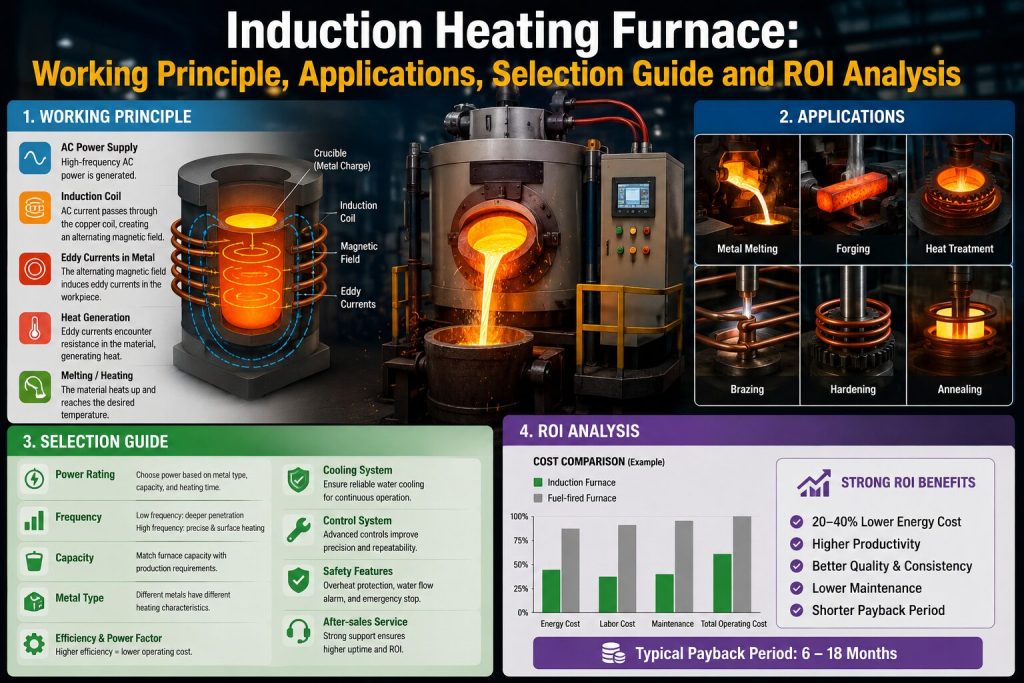
What Is an Induction Heating Furnace?
An induction heating furnace is not simply a “different heating method.” It changes how heat is generated.
Instead of heating from the outside (like gas or resistance furnaces), it generates heat directly inside the metal.
In real production, this leads to three practical differences:
- Heating speed is significantly faster
- Temperature distribution is more uniform
- Surface oxidation is noticeably lower
This is why induction heating is widely adopted in processes where temperature consistency directly affects product quality, such as forging and heat treatment.
How Does an Induction Heating Furnace Work?
The physics itself is simple, but what matters is how it performs in real production.
Q=I2Rt
Instead of focusing only on the formula, what you should care about is this:
Heating efficiency depends on how effectively current is induced inside the material.
In practical terms:
- Larger cross-section materials → require lower frequency
- Smaller precision parts → require higher frequency
- Poor matching → leads to energy waste and uneven heating
What this means for you:
If your current heating process shows:
- uneven temperature distribution
- slow core heating
- excessive surface burning
then the issue is often not “power shortage,” but frequency mismatch or poor system design.
Main Types of Induction Heating Furnaces (From a Practical Perspective)
Instead of just listing types, it’s more useful to understand where each one actually fits:
| Furnace Type | Where It Is Actually Used | When It Makes Sense |
|---|---|---|
| Induction Melting Furnace | Foundries, steel casting | When you need controlled composition and fast melting |
| Billet Heating Furnace | Forging plants | When production is continuous and rhythm matters |
| Heat Treatment Furnace | Automotive, parts manufacturing | When temperature precision affects product performance |
| Brazing Furnace | HVAC, electrical parts | When joint quality must be consistent |
Who Should Really Use an Induction Heating Furnace?
Not every factory needs it — and saying otherwise is just sales talk.
Suitable for:
1. Medium to Large Production Workshops
If your production is:
- Continuous or semi-continuous
- Above ~3–5 tons per day
- Sensitive to cycle time
Then induction heating usually becomes more cost-effective over time.
2. Quality-Sensitive Manufacturing
Especially:
- Automotive parts
- Alloy steel components
- Precision forging
Because:
Even small temperature fluctuations can lead to defects or rework.
3. Companies Under Energy or Environmental Pressure
If you are dealing with:
- Rising gas costs
- Emission restrictions
- Workshop environment issues
Induction heating becomes a strategic upgrade, not just a technical change.
Not Ideal for:
Let’s be honest — it’s not always the right choice.
Induction heating may NOT be suitable if:
- Production is very small and irregular
- Electricity supply is unstable
- Initial investment budget is extremely limited
In these cases, traditional furnaces may still be more practical.
How to Choose the Right Induction Heating Furnace
Most problems we see in projects are not equipment issues — they are wrong configuration choices.
1. Match Frequency to Material Size
| Workpiece Type | Recommended Frequency |
|---|---|
| Large steel billets | Medium frequency |
| Small bars / rods | Higher frequency |
| Precision components | High frequency |
Wrong frequency =
- low efficiency
- uneven heating
- higher electricity cost
2. Match Capacity to Real Production (Not Maximum)
Many buyers overestimate capacity.
Practical rule:
| Actual Production | Recommended Configuration |
|---|---|
| ≤1 ton/day | Small system |
| 1–5 tons/day | Medium system |
| ≥5 tons/day | Continuous system |
Oversized equipment leads to:
- unnecessary energy consumption
- higher initial investment
- lower utilization rate
3. Understand Your Heating Goal
Ask yourself one question:
“Am I heating for melting, forming, or treatment?”
Because each requires a different system.
Energy Consumption: What You Actually Pay
Instead of theoretical efficiency, here’s what matters:
In real steel heating applications:
- Induction systems typically consume 500–650 kWh per ton
- Gas systems often reach 800–1000 kWh equivalent per ton
That gap is where your long-term savings come from.
ROI Analysis (Realistic Scenario)
Let’s break it down the way most factory owners actually think:
Example Case
| Parameter | Value |
|---|---|
| Daily production | 10 tons |
| Energy saving | ~200 kWh/ton |
| Electricity cost | $0.1/kWh |
| Daily saving | ~$200 |
| Annual saving | ~$70,000 |
What this means:
If your system costs $80,000–$150,000:
Payback period ≈ 1.5–3 years
But note:
ROI depends heavily on:
- production stability
- electricity price
- equipment utilization
Idle equipment = no return
Advantages (From a Production Perspective)
Faster Heating → Higher Throughput
Shorter cycles directly increase daily output.
Lower Oxidation → Better Yield
Especially important in high-temperature steel processing.
Stable Temperature → Less Rework
Reduces defect rate in forging and heat treatment.
Cleaner Operation → Easier Compliance
No open flame, fewer emissions, better working conditions.
FAQ
Is induction heating always more economical?
Not always. It depends on production volume and utilization rate. For continuous production, it is usually more cost-effective.
What is the biggest mistake when buying an induction furnace?
Choosing capacity based on “future expansion” instead of current production needs.
How do I know if induction heating fits my factory?
Check three things:
- daily production
- heating consistency requirements
- current energy cost
If all three are significant, induction is worth considering.
How long before I see ROI?
Typically between 1.5–3 years in stable production conditions.
Looking for a Practical Recommendation?
Choosing an induction heating furnace is not just about equipment — it is about matching the system to your actual production.
What we usually do for clients is simple:
- Analyze production process
- Estimate energy consumption
- Recommend configuration based on real usage (not theoretical maximum)
If you are planning to upgrade or invest in a new heating system, it’s worth getting a configuration that actually fits your operation.
You can reach out with:
- material type
- daily output
- heating purpose
And we can give you a practical, not overconfigured recommendation.