
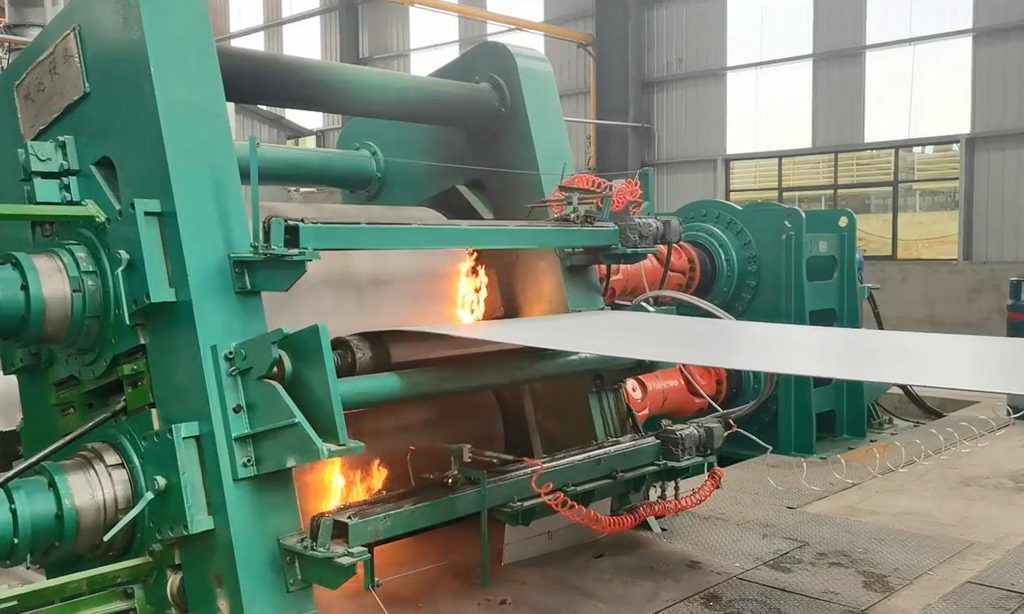
Cold rolling is an important stage in aluminum sheet and foil production. It reduces the thickness of hot-rolled aluminum coil while improving thickness control, surface finish, and, depending on the alloy and temper, mechanical properties. Unlike hot rolling, cold rolling is performed below the metal's recrystallization temperature, often starting with material at or near room temperature. However, the strip can heat up during rolling because of deformation and friction, so cooling and lubrication are essential.
Understanding the cold rolling mill process helps manufacturers select the right rolling equipment and build a suitable aluminum sheet production line. This guide explains the main cold rolling steps, how a cold rolling mill works, the difference between cold and hot rolling, key equipment, and common production problems.
What Is Cold Rolling?
Cold rolling is a metal forming process in which a strip passes between rotating rolls to reduce its thickness at a temperature below its recrystallization temperature. The rolls apply compressive force to the material, making it thinner and longer while controlling its final dimensions.
For aluminum, cold rolling is commonly used after hot rolling to produce thinner sheet, strip, and foil stock. The process can improve surface finish and dimensional control, while cold deformation can increase strength in alloys that respond to work hardening. The final thickness is not defined by one universal range; it depends on the alloy, product specification, mill configuration, and number of rolling passes.
Main Steps of Cold Rolling Process
The cold rolling process normally includes the following stages:
1. Raw Material Preparation
The starting material is generally hot-rolled aluminum coil or another suitable semi-finished strip. Before rolling, the coil is inspected for thickness, width, surface condition, and other production requirements.
2. Pickling or Surface Cleaning
Surface cleaning may be used when required by the material and production route. Its purpose is to remove surface contaminants or oxides that could affect subsequent rolling and surface quality. The exact cleaning method depends on the alloy and mill process.
3. Rolling
The strip enters the cold rolling mill and passes through the roll gap. Rolling force reduces the gauge progressively, while roll gap, rolling force, strip tension, speed, and lubrication are controlled to achieve the required thickness and flatness.
4. Annealing
Cold deformation increases work hardening and can reduce ductility. Where the required product temper or further reduction calls for it, the coil can be annealed to soften the material and restore workability before additional rolling or finishing. Annealing is therefore process-dependent rather than mandatory after every cold-rolling operation.
5. Finishing
After the required gauge is achieved, the material may be trimmed, straightened, inspected, and recoiled. Final processing depends on the customer's required width, surface condition, flatness, temper, and packaging specification.
How Does a Cold Rolling Mill Work?
A cold rolling mill reduces strip thickness by passing the material through a controlled roll gap. The main components include work rolls, which directly contact the aluminum strip, and backup rolls, which support the work rolls and help control their deflection.
The roll-gap adjustment determines the reduction in thickness, while the tension system keeps the strip stable as it enters and leaves the roll bite. An online thickness measurement system monitors the strip gauge and allows the mill control system to maintain the target thickness. Roll bending can also be used to influence strip shape and flatness.
In operation, the coil is loaded onto an uncoiler and fed continuously into the mill. The strip passes through the rolls, where its thickness is reduced, and then travels to the recoiler. Depending on the required reduction, the material may pass through a single-stand mill several times or through multiple stands in a continuous arrangement. The Aluminum Association notes that aluminum sheet may be cold rolled in several passes through a single-stand mill or in one pass through a multiple-stand mill.
For aluminum sheet production, an Aluminum Sheet Cold Rolling Machine can be selected according to strip width, target gauge, reduction requirements, production speed, and required product quality.
Cold Rolling vs Hot Rolling
Cold rolling and hot rolling perform different roles in aluminum production. Hot rolling is normally used for major thickness reduction, while cold rolling provides further gauge reduction and helps achieve the required surface, dimensional, and temper characteristics.
| Comparison | Cold Rolling | Hot Rolling |
|---|---|---|
| Temperature | Below recrystallization temperature | Elevated temperature |
| Thickness | Used for thinner gauges | Used for initial and major reduction |
| Surface | Generally smoother and more controlled | More affected by high-temperature processing |
| Accuracy | Higher dimensional control | Generally lower than cold rolling |
| Strength | Cold working can increase strength | Less work hardening during hot deformation |
| Subsequent processing | May require annealing or finishing | May proceed to cold rolling or other processing |
The exact thickness range achievable by either process depends on alloy, mill design, rolling schedule, and product specification rather than a fixed universal limit.
Benefits of Cold Rolling Aluminum
Cold rolling provides several important advantages for aluminum sheet production.
1. Better Surface Quality
Controlled rolling conditions can produce a smoother, more consistent surface finish. The process also avoids the high-temperature oxidation associated with hot rolling, although the incoming hot-rolled material may already have surface oxide or other defects.
2. High Dimensional Accuracy
Controlled roll gaps, tension, and online gauge measurement allow the mill to maintain consistent strip thickness and dimensional tolerances.
3. Higher Strength and Hardness
Cold working increases dislocation density in suitable aluminum alloys, which can increase strength and hardness. The Aluminum Association specifically identifies cold working as a strengthening mechanism for non-heat-treatable aluminum alloys.
4. Suitable for Thin Products
Cold rolling allows aluminum to be reduced to much thinner gauges than those typically produced after hot rolling. It is an important part of the production route for thin sheet and aluminum foil stock.
These properties make cold-rolled aluminum suitable for applications including packaging, transportation, construction, appliances, and other products requiring controlled thickness and surface quality.
Key Equipment in Cold Rolling
A complete cold rolling line may include the following equipment:
- Cold rolling mill: Reduces strip thickness and controls the final gauge.
- Uncoiler and recoiler: Feed the incoming coil and wind the finished strip.
- Tension control system: Maintains stable strip tension during rolling.
- Thickness measurement and control system: Measures strip gauge and helps maintain thickness accuracy.
- Roll bending system: Helps control strip profile and flatness.
- Emulsion cooling and lubrication system: Removes rolling heat and reduces friction between the rolls and strip.
Cooling and lubrication are particularly important in aluminum cold rolling because rolling pressure and friction can raise strip temperature significantly during operation.
For a complete aluminum production line, annealing equipment can be integrated with the rolling process when the required alloy temper and processing schedule call for intermediate or final annealing.
Common Problems in Cold Rolling
1. Poor Strip Shape
Waves, buckles, or other flatness defects can result from uneven deformation or inappropriate rolling conditions. Roll bending, tension, and other mill settings can be adjusted to improve strip shape.
2. Thickness Deviation
Thickness variation may be caused by unstable roll gap, changing rolling force, tension fluctuations, or inaccurate gauge measurement. The thickness-control system and mechanical settings should be checked.
3. Surface Scratches
Scratches and surface marks can result from damaged or contaminated rolls, foreign particles, or unsuitable lubrication conditions. Roll surfaces and the cooling and lubrication system should be inspected.
Conclusion
The cold rolling mill process is an important stage in producing thin aluminum sheet and foil stock. By controlling rolling force, roll gap, tension, speed, and lubrication, a cold rolling mill can achieve the required thickness, surface quality, flatness, and material properties. The right combination of rolling, annealing, and finishing equipment is essential for a reliable aluminum sheet production line.
Looking for a cold rolling mill for aluminum sheet? We provide aluminum sheet cold rolling mills, annealing furnaces, and melting and casting equipment for complete aluminum sheet production lines.
Contact our engineer for a FREE line configuration and quote →
FAQ
What is cold rolling process?
Cold rolling reduces metal thickness by passing the material between rotating rolls below its recrystallization temperature.
What is the difference between cold rolling and hot rolling?
Cold rolling is performed below the recrystallization temperature and is mainly used for thinner, more accurately controlled products. Hot rolling uses elevated temperatures for major thickness reduction.
What are the advantages of cold rolling?
The main advantages include better dimensional control, improved surface finish, thinner gauges, and increased strength from cold working in suitable alloys.
What equipment is used in cold rolling?
Typical equipment includes a cold rolling mill, uncoiler, recoiler, tension system, thickness gauge, roll bending system, and cooling and lubrication system.