
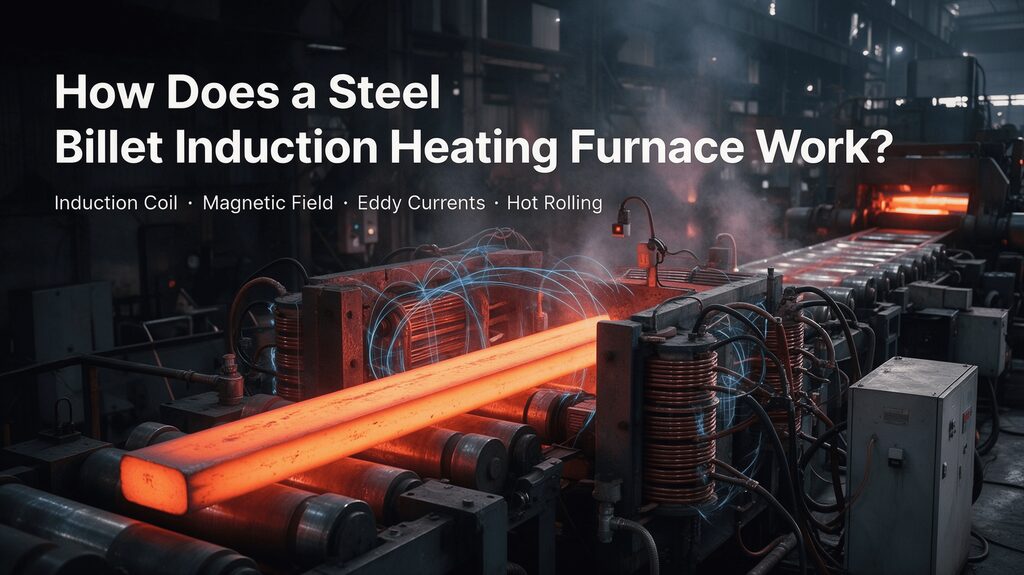
A steel billet induction heating furnace heats steel billets before hot rolling, forging, or other high-temperature forming processes by using electromagnetic induction. Unlike a conventional furnace that transfers heat from combustion gases to the billet surface, induction heating generates heat directly inside the steel through induced electrical currents.
The billet heating principle is based on three basic steps: an alternating current passes through an induction coil, the resulting magnetic field induces eddy currents inside the billet, and the electrical resistance of the steel converts those currents into heat. The heating depth and temperature distribution are affected by operating frequency, billet size, steel grade, power, and coil design.
This guide explains how an induction billet heating furnace works, how eddy current heating generates heat, how billets are heated in actual production, how frequency and power are selected, and how induction heating compares with gas reheating furnaces.
What Is a Steel Billet Induction Heating Furnace?
A steel billet induction heating furnace is an industrial heating system used to raise the temperature of steel billets to the required level before hot rolling, forging, or other forming processes.
In a typical steel production line, the heating stage is positioned between billet production and hot forming:
Continuous casting → Billet handling → Induction heating → Rolling or forging
The main difference between induction heating and a conventional gas-fired reheating furnace is the way heat is generated.
A gas furnace heats the billet mainly from the outside inward. Combustion produces hot gases that transfer heat to the billet surface, and the heat then conducts toward the billet core.
An induction furnace works differently. An alternating electromagnetic field is generated by a copper induction coil. When the steel billet enters this magnetic field, electrical currents are induced inside the billet. The electrical resistance of the steel converts these currents into heat.
Because the heat is generated directly within the billet, induction heating can provide a fast response, precise power adjustment, and a compact heating section.
For continuous production lines, multiple induction heating zones can also be arranged in sequence. This allows heating power and billet speed to be controlled according to the required temperature profile and production rate.
How Does Induction Heating Generate Heat in a Steel Billet?
The billet heating principle can be understood through electromagnetic induction, eddy current heating, and resistance heating.
1. Alternating current creates a magnetic field
The induction power supply delivers alternating current to the copper induction coil surrounding the billet.
Because the current changes direction continuously, it creates an alternating magnetic field around the coil. The magnetic field also changes continuously with the electrical current.
The frequency of this alternating current is an important operating parameter because it affects how deeply the induced current penetrates into the billet.
2. The changing magnetic field induces electrical currents
When a conductive steel billet enters the changing magnetic field, electromagnetic induction causes electrical currents to form inside the billet.
These circulating currents are called eddy currents.
The billet therefore acts as part of the electrical heating system. No physical electrical connection between the coil and billet is required.
The induced currents are distributed throughout the billet, but their concentration is affected by frequency and the electrical and magnetic properties of the steel.
This is the basis of eddy current heating in an induction billet heating system.
3. Electrical resistance converts current into heat
Steel has electrical resistance. When the induced current flows through the billet, electrical energy is converted into thermal energy.
The basic relationship is:
P = I²R
where:
- P is the power converted into heat
- I is the induced electrical current
- R is the electrical resistance
This means the billet itself becomes the heating body.
The amount and distribution of heat depend on the induced current, electrical resistance, operating frequency, magnetic properties, billet geometry, and heating time.
Understanding the skin effect
The skin effect is particularly important when selecting the operating frequency.
At higher frequencies, induced currents tend to concentrate closer to the billet surface. This results in a relatively shallow penetration depth and stronger surface heating.
At lower frequencies, the induced current penetrates more deeply into the billet, which is generally more suitable for larger cross-sections where heat needs to be distributed deeper into the material.
In simplified terms:
Higher frequency → shallower penetration → stronger surface concentration
Lower frequency → deeper penetration → deeper heating
This does not mean that higher frequency is always better. A frequency that works well for a small billet may not provide the desired heating distribution in a much larger billet.
The final frequency must therefore be matched with billet dimensions, steel grade, target temperature, required heating rate, production capacity, and induction coil design.
What happens at the Curie point?
The magnetic properties of steel also affect induction heating.
For pure iron, the Curie temperature is approximately 770°C. Alloy composition can change the exact magnetic transition temperature in practical steels.
Below the Curie temperature, magnetic hysteresis can contribute to induction heating. As the steel approaches and passes through the Curie region, it loses its ferromagnetic behavior and hysteresis heating decreases significantly.
Above the Curie point, heating continues mainly through eddy current heating and electrical resistance losses.
This change in magnetic behavior is one reason why the electrical characteristics of a steel billet are not constant throughout the heating process. A properly designed induction system takes these temperature-dependent characteristics into account.
How an Induction Billet Heater Works in Production: Step by Step
An induction billet heater normally operates as part of an integrated production line that includes billet handling, heating, temperature measurement, and downstream rolling equipment.
Step 1: Billet loading
Billets are transferred from storage, continuous casting, or another upstream process to the induction heating line.
The loading system positions the billets correctly and maintains a controlled feeding sequence.
Step 2: Billet enters the induction coil
The billet moves through the induction coil while the power supply provides the required alternating current.
The changing magnetic field induces electrical currents inside the billet, causing the billet temperature to increase.
Step 3: Billet passes through heating zones
Longer heating systems can use multiple induction coils or heating zones.
Different zones can receive different levels of electrical power to control the heating profile. This is particularly useful when the billet needs to reach a high discharge temperature while maintaining acceptable temperature uniformity between the surface and core.
Step 4: Temperature is measured
Infrared temperature measurement can monitor the billet temperature without physical contact.
The measured temperature can be integrated with a PLC control system to adjust heating power, billet speed, or zone operation according to production requirements.
Step 5: Heated billet enters the rolling line
Once the billet reaches the required process temperature, it is transferred to the rolling mill or forging equipment.
Hot charging can significantly change the heating requirement because the billet already contains substantial thermal energy.
Based on operating data from our production applications, continuously cast billets can enter the heating process with a surface temperature of approximately 750–850°C and a core temperature of approximately 950–1000°C. Under suitable production conditions, around one-third of billets may not require reheating.
These figures are application-specific operating data, not universal values. Actual billet temperatures and the proportion of billets requiring reheating depend on the continuous casting process, transfer time, billet dimensions, steel grade, production schedule, and line configuration.
Key Components of Steel Billet Induction Heating Equipment
A complete steel billet induction heating equipment system consists of several components working together to generate, control, and remove heat.
Medium-frequency power supply
The induction power supply converts the plant's electrical power into the required output frequency and power for the heating coils.
The inverter section controls the electrical energy delivered to the induction system and allows heating power to be adjusted according to production requirements.
Water-cooled copper induction coil
The induction coil creates the alternating magnetic field used to heat the billet.
Copper is commonly used because of its high electrical conductivity. Cooling water circulates through the coil to remove heat generated during operation and maintain reliable continuous performance.
The coil geometry is designed according to billet dimensions, required heating characteristics, frequency, and production conditions.
Billet loading and conveying system
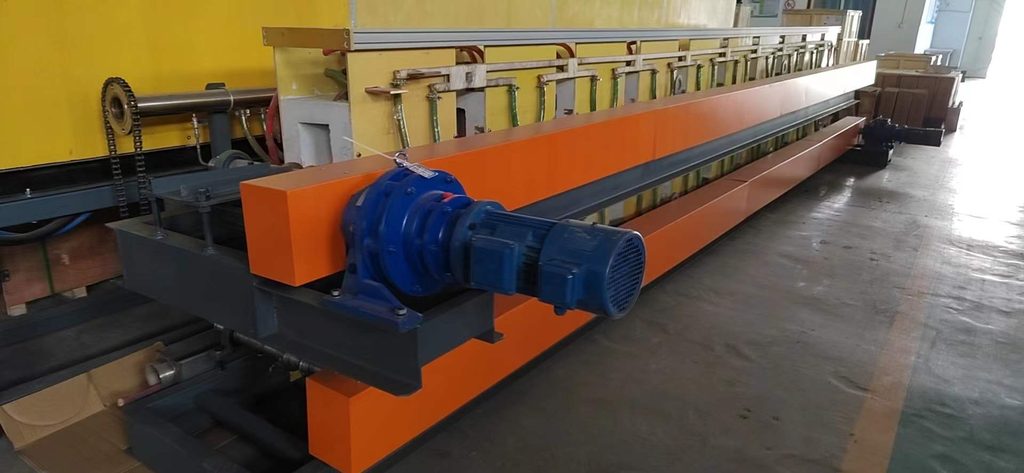
The loading and conveying mechanism moves billets through the induction heating section at a controlled speed.
Stable billet positioning and movement are important because heating time is directly related to the billet's residence time inside the induction coils.
Infrared temperature measurement and PLC control
Infrared temperature sensors provide non-contact billet temperature measurements.
The PLC control system can coordinate temperature feedback, heating power, billet movement, heating zones, and other production parameters.
Cooling system
The power supply, induction coils, and other components require reliable cooling during operation.
Cooling-water temperature, flow rate, pressure, and water quality should be monitored to prevent overheating and maintain equipment reliability.
Frequency, Power and Penetration Depth: Matching the System to Your Billet
Frequency plays an important role in determining how electromagnetic energy is distributed within a steel billet.
The correct frequency depends heavily on billet cross-section. Smaller billets generally allow the use of relatively higher frequencies, while larger cross-sections often require lower frequencies to achieve deeper penetration.
| Billet condition | General frequency tendency | Typical heating characteristic |
|---|---|---|
| Small cross-section | Relatively higher frequency | More concentrated near the surface |
| Medium cross-section | Medium frequency | Balanced heating distribution |
| Large cross-section | Relatively lower frequency | Deeper electromagnetic penetration |
| High production rate | Adequate power is required | Faster heating at higher throughput |
| High target temperature | Sufficient power and heating time required | Controlled heating profile |
Note: This table is a general engineering reference. Actual frequency selection depends on billet dimensions, steel grade, target temperature, heating rate, production capacity, coil design, and equipment configuration. Final parameters should be determined by the equipment manufacturer.
Power selection is equally important.
A system producing a higher number of tons per hour generally requires more heating power because more thermal energy must be transferred to the billets within a given period.
However, increasing power alone is not a solution to every heating problem. Excessive power density can increase surface temperature too quickly and create an undesirable temperature difference between the billet surface and core.
The system should therefore be designed around the complete production requirement:
- Billet cross-section
- Billet length and weight
- Steel grade
- Initial billet temperature
- Target discharge temperature
- Required heating rate
- Production capacity in tons per hour
- Operating frequency
- Coil configuration
- Available electrical capacity
What Temperature Do Billets Need Before Rolling?
Steel billets entering a hot rolling process are commonly heated to approximately 1100–1250°C.
This is a general reference range rather than a universal specification. The required temperature depends on steel grade, billet dimensions, rolling schedule, final product, deformation conditions, and rolling mill configuration.
More importantly, the billet should reach the required process temperature with adequate temperature uniformity.
If the surface becomes significantly hotter than the core, the billet may have an unsuitable temperature profile when it enters the rolling mill. Excessive surface temperature can also increase oxidation and scale formation.
On the other hand, a billet that is too cold can increase rolling loads and affect deformation behavior and product quality.
Therefore, induction heating should be designed around three related targets:
Required discharge temperature + temperature uniformity + production throughput
The exact values should be established from the requirements of the downstream rolling process and steel grade.
Induction Billet Heating vs Gas Reheating Furnaces
Both induction heating and gas-fired reheating furnaces can be used for steel billet heating, but they generate and transfer heat in different ways.
| Factor | Induction Billet Heating | Gas Reheating Furnace |
|---|---|---|
| Start-up | No long furnace preheating; can begin heating when powered | Requires furnace preheating |
| Heating method | Electromagnetic induction | Combustion and heat transfer |
| Temperature adjustment | Rapid electrical power adjustment | Burner and furnace-zone adjustment |
| Heating response | Fast response | Relatively slower thermal response |
| Oxidation exposure | Shorter high-temperature exposure can reduce scale formation | Longer exposure to high-temperature furnace atmosphere |
| Equipment footprint | Compact heating section | Generally larger furnace structure |
| Production adjustment | Billet speed and heating power can be adjusted quickly | Furnace operating conditions need to be adjusted |
| Automation | Suitable for PLC and temperature-feedback control | Also suitable for automated control |
One major practical difference is start-up.
An induction system does not require a large furnace chamber to be heated to operating temperature before the billets can begin receiving electromagnetic heating. This allows the system to respond quickly to production changes.
Induction heating also allows the heating power, billet speed, and heating zones to be adjusted according to production requirements.
Because the billet can be heated rapidly, its exposure time at elevated temperature can be reduced. This can help limit oxidation and scale formation compared with processes involving prolonged high-temperature exposure.
Induction equipment can also occupy less floor space than a large conventional reheating furnace, making it attractive where plant layout is an important consideration.
However, induction is not automatically the best solution for every application. The decision should consider billet size, production capacity, available electrical power, fuel infrastructure, plant layout, and the required heating process.
Common Problems and How to Avoid Them
Uneven billet heating
Uneven heating may occur when the selected frequency, power density, billet speed, or coil configuration does not match the billet cross-section.
For example, excessive surface heating can occur when the electromagnetic penetration is too shallow for the billet size.
Possible solutions include adjusting operating frequency, reducing or redistributing heating power, changing billet conveying speed, or optimizing the coil configuration.
Excessive oxidation and scale
Scale formation increases when steel remains at high temperature for an extended period.
Correct control of target temperature and heating time is therefore important.
Induction heating can reduce the time required to bring the billet to the required temperature, but it should still be operated with an appropriate heating profile rather than simply maximizing power.
Induction coil overheating or short service life
The induction coil operates under high electrical and thermal loads. Insufficient cooling-water flow, high cooling-water temperature, poor water quality, or improper maintenance can affect coil service life.
Cooling-water flow and temperature should be monitored during operation.
The induction coil should also be designed according to the actual billet dimensions and heating requirements. Since billet sizes and production conditions vary, the inductor can be customized according to the application, helping achieve the required heating pattern while keeping maintenance requirements manageable.
How to Choose a Steel Billet Induction Heating Furnace
Selecting an induction billet heating furnace should begin with the actual production requirements rather than simply choosing a furnace based on rated power.
1. Confirm billet dimensions
Provide the billet cross-section, length, and weight.
These parameters affect induction frequency, coil dimensions, heating time, conveying equipment, and required power.
2. Determine the incoming billet temperature
This is particularly important for billets coming directly from continuous casting.
If hot charging is available, the induction system should be designed around the actual incoming billet temperature rather than assuming the billets are cold.
3. Define the target discharge temperature
Specify the required temperature before rolling or forging.
The steel grade and downstream process should be considered when determining the target temperature and acceptable temperature variation.
4. Determine production capacity
Production capacity is normally expressed in tons per hour.
The required throughput affects the heating power, coil length, billet conveying speed, number of heating zones, and overall system configuration.
5. Check available electrical capacity
The plant's transformer and electrical infrastructure must be able to support the required induction power.
Electrical capacity should be evaluated before finalizing the power supply configuration.
6. Define automation requirements
For an automated rolling line, consider billet tracking, infrared temperature measurement, PLC control, automatic power regulation, multi-zone heating, and integration with upstream and downstream equipment.
7. Evaluate the complete heating system
The power supply is only one part of the system.
A complete solution may include:
- Induction power supply
- Water-cooled copper coils
- Billet loading equipment
- Billet conveying system
- Temperature measurement
- PLC control system
- Cooling system
- Electrical control cabinet
For plants looking for a compact and controllable heating solution, our induction billet heating furnace can be configured according to billet dimensions, steel grade, initial temperature, target temperature, and production capacity.
Frequently Asked Questions
1. How does an induction billet heater work?
An induction billet heater uses an alternating current in an induction coil to create a changing magnetic field. This magnetic field induces eddy currents inside the steel billet. The billet's electrical resistance converts the induced current into heat, raising the billet temperature without direct contact between the coil and steel.
2. What is eddy current heating?
Eddy current heating occurs when a changing magnetic field induces circulating electrical currents inside a conductive material. Because the material has electrical resistance, the induced currents generate heat according to the resistance-heating relationship P = I²R. Above the Curie point, eddy current heating is the main induction heating mechanism in steel.
3. What temperature do steel billets need before rolling?
Steel billets for hot rolling are commonly heated to approximately 1100–1250°C, but the exact target depends on the steel grade, billet dimensions, rolling process, and mill configuration. Temperature uniformity between the surface and core is also important.
4. How much electricity does an induction billet heating furnace use?
Electricity consumption depends on the billet weight, incoming temperature, target temperature, production rate, steel grade, heating time, and system configuration. There is therefore no single electricity-consumption value that applies to every induction billet heating furnace.
For a detailed discussion of the factors affecting electricity consumption, see our [Induction Furnace Power Consumption] guide.
5. Is induction heating better than gas reheating?
Neither technology is universally better.
Induction heating offers rapid response, precise electrical control, compact equipment, and shorter high-temperature exposure. Gas reheating can be suitable for applications where conventional furnace infrastructure and fuel systems are already established.
The better option depends on billet dimensions, production capacity, available electrical power, fuel availability, plant layout, and process requirements.
6. Can one induction billet heater handle different billet sizes?
Yes. An induction heating system can be designed to handle different billet sizes within a specified range. However, billet cross-section affects the required frequency, coil configuration, power distribution, and heating time.
If multiple billet sizes will be processed, the size range should be provided during system design so that the induction configuration can accommodate the expected production requirements.
Conclusion
A steel billet induction heating furnace works by using electromagnetic induction to generate heat directly inside the steel billet. The process starts with alternating current in the induction coil, followed by electromagnetic induction and eddy current heating, with the billet's electrical resistance converting the induced current into thermal energy.
Frequency determines the general penetration behavior, while power, coil design, billet dimensions, steel grade, initial temperature, and production speed determine the actual heating performance.
For steel rolling applications, induction heating can provide rapid heating, precise control, compact equipment, and flexible integration with automated billet handling and temperature measurement systems.
The correct system should always be designed around the actual production conditions rather than a generic furnace specification.