
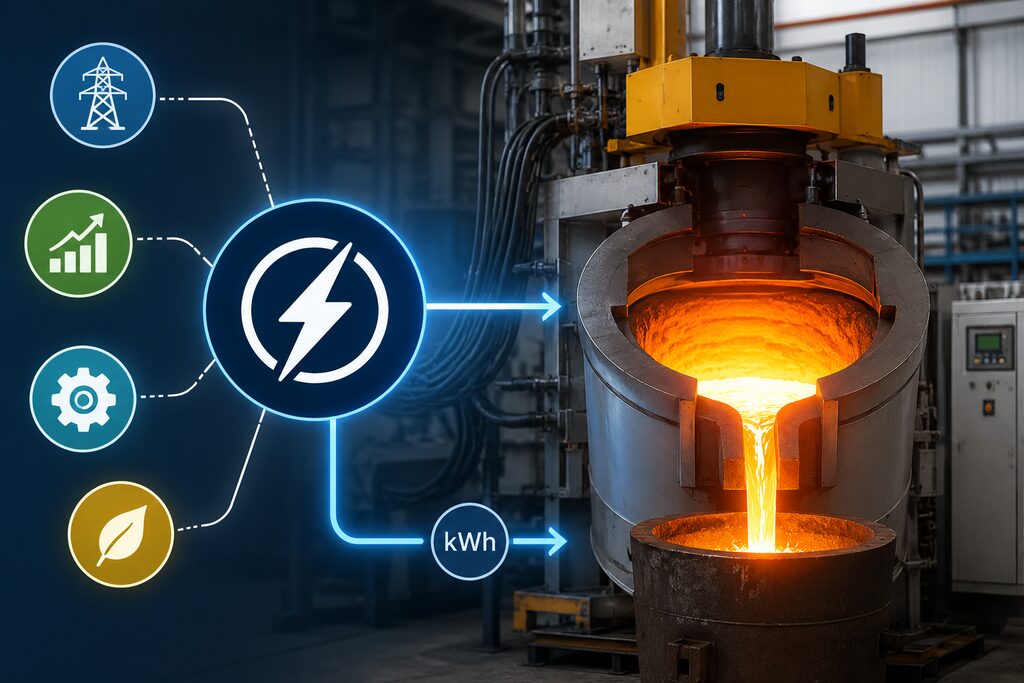
Induction furnace power consumption is an important consideration when planning metal melting production. The electricity used by an induction furnace depends on its rated power, furnace capacity, metal type, melting temperature, furnace efficiency, and operating time.
A simple way to estimate electricity consumption is:
Electricity Consumption (kWh) = Furnace Power (kW) × Operating Time (h)
However, actual energy consumption per ton of melted metal is more useful for production planning because an induction furnace does not operate at full power continuously.
What Is Induction Furnace Power Consumption?
Induction furnace power consumption refers to the electrical energy required to melt and, when necessary, hold a specific amount of metal at the required temperature.
For example, a furnace with a rated power of 500 kW operating continuously for one hour would theoretically consume:
500 kW × 1 hour = 500 kWh
In actual production, the energy required to melt one ton of metal can be affected by many factors. Therefore, rated furnace power should not be confused with actual electricity consumption per ton.
For industrial users, the more useful question is usually:
How many kWh of electricity are required to melt one ton of metal?
How to Calculate Induction Furnace Electricity Consumption
The basic calculation is straightforward:
Electricity Consumption = Power × Operating Time
For example, if an induction furnace operates at an average electrical input of 600 kW for 1.5 hours:
600 kW × 1.5 h = 900 kWh
This means the furnace consumes approximately 900 kWh during that operating period.
For production cost calculations, electricity consumption per ton can be estimated as:
Energy Consumption per Ton = Total Electricity Consumption ÷ Melted Metal Weight
If a furnace consumes 900 kWh while melting 1,500 kg of metal:
900 kWh ÷ 1.5 tons = 600 kWh/ton
This value provides a more useful reference for comparing production efficiency.
Actual results can vary depending on furnace design, material, operating conditions, and the efficiency of the complete electrical and melting system.
What Affects Induction Furnace Power Consumption?
1. Furnace Capacity
Furnace capacity affects both the required electrical power and melting time.
A furnace that is too small for the required production volume may need more frequent charging and longer operating hours. A furnace that is significantly oversized may also operate inefficiently if it is not loaded appropriately.
The right capacity should therefore be selected according to:
- Required output per hour
- Batch size
- Metal type
- Melting cycle
- Expected operating hours
Choosing the appropriate Induction Furnace capacity is an important step in controlling energy consumption.
2. Metal Type
Different metals require different amounts of energy because their melting points and thermal properties are different.
For example, melting aluminum generally requires less thermal energy than melting steel because aluminum has a much lower melting temperature.
Therefore, the same induction furnace can have different energy consumption when melting different metals.
3. Melting Temperature
The higher the required melting temperature, the more energy is generally needed.
The process does not only need to bring the metal to its melting point. Additional energy may be required to reach the desired pouring or processing temperature.
For this reason, production should avoid unnecessary overheating or prolonged holding at high temperatures.
4. Charge Material Temperature
The initial temperature of the metal charge also affects energy consumption.
Cold metal requires more energy than preheated material because the furnace must provide additional heat before melting begins.
Using properly prepared charge material and minimizing unnecessary heat loss can improve overall melting efficiency.
5. Melting Time
Longer melting times normally result in higher total electricity consumption.
However, melting time and energy consumption are not always directly proportional. A furnace operating inefficiently for a longer period can consume significantly more energy per ton than a properly matched system with a shorter melting cycle.
This is why Induction Melting Furnace performance should be evaluated based on both melting speed and energy consumption.
6. Furnace Efficiency
The efficiency of the complete induction melting system affects how much electrical energy is converted into useful heat in the metal.
Factors such as the induction coil, power supply, furnace lining, cooling system, and furnace design can influence overall efficiency.
A well-maintained system can reduce unnecessary energy losses during production.
7. Holding Time
After the metal has melted, keeping it at high temperature consumes additional energy.
If molten metal remains in the furnace for an extended period before pouring, electricity consumption per ton can increase.
Efficient production scheduling can reduce unnecessary holding time.
How to Reduce Induction Furnace Power Consumption
Reducing energy consumption is not simply a matter of lowering furnace power. The goal is to melt the required amount of metal as efficiently as possible.
Use the Right Furnace Capacity
Select furnace capacity according to actual production requirements.
An appropriately sized furnace can help maintain efficient loading, suitable melting cycles, and stable production.
Optimize Charging
Use properly prepared charge material and avoid excessive empty space in the furnace.
Efficient charging helps the furnace transfer energy to the metal more effectively and can reduce unnecessary melting time.
Reduce Heat Loss
Heat loss can increase when the furnace remains open for unnecessary periods or when the furnace lining and related components are not maintained properly.
Reducing unnecessary heat loss helps lower the energy required to maintain and melt the metal.
Minimize Holding Time
Once the metal reaches the required temperature, unnecessary holding should be avoided whenever the production process allows it.
Good coordination between melting and casting operations can reduce electricity consumption during holding.
Maintain the Furnace Lining
The furnace lining plays an important role in thermal insulation and safe operation.
A damaged or improperly maintained lining can increase heat loss and affect melting performance. Regular inspection and proper maintenance help maintain stable furnace operation.
Maintain the Power and Cooling Systems
The power supply and cooling system are important parts of an induction melting system.
Regular maintenance helps the equipment operate under stable conditions and reduces the risk of performance problems that can affect production efficiency.
Does a Higher-Power Induction Furnace Use More Electricity?
Not necessarily in terms of energy consumed per ton.
A higher-power furnace can consume more electricity per hour because its electrical input is higher. However, it can also melt metal faster and increase production output.
For example, a high-power furnace may consume more electricity during one hour of operation but require less time to melt the same production batch.
Therefore, kWh per ton is usually a more meaningful metric than simply looking at the furnace's rated power.
When comparing different furnaces, consider:
- Rated power
- Melting time
- Melting capacity
- Energy consumption per ton
- Metal type
- Production output
- Holding time
How to Improve Induction Furnace Energy Efficiency
A practical approach is to evaluate the complete melting process rather than focusing on the furnace power rating alone.
Production teams should monitor:
Electricity consumption → Melting time → Melted metal weight → kWh per ton
This makes it easier to identify energy losses and compare operating performance.
For example, if electricity consumption increases while production output remains unchanged, possible causes may include longer melting cycles, increased holding time, improper charging, heat loss, or equipment maintenance issues.
Regularly tracking energy consumption per ton can therefore provide useful information for production optimization.
How Much Electricity Does an Induction Furnace Use?
There is no single electricity consumption figure that applies to every induction furnace.
Actual consumption depends on:
- Furnace power
- Furnace capacity
- Metal type
- Charge temperature
- Target temperature
- Melting time
- Furnace efficiency
- Holding time
- Operating conditions
For this reason, manufacturers and buyers should evaluate actual energy consumption per ton rather than relying only on the rated power shown on the equipment specification.
Conclusion
Induction furnace power consumption depends on much more than the furnace's rated electrical power. Capacity, metal type, melting temperature, charge material, melting time, furnace efficiency, and holding time can all affect electricity consumption.
For production planning, the most useful measurement is usually kWh per ton of melted metal. Choosing the right furnace capacity, optimizing charging, reducing heat loss, minimizing holding time, and maintaining the furnace properly can help improve energy efficiency.
If you are selecting an induction furnace for a specific metal and production capacity, contact us with your required output, metal type, furnace capacity, and operating requirements. A suitable furnace configuration can then be selected according to your actual melting process.