
Introduction
Induction furnaces have become the mainstream equipment for aluminum melting and scrap aluminum recycling in modern foundries, thanks to their high thermal efficiency, uniform heating, and low energy consumption compared with traditional gas-fired and resistance furnaces. However, after cooperating with dozens of aluminum processing factories, we found that most low-yield and high-consumption problems are not caused by equipment quality, but by irregular daily operation.
Many workshop operators pursue fast melting speed blindly and ignore standardized operating procedures, resulting in shortened crucible service life, increased aluminum oxidation loss, frequent slag accumulation, unqualified casting quality, and even sudden equipment shutdowns. This article summarizes the six most typical operational mistakes in aluminum melting production, analyzes the on-site hazards of each error, and provides targeted, workshop-friendly correction solutions to help factories stabilize production and reduce comprehensive production costs.
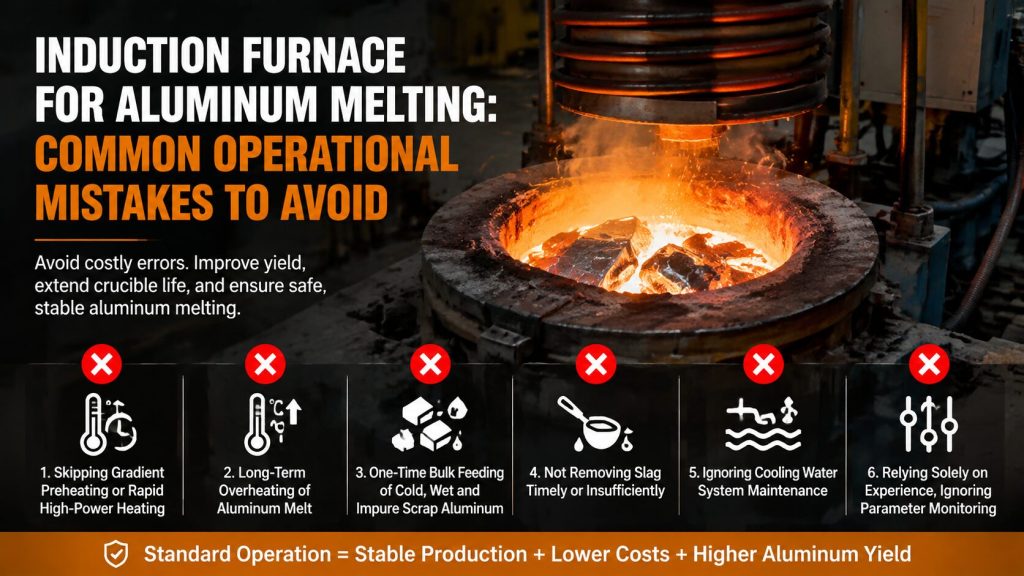
Mistake 1: Skipping Gradient Preheating or Rapid High-Power Heating
This is the most common mistake in the daily operation of aluminum melting induction furnaces, especially for newly replaced crucibles or equipment restarted after long-term shutdown. Many operators directly turn on high power to heat up rapidly to shorten the preparation time, or even skip the whole preheating process and start feeding cold aluminum materials directly.
Actual on-site hazards: Aluminum melting crucibles are mostly made of silicon carbide and graphite composite materials. Rapid temperature rise will cause severe thermal shock inside the crucible. The inconsistent expansion speed between the inner and outer walls will lead to micro-cracks, peeling of the inner lining, and even overall cracking in severe cases. In addition, the moisture remaining in the new crucible cannot be completely volatilized, which will cause aluminum liquid splashing and bring safety hazards. Unstandardized preheating will directly cut the service life of the crucible by more than half and increase the frequent replacement cost of consumables for the factory.
Standard correct operation: Strictly implement segmented gradient preheating according to the crucible state. For new crucibles or crucibles after overhaul, low-power heating shall be adopted first to slowly volatilize internal moisture, with temperature raised step by step rather than through one-time high-power heating. A gradual and complete crucible baking routine lays a solid foundation for stable aluminum melting. For detailed temperature curves and standardized daily maintenance rules, refer to our guide on Aluminum Melting Crucible: Baking Method, Usage Tips and Maintenance Guide.
Mistake 2: Long-Term Overheating of Aluminum Melt to Pursue Faster Melting
In actual workshop production, many operators have a wrong cognition: the higher the temperature of the aluminum liquid, the faster the melting speed and the smoother the casting. Therefore, they often keep the furnace running at high power for a long time, making the aluminum liquid temperature continuously exceed 800℃, even during the holding stage. This operation is the main cause of high aluminum loss and excessive dross in many scrap aluminum recycling factories.
Actual on-site hazards: The optimal melting and casting temperature of industrial aluminum liquid is 720℃-750℃. When the temperature exceeds 780℃, the oxidation reaction of aluminum liquid will be greatly accelerated, producing a large amount of dense aluminum oxide dross. Excessive dross will not only reduce the yield of finished aluminum products and increase raw material waste, but also adhere to the inner wall of the crucible, which is difficult to clean and affects subsequent melting efficiency. At the same time, long-term high-temperature operation will accelerate the aging of the furnace body coil and insulation layer, increasing equipment failure rate.
Standard correct operation: Control power output by stage according to real-time melting conditions. Run high power only during cold material melting to speed up raw material penetration and melting. Once the aluminum is fully liquefied, reduce power immediately to stabilize the melt temperature between 720℃ and 750℃, and avoid unnecessary high-temperature holding. Excessive heat is the leading cause of heavy dross and metal loss in aluminum workshops. To fully understand oxidation mechanisms and targeted mitigation methods, check our in-depth article: Why Does Aluminum Oxidize During Melting? Causes and Solutions.
Mistake 3: One-Time Bulk Feeding of Cold, Wet and Impure Scrap Aluminum
To improve production efficiency, many workshops adopt the operation of filling the crucible with a large amount of cold aluminum blocks, aluminum scraps, and waste aluminum materials at one time. Moreover, they often put uncleaned scrap aluminum with oil stains, moisture, and surface sundries directly into the furnace without pre-treatment, which is a very dangerous and non-standard operation.
Actual on-site hazards: First, one-time bulk cold material feeding will cause the temperature of the aluminum liquid to drop sharply, resulting in uneven internal temperature of the melt, incomplete melting of local raw materials, and reduced overall production efficiency. Second, the moisture attached to the surface of scrap aluminum will vaporize rapidly at high temperature, causing aluminum liquid splashing, which easily causes safety accidents. Oil stains and sundries will produce harmful flue gas after high-temperature combustion, and the generated impurities will be mixed into the aluminum liquid, resulting in defective casting products and increased scrap rate.
Standard correct operation: Sort scrap aluminum before feeding. Remove surface oil, dust and accumulated moisture, and fully dry wet materials before charging. Always adopt small-batch and multi-time feeding to avoid sharp temperature drops and incomplete melting. Gradual feeding ensures steady temperature distribution and cleaner molten aluminum, effectively reducing splashing, impurity entrapment and secondary oxidation.
Mistake 4: Excessive Stirring and Long-Time High-Temperature Holding After Melting
After the aluminum material is completely melted, some operators will keep the furnace in high-power operation and continuously stir the aluminum liquid, thinking that this can make the temperature more uniform. Some workshops will also store the melted aluminum liquid in the furnace at high temperature for a long time to cope with subsequent continuous casting, ignoring the impact of long-time holding on aluminum quality.
Actual on-site hazards: Frequent and excessive stirring will make the aluminum liquid fully contact with air, which greatly increases the oxidation area and produces a large amount of suspended oxide slag inside the melt. Long-term high-temperature holding will further aggravate oxidation and grain coarsening of aluminum liquid, resulting in defects such as air holes, slag inclusions and loose structure in subsequent castings, seriously affecting the mechanical properties and surface quality of finished products.
Standard correct operation: Stop high-power heating and excessive stirring immediately after the aluminum liquid reaches the standard temperature and uniform state. Complete slag removal and casting within the shortest effective time. If temporary storage is required, switch to low-power constant temperature holding mode to avoid continuous high-temperature operation, reduce the contact oxidation time of aluminum liquid and air, and ensure the stability of aluminum liquid quality.
Mistake 5: Ignoring Daily Inspection and Maintenance of Cooling System
The cooling water system is the core protection device of induction melting furnaces, but it is the most easily overlooked link in daily operation. Most operators only focus on the melting state of aluminum materials, and do not regularly check the water temperature, water pressure, water flow and pipeline blockage of the cooling system, and lack daily maintenance habits.
Actual on-site hazards: Blocked cooling pipelines, insufficient water flow and excessive water temperature will cause the furnace coil and capacitor to fail to dissipate heat normally. Long-term heat accumulation will lead to coil aging, insulation damage, equipment over-temperature alarm, and even sudden shutdown and burning of electrical components, resulting in production interruption and high equipment maintenance costs. In winter, unemptied cooling water will freeze and crack the pipeline, directly damaging the equipment system.
Standard correct operation: Arrange special personnel to inspect the cooling system before each startup, check whether the water pressure and water flow are normal, and clean the pipeline filter regularly to avoid blockage. Monitor the water temperature in real time during operation, and stop feeding and adjust the equipment in time if abnormal temperature rise is found. Empty the cooling water in the pipeline in time after shutdown in winter to prevent freezing and cracking.
Mistake 6: Irregular and Forced Slag Removal Operation
In the daily slag removal link, many operators adopt rough operation methods: scrape the furnace wall and crucible inner wall violently with iron tools to pursue thorough slag removal, or carry out slag removal operation when the aluminum liquid temperature is too high or too low, which will cause irreversible damage to the furnace body lining and crucible.
Actual on-site hazards: Violent scraping will scratch and peel the refractory lining and crucible inner wall, destroy the thermal insulation structure of the furnace body, reduce the thermal efficiency of the equipment, and cause the crucible to be damaged in advance. Slag removal at inappropriate temperatures will lead to incomplete slag cleaning or secondary mixing of slag into the aluminum liquid, failing to achieve the purpose of purification and affecting casting quality.
Standard correct operation: Grasp the optimal slag removal temperature (730℃-740℃ for aluminum liquid). Use special soft slag removal tools to gently skim the surface dross, avoid violent collision and scraping with the crucible and furnace wall. Clean the floating slag completely at one time, and do not repeatedly scrape and polish the inner wall to protect the furnace body structure and prolong the service life of equipment consumables.
Conclusion
The production efficiency, finished product quality and equipment service life of induction furnace for aluminum melting depend not only on the performance of the equipment itself, but more on standardized and refined daily operation. Most production losses and equipment failures in foundry workshops are caused by trivial operational mistakes that are easy to ignore.
By correcting the above six common mistakes, foundries can effectively cut aluminum oxidation loss, lower equipment failure rates, stabilize casting consistency, and reduce long-term operational and consumable costs. Standardized operation matches high-quality equipment to deliver reliable melting results. For industrial-grade melting equipment tailored for aluminum and scrap aluminum production, explore our aluminum melting furnace designed for stable, low-loss and high-yield melting scenarios.
Fine operational management is the most cost-effective way to improve overall factory productivity. Stable melting conditions not only extend crucible and furnace service life, but also minimize dross generation and ensure qualified casting quality for long-term mass production.