
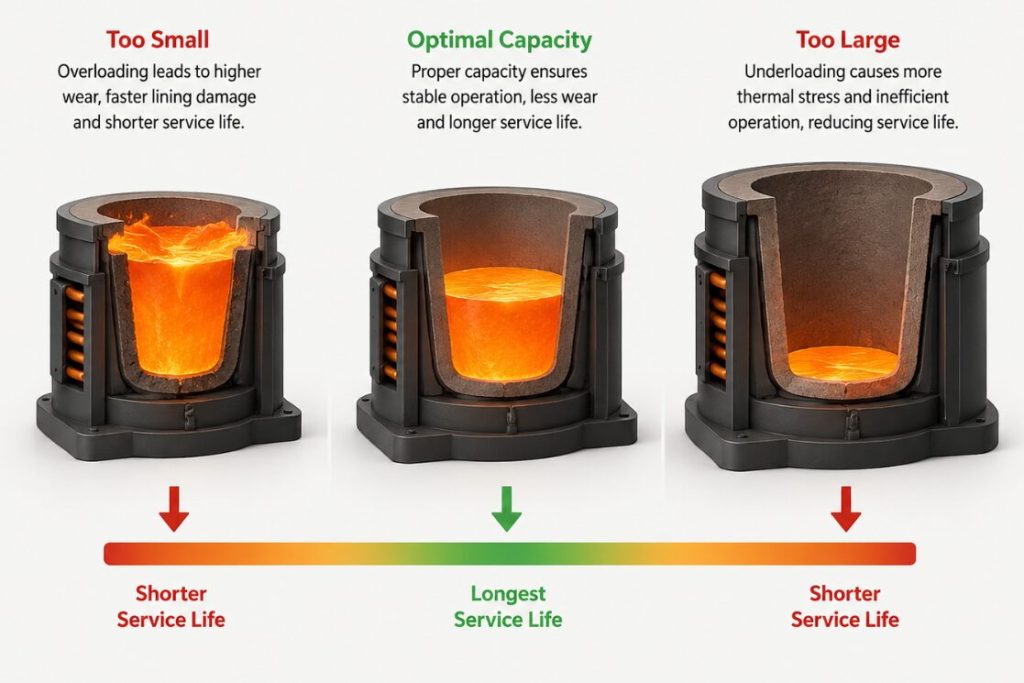
The service life of an induction furnace crucible generally decreases as furnace capacity increases. In vacuum induction furnaces, where slag formation is minimal or absent, crucibles typically have a longer service life than those used in non-vacuum induction furnaces of the same capacity. Nevertheless, regardless of furnace type, larger crucible capacities are generally associated with shorter service life.
Typical Service Life of Alkaline Crucibles in Non-Vacuum Induction Furnaces
| Crucible Capacity (kg) | Crucible Material | Typical Service Life (Cycles) | Smelted Steel Grades |
|---|---|---|---|
| 150 | Fused Magnesia | 30–60 | Precision resistance alloys |
| 430 | Fused Magnesia | 30–50 | Stainless steel, heat-resistant steel |
| 900 | Ordinary Magnesia | 20–30 | Stainless steel, precision alloys |
| 3000 | Magnesia-Alumina Spinel | 30–40 | High-temperature alloys, special steels |
| 5000 | Magnesia-Alumina Spinel | 30–35 | High-temperature alloys, special steels |
Note: The service life values listed above are typical industrial references. Actual crucible life varies depending on refractory material quality, steel grade, melting temperature, operating practices, slag chemistry, and furnace maintenance conditions.
The relationship between crucible capacity and service life can be explained by the following factors:
1. Increased Hydrostatic Pressure on the Refractory Lining
As crucible capacity increases, the hydrostatic pressure exerted by molten steel on the furnace lining also increases. Higher hydrostatic pressure promotes deeper penetration of molten metal into the refractory lining, accelerating wear and reducing crucible life. Consequently, larger induction furnaces generally experience faster lining deterioration than smaller units.
The greater pressure also increases the likelihood of molten steel penetrating the refractory lining through microscopic cracks or pores, which can lead to premature lining failure and shorten the overall service life of the crucible.
2. Stronger Electromagnetic Stirring
As the capacity of an induction furnace increases, the operating frequency of the power supply generally decreases. The larger the furnace, the lower the operating frequency.
The intensity of electromagnetic stirring is generally inversely related to the square root of the power supply frequency. Lower frequencies generate stronger stirring forces, resulting in greater mechanical stress on the refractory lining. Continuous stirring accelerates refractory wear and contributes to a shorter crucible service life in large-capacity induction furnaces.
3. More Severe Slag-Line Erosion
Slag-line erosion is generally more severe in large induction furnaces than in smaller ones.
As crucible capacity increases, the surface-area-to-volume ratio of the molten steel decreases, reducing relative heat loss from the melt surface. As a result, the slag temperature remains higher and the slag stays more fluid, increasing its chemical and mechanical attack on the refractory lining.
In addition, large induction furnaces commonly adopt a steel-and-slag tapping practice, which requires the slag to maintain good fluidity during tapping. This operating condition further intensifies slag-line erosion, making it another important factor that reduces crucible service life.
Summary
For the reasons outlined above, crucibles in large induction furnaces generally have a shorter service life than those used in small and medium-sized furnaces. To extend service life, the refractory lining thickness may be appropriately increased within design limits. However, increasing the lining thickness also increases electrical resistance, resulting in higher reactive power losses and lower electrical efficiency. Therefore, the lining thickness must be carefully optimized to achieve a balance between crucible service life and furnace operating efficiency.