
Understanding the Induction Melting Process
Induction melting is widely used in modern metallurgical production because of its efficiency, cleanliness, and controllability. To better understand the core working principle of an induction melting furnace, we first need to look at how electromagnetic energy is converted into heat inside the metal.
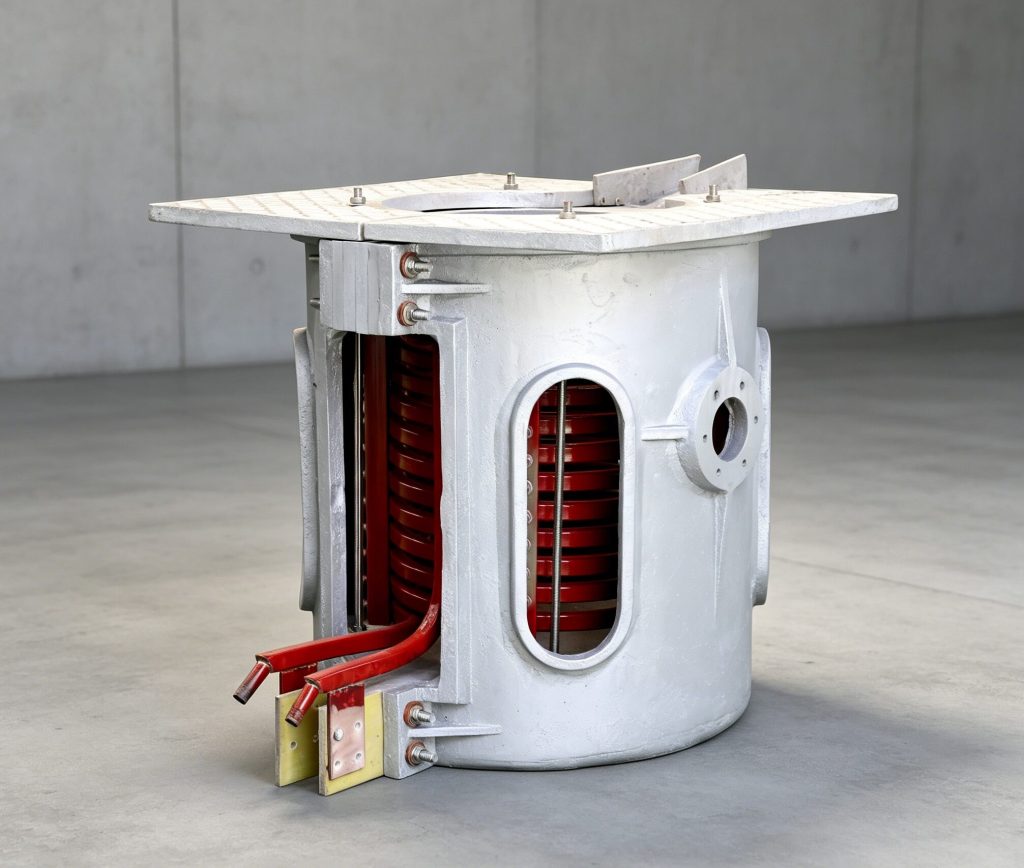
Technical Explanation
There is no fundamental difference between using a pulsed magnetic field to heat a solid billet and to melt metal for casting. The pulsed magnetic field at the surface of the melt induces an electromotive force in the material; since the material acts as a secondary short-circuit coil, this causes a current to flow through the metal, thereby heating it. With the exception of scrap steel, which exhibits a relative permeability of nearly 1 when heated to the Curie point, all concepts related to skin depth can be applied without restriction to the material being melted.
The advantages of induction melting are as follows:
1. It prevents undesirable metallurgical reactions, such as oxidation and reduction, and eliminates harmful gases and combustion products caused by sulfur contamination.
2. Fast melting speed. For the same capacity, induction furnaces have a higher daily output than other types of furnaces.
3. Low operating costs; energy costs are as low as or slightly higher than those of high-efficiency fuel-fired furnaces.
4. Improved working conditions, with no significant heat loss or fumes from the furnace, and no pollutants or slag.
5. Reduced metal loss. When melting copper-zinc alloys, zinc loss due to oxidation can be less than 0.5% by weight.
6. Automatic stirring (though this may be detrimental under certain conditions).
7. Maintenance costs for refractory linings are low. Since the furnace body does not reach temperatures higher than the metal itself, as is the case with fuel-fired furnaces, the cost of refractory linings for trough-type induction furnaces is lower compared to fuel-fired furnaces; however, the cost of refractory materials for coreless induction furnaces is higher.
8. It can be used for specialized processes, such as vacuum melting, and can be employed to produce alloys that cannot be manufactured by other methods.
Why Industries Choose Induction Melting Technology
The adoption of induction melting technology is not accidental. It is driven by strict requirements in metallurgy, casting quality, and production efficiency.
Clean Metallurgical Environment
Industries working with high-purity metals need to avoid oxidation and gas contamination. Induction melting minimizes direct combustion contact, making it suitable for high-purity metal processing.
High Production Efficiency
Manufacturers using industrial melting furnaces often prioritize output. Induction systems deliver faster melting cycles, which directly increases daily production capacity.
Cost Optimization
Compared with traditional fuel-based systems, induction systems reduce fuel consumption and improve energy utilization efficiency.
Which Industries Should Choose Induction Melting?
Not every melting process requires induction, but for many industries, it is the most efficient and stable solution.
Industrial Application Overview
| Industry Type | Material Processed | Why Induction Melting is Suitable |
|---|---|---|
| Foundries | Cast iron, steel, alloys | High efficiency and stable temperature control |
| Copper processing plants | Copper, brass, alloys | Low oxidation loss and high purity output |
| Aluminum casting factories | Aluminum alloys | Precise temperature control |
| Precious metal refining | Gold, silver, platinum | Minimal contamination risk |
| Advanced alloy production | Special alloys | Supports vacuum and controlled atmosphere melting |
Industries that prioritize metal quality, production stability, and energy efficiency should strongly consider upgrading to an induction melting furnace system.
Key Advantages of Induction Melting for Industrial Production
Based on industrial application experience, the advantages can be summarized into the following strategic benefits:
1. Higher Yield and Lower Loss
Metal loss is significantly reduced due to controlled atmosphere and reduced oxidation.
2. Improved Product Consistency
Electromagnetic stirring improves composition uniformity, which is critical for alloy performance.
3. Flexible Production Capability
Supports multiple materials and can switch between different alloys with minimal downtime.
4. Environmental Compliance
Modern factories increasingly require low-emission production systems. Induction melting meets strict environmental standards.
5. Advanced Process Compatibility
Compatible with vacuum systems and controlled atmosphere furnaces for high-end metallurgy applications.
Technical Position of Induction Melting in Modern Metallurgy
The induction heating principle based on electromagnetic induction is now considered one of the most stable and controllable heating methods in industrial metallurgy.
Compared with traditional furnace systems, it offers:
- Better temperature accuracy
- Higher thermal efficiency
- Stronger process repeatability
- Reduced human operation risk
This makes it the preferred solution for companies upgrading toward automated and intelligent production systems.
Frequently Asked Questions (FAQ)
What is an induction melting furnace used for?
It is used to melt metals such as steel, copper, aluminum, and alloys using electromagnetic induction heating.
Is induction melting better than fuel-fired furnaces?
In most industrial cases, yes. It offers better control, lower oxidation, and higher efficiency.
What metals can be melted in an induction furnace?
Steel, iron, copper, aluminum, brass, and many special alloys.
Does induction melting reduce metal loss?
Yes, due to reduced oxidation and controlled heating conditions.
Can induction furnaces support special processes?
Yes, they can be integrated with vacuum melting and controlled atmosphere systems.
Contact Us for Industrial Induction Melting Solutions
If you are planning to upgrade your production line or evaluate a more efficient induction melting furnace system, we can help you design a solution based on your material type, capacity requirements, and production goals.
We provide:
- Customized furnace design
- Technical selection guidance
- Production line optimization support
- After-sales technical assistance