
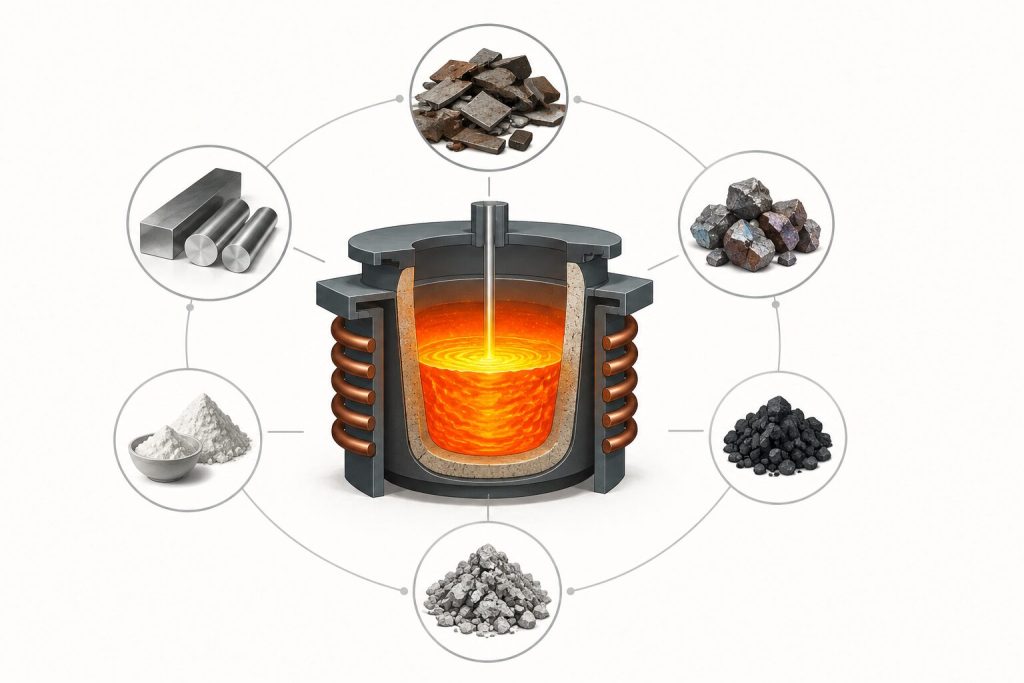
The raw materials used in induction furnace steelmaking include: steel scrap, pure metals and ferroalloys, oxidizing and deoxidizing agents, carbon and sulfur additives, and slagging materials. Due to the induction furnace’s limited refining capacity and low operational flexibility, the requirements for raw materials are much stricter than those for electric arc furnaces. The requirements for raw materials in induction furnace steelmaking are as follows:
1. Chemical Composition Must Be Accurate
Accurate composition is the basis for charge calculation. All raw materials entering the warehouse must be sampled and analyzed according to standard methods. Even if accompanied by a certificate of conformity from the manufacturer, analysis is still required. This is because manufacturers produce in large batches, and sampling may not necessarily represent the actual condition of the specific raw materials being stored. Additionally, this serves as a precaution against potential errors. Based on the analysis results, the materials should first be tested in small batches; only after confirming they are error-free should they be put into large-scale use.
2. Raw Materials Must Be Clean, Free of Oil Contamination, and Have Minimal Rust
Oil contamination and rust on furnace charge are sources of gases in steel, particularly hydrogen. This is because rust primarily consists of Fe₂O₃・2H₂O, which undergoes the following reaction at high temperatures:
Fe₂O₃・2H₂O = Fe₂O₃ + 2H₂O↑
Water vapor above the molten steel surface reacts with the molten steel as follows:
H₂O gas + [Fe] = H₂↑ + [FeO]
H₂ ⇌ 2 [H]
Consequently, this increases the [H] content in the molten steel. Similarly, moisture contained in slag or raw materials can cause similar reactions, leading to an increase in the [H] content of the molten steel.
Oil contamination consists primarily of hydrocarbons; when these decompose through combustion at high temperatures, they also produce hydrogen, which increases the [H] content of the molten steel. Therefore, raw materials contaminated with oil, rust, or moisture must undergo appropriate treatment. Oil and moisture can be removed through baking; rust can be removed by shot blasting or tumbling.
3. Appropriate Material Block Size
To increase the melting rate, suitable raw materials—particularly the size of steel scrap—should be selected for furnaces operating at different power supply frequencies. Power Supply Frequency and Optimal Steel Charge Size
The size requirements for alloy charges, slagging materials, and deoxidizing agents added after the furnace has been purged should not be based on the size of the steel charge; rather, reasonable charging sequence requirements should be established based on the specific charging conditions.
4. Dry Storage Area
All furnace charges must be stored in a dry environment to prevent moisture absorption.
Conclusion
In induction furnace steelmaking, the quality of raw materials directly determines the stability of the melting process and the final steel quality. Due to the limited refining capacity of induction furnaces, stricter control over chemical composition, cleanliness, material size, and storage conditions is essential.
Accurate composition ensures reliable charge calculation, while clean and dry materials help minimize hydrogen and other gas-related defects in molten steel. At the same time, selecting appropriate scrap size and maintaining proper storage conditions can significantly improve melting efficiency and process stability.
In practice, consistent raw material management is not just a technical requirement, but a key factor in reducing defects, improving yield, and achieving stable production results in induction furnace operations.