
Introduction
An induction melting furnace is one of the most widely used pieces of equipment in modern metal processing industries. It is especially valued in aluminum, steel, and copper foundries due to its high efficiency, precise temperature control, and clean working environment.
With the increasing demand for high-quality metal products and sustainable recycling solutions, induction melting technology has become a preferred choice for manufacturers worldwide.
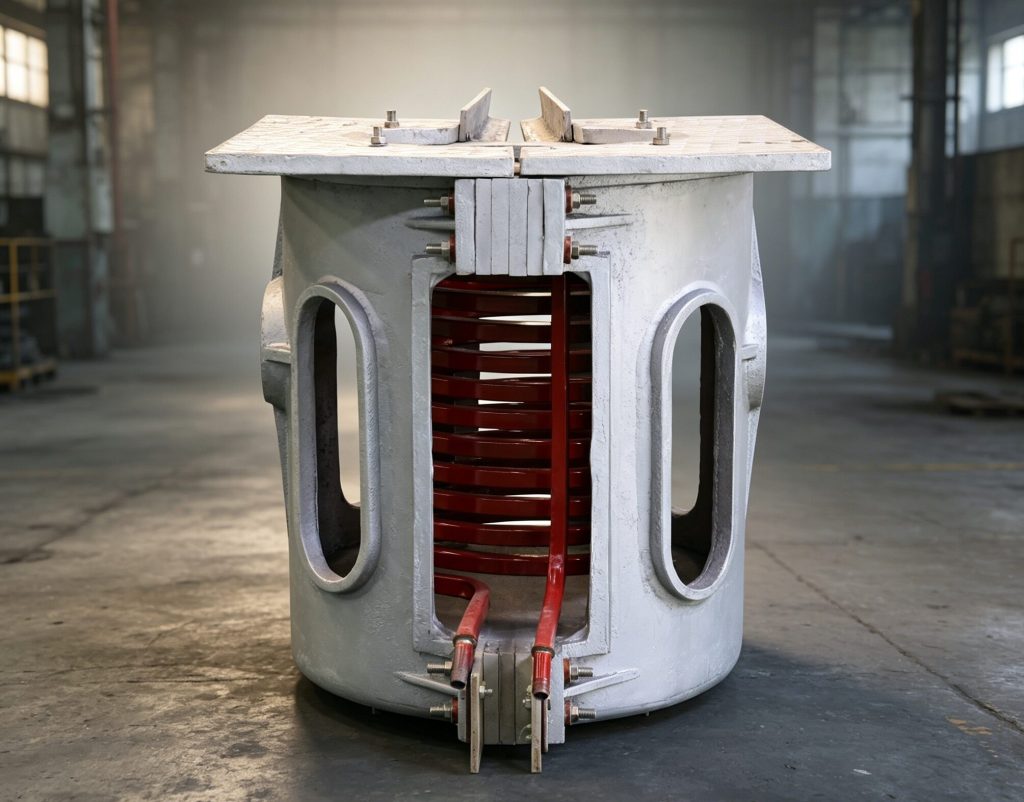
What Is an Induction Melting Furnace?
An induction melting furnace uses electromagnetic induction to generate heat inside a conductive metal charge. When alternating current passes through a coil, it creates a magnetic field that induces eddy currents in the metal, causing it to heat and eventually melt.
Unlike traditional fuel-fired furnaces, induction furnaces do not rely on combustion. This makes them cleaner, more energy-efficient, and easier to control.
Working Principle of Induction Melting Furnaces
The operation of an induction melting furnace is based on two key physical phenomena:
- Electromagnetic induction
- Resistive (Joule) heating
When the metal is placed inside the furnace coil:
- An alternating current flows through the coil
- A changing magnetic field is generated
- Eddy currents are induced in the metal charge
- Internal resistance of the metal generates heat
- The metal melts uniformly from within
Additionally, electromagnetic stirring improves the homogeneity of the molten metal, which is especially important in aluminum alloy production.
Advantages and Disadvantages of Induction Furnaces
The advantages and disadvantages of induction furnaces play a crucial role in selecting the right equipment for specific industrial applications.
Answer: The advantages of induction furnaces are: high thermal efficiency; uniform composition and temperature of the melt due to electromagnetic stirring; fast melting speed; minimal ratio of melt surface area to volume, resulting in low alloy loss and gas absorption; easy temperature control; low ambient temperature, minimal fumes, low noise, and a good working environment. The main disadvantages are: the melt in the melting channel (in core-type induction furnaces) is prone to overheating, resulting in coarse grain structure in the ingots; high capital investment, particularly for crucible-type induction furnaces; and difficulties in mechanizing the charging process when the primary raw material is entirely solid aluminum. For channel-type induction furnaces, the melting channel is prone to clogging during operation, resulting in a short service life. Judging by the basic requirements for aluminum alloy melting furnaces, the induction furnace is a promising type of furnace that can integrate the functions of a melting furnace and an electromagnetic stirring device.
Induction furnaces are widely used in Germany, with furnace capacities reaching up to 50 tons.
Applications of Induction Melting Furnaces
Induction melting furnaces are widely used across multiple industries due to their flexibility and efficiency:
1. Aluminum Recycling Industry
They are ideal for melting scrap aluminum with minimal oxidation loss, making them a key solution in sustainable metal recycling.
2. Foundries and Casting Plants
Used for producing high-quality castings where precise temperature and composition control are required.
3. Steel and Iron Production
Induction furnaces are commonly used for melting alloy steels and specialty metals.
4. Non-Ferrous Metal Processing
Including copper, brass, and zinc alloys, where clean melting conditions are critical.
Induction Furnace vs Traditional Melting Furnace
Compared with gas-fired or oil-fired furnaces, an induction melting furnace offers several distinct advantages:
| Feature | Induction Furnace | Traditional Furnace |
|---|---|---|
| Energy Efficiency | High | Medium |
| Temperature Control | Precise | Less accurate |
| Environmental Impact | Clean | Emissions present |
| Metal Loss | Low | Higher |
| Automation | Easy to integrate | Limited |
These differences make induction furnaces particularly suitable for modern, environmentally conscious manufacturing facilities.
How to Choose the Right Induction Melting Furnace
Selecting the right induction melting furnace depends on several key factors:
- Type of metal (aluminum, steel, copper)
- Production capacity (kg to tons per batch)
- Energy consumption requirements
- Automation level
- Budget and ROI considerations
For aluminum applications, crucible-type induction furnaces are commonly preferred due to their flexibility and efficiency.
Conclusion
The induction melting furnace has become an essential tool in modern metallurgy due to its efficiency, precision, and environmental advantages. While it requires a higher initial investment, its long-term benefits—such as reduced energy consumption, improved metal quality, and cleaner operation—make it a highly competitive solution.
As industries continue to prioritize sustainability and product quality, induction melting technology is expected to play an even more significant role in the future of metal processing.
Contact Us
If you are looking for a reliable induction melting furnace for aluminum or other metals, our team can provide customized solutions based on your production needs.
Feel free to contact us for technical consultation, equipment selection, and project support.