
Case Studies
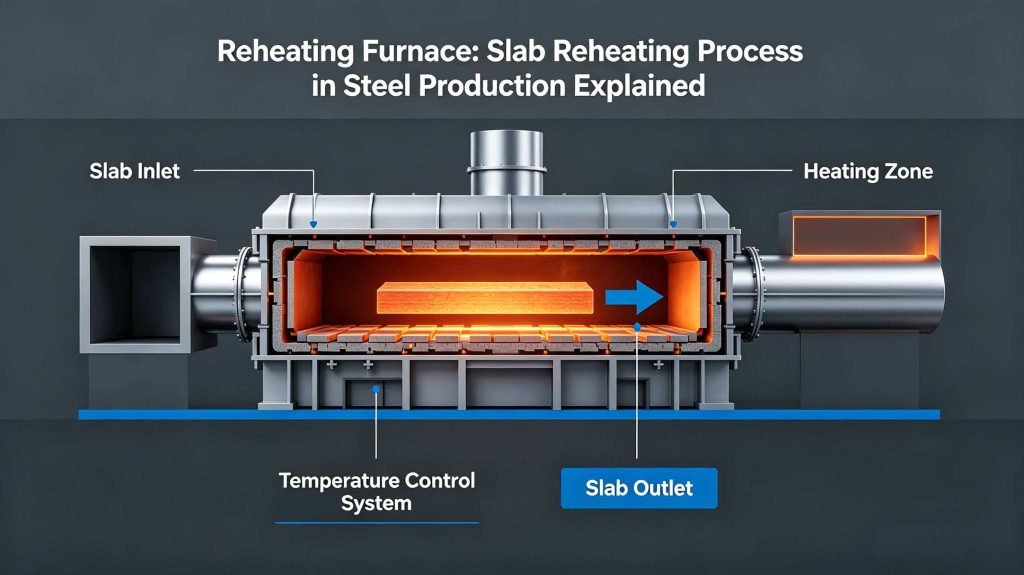
A growing trend in modern hot-rolled strip production involves using continuously cast slabs to replace metal ingots in the rolling process. In 1965, the McLooth Steel Company (U.S.) decided to apply this method to its new rolling equipment. Before entering the rolling mill, these slabs must undergo a second heating process; that is, they enter the reheating furnace as cold, warm (200–500°C), or hot slabs (cast slabs are continuously heated to 500–700°C). They had previously studied pusher-type reheating furnaces, but the maximum slab thickness that could be reheated was 250 mm. Pitch-furnaces were also investigated, but none of these furnaces could accommodate the mixed loading of cold and hot slabs described above. Due to high operating costs and difficulties in handling mixed loads of cold and hot slabs, a roller-hearth furnace was abandoned.
To meet the above requirements using induction heating, Ross (c86) at Ajax Magnathermic proposed a method employing a new type of wide rectangular induction coil. The slabs are heated in a vertical position and lifted into the stationary induction coil by a specially designed manipulator for heating. Since the slabs may bend, a considerable gap must be provided between the slab and the furnace lining, which reduces the power factor.
The specifications for this system are as follows:
1. Annual production of approximately 2,200,000 tons;
2. Slab thickness of 300 mm;
3. Slab widths of 0.9 m, 1.1 m, 1.3 m, and 1.5 m;
They also specify:
4. An average production rate of 275 tons per hour for slabs of any width, and 550 tons per hour for slabs 1.5 meters wide;
5. The ability to handle mixed charges of cold, warm, or hot slabs;
6. The ability to meet continuous production requirements and offer high flexibility;
7. Easy to control via computer;
8. High production capacity;
9. Minimal floor space required due to limited workshop area;
10. Requires the fewest operators.
McLose’s system has proven successful and meets the requirements outlined above. When heating the largest slabs (300 mm thick × 1.5 m wide × 8 m long), there are six heating lines, each with a throughput of 100 tons per hour. Each line features three heating furnaces with rated capacities of 20,000 kW, 10,000 kW, and 5,000 kW, respectively. The power output per line is 35,000 kW, resulting in a total power of 210,000 kW. Each of the figures mentioned above represents the maximum rated value for the heating furnaces; however, all furnaces operating at maximum power simultaneously occurs only under exceptional circumstances.
Published data indicates that, regardless of slab dimensions, power consumption is less than 358 kWh/ton. Scale content is less than 0.25% and is loose, with good temperature uniformity.
To accommodate induction coils of varying widths, the coils are equipped with taps. Power is switched using specially designed thyristor switches, which turn the power on or off at the zero crossing of the sine wave.
Technical Expansion and Engineering Context
Industrial Evolution: Continuous Casting and Slab-Based Rolling
The transition described in this case reflects one of the most important structural changes in steel manufacturing: the replacement of ingot casting with continuous casting slabs.
From a metallurgical perspective, this shift significantly improved:
- Solidification uniformity
- Yield efficiency in downstream rolling
- Reduction of reheating energy per ton of steel
- Overall process integration between casting and rolling
This development directly increased the importance of controlled slab reheating systems, since slabs now arrive at the rolling mill in a wider range of thermal conditions.
Thermal Variability and Its Impact on Furnace Design
One of the central engineering challenges in the described system is the presence of mixed thermal states within the charging process.
Slabs entering the reheating furnace may vary significantly in temperature:
- Cold slabs (ambient condition)
- Warm slabs (200–500°C)
- Hot slabs (500–700°C, hot-charged material)
This variability introduces several operational constraints:
- Non-uniform heat absorption rates
- Different residence time requirements for each slab type
- Increased complexity in thermal control strategies
- Higher risk of temperature deviation at furnace discharge
These conditions are difficult to manage using traditional hot rolling furnace systems without sacrificing efficiency or productivity.
Limitations of Conventional Furnace Technologies
The evaluation of pusher-type reheating furnaces and pitch-type furnaces reflects typical constraints observed in conventional reheating systems.
Key limitations include:
- Restricted slab thickness handling capability (not exceeding 250 mm in some configurations)
- Limited adaptability to mixed hot and cold charging
- Inefficient thermal distribution under variable loading conditions
- Mechanical constraints in continuous high-capacity operation
The rejection of roller-hearth furnace design further highlights the importance of operational flexibility over simple mechanical throughput capacity.
Induction Heating Innovation and System Engineering
The proposed induction heating system for slabs represents an early industrial application of electromagnetic heating at scale.
The system design introduces several engineering principles:
- Vertical slab positioning for controlled heating exposure
- Use of wide rectangular induction coils for uniform field distribution
- Automated mechanical manipulators for slab handling and positioning
However, this configuration also introduces engineering trade-offs:
- Reduced electromagnetic coupling efficiency due to air gap requirements
- Structural deformation risk of large slabs under vertical suspension
- Lower power factor caused by increased coil-to-slab distance
Despite these limitations, the system demonstrates a significant advancement in process flexibility and controllability within industrial reheating furnace design.
Industrial Scale and Production Architecture
The described installation reflects a high-capacity steel production environment designed for continuous operation.
Key design parameters include:
- Annual output exceeding 2.2 million tons
- Slab thickness capability up to 300 mm
- Flexible slab width processing from 0.9 m to 1.5 m
- Variable throughput depending on slab geometry
These specifications are typical of modern steel slab reheating furnace systems used in integrated steel plants.
Multi-Line Furnace Configuration and Power Distribution
The heating system is structured into six parallel production lines, each operating independently to ensure continuous throughput.
Each line includes:
- Three-stage furnace configuration with different power levels (20,000 kW, 10,000 kW, 5,000 kW)
- Total installed capacity per line of 35,000 kW
- Overall system capacity reaching 210,000 kW
This architecture is commonly found in large-scale reheating furnace manufacturers’ solutions, where production redundancy and thermal stability are critical.
Energy Efficiency and Metallurgical Performance
Operational performance data highlights several key efficiency indicators:
- Energy consumption below 358 kWh per ton of steel
- Scale formation below 0.25 percent
- Stable temperature uniformity across slab surfaces
These parameters directly affect downstream rolling mill furnace performance, especially in hot strip production lines.
Electrical Control System and Power Regulation Technology
The system utilizes thyristor-based power control technology, which allows precise regulation of electrical input.
Key characteristics include:
- Zero-cross switching to minimize electrical stress
- Improved reliability under high-load industrial conditions
- Fine-grained control of heating power levels
- Compatibility with automated process control systems
This technology forms the foundation of modern induction reheating furnace control systems used in contemporary steel plants.