
1. Why Continuous Casting Dominates Modern Steel Production
Continuous casting is now the standard method of solidifying molten steel in modern steel plants. Before its widespread adoption, ingot casting was the primary method, requiring multiple reheating and rolling stages. This older process resulted in:
- Higher energy consumption
- Greater material loss
- Lower productivity
- Increased internal segregation
The introduction of continuous casting significantly improved efficiency and yield. Today, most steel plants worldwide rely on continuous casting to produce billets, blooms, and slabs.
Among these, the Steel Billet Continuous Casting Production Line plays a critical role in producing square billets for downstream rolling applications such as rebar, wire rod, and structural steel.
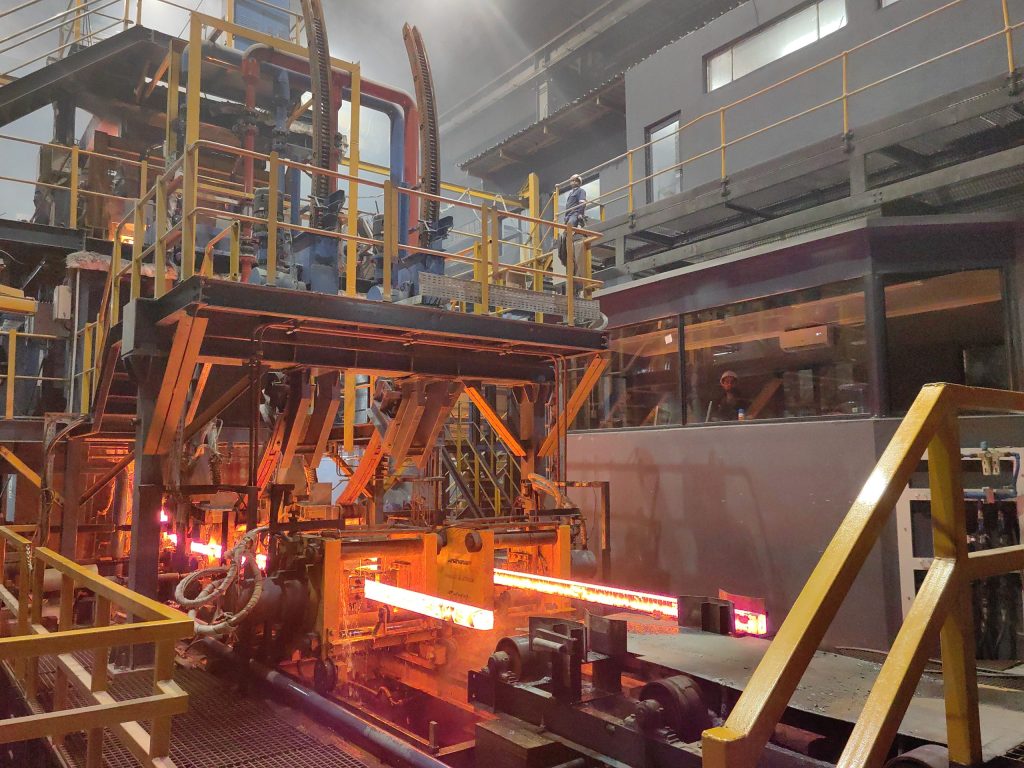
2. What Is a Steel Billet Continuous Casting Production Line?
A steel billet continuous casting production line is an integrated metallurgical system designed to transform molten steel into solid square billets through controlled and continuous solidification.
Unlike batch-based ingot casting, this process allows molten steel to flow continuously from a ladle, through a tundish, into a water-cooled mold where a solid shell forms. The billet is then withdrawn, cooled, straightened, and cut to length without interrupting the casting flow.
2.1 Typical Billet Dimensions
Common billet cross-sections include:
- 60 × 60 mm
- 70 × 70 mm
- 80 × 80 mm
- 90 × 90 mm
- 100 × 100 mm
- 120 × 120 mm
- 150 × 150 mm
- 180 × 180 mm
- 220 × 220 mm
Billet length is typically determined by downstream rolling mill requirements and controlled automatically by the cutting system.
3. Main Components of a Billet Continuous Casting Line
A complete casting line consists of several coordinated systems. Each section directly influences billet quality and production stability.
3.1 Ladle and Ladle Turret
Molten steel is transported from the primary steelmaking furnace—such as an electric arc furnace or converter—in a ladle.
The ladle turret enables continuous operation by allowing one ladle to pour while another is positioned for replacement. This ensures uninterrupted casting.
3.2 Tundish: Flow Control and Cleanliness
The tundish acts as an intermediate reservoir between the ladle and the mold. Its main functions include:
- Stabilizing molten steel flow
- Reducing turbulence
- Controlling temperature distribution
- Promoting inclusion flotation
Proper tundish design improves steel cleanliness and reduces non-metallic inclusions.
3.3 Mold: Initial Solidification Zone
The mold is a water-cooled copper structure where solidification begins.
Key features:
- Rapid heat extraction
- Formation of a solid outer shell
- Mold oscillation to prevent sticking
- Mold powder for lubrication and heat control
Shell thickness must be sufficient to contain the liquid core during withdrawal.
3.4 Secondary Cooling Zone
After exiting the mold, the billet enters the spray cooling region.
Water spray nozzles are arranged in zones to control cooling intensity. The objectives are:
- Complete solidification of the liquid core
- Minimize internal stress
- Prevent surface and internal cracking
Cooling parameters must be adjusted according to steel grade and billet size.
3.5 Withdrawal and Straightening System
A series of driven rollers continuously pull the billet downward or along a curved path.
Depending on design, casting machines may be:
- Vertical type
- Curved type
- Vertical-curved combination
Multi-point straightening is applied after solidification to ensure dimensional accuracy.
3.6 Cutting System
Billets are cut to specified lengths using:
- Flame cutting
- Hydraulic shear
The cutting system is synchronized with casting speed to maintain productivity and dimensional precision.
3.7 Run-Out and Cooling Bed
After cutting, billets move to a cooling bed or transfer system where they:
- Cool to safe handling temperatures
- Are inspected for surface defects
- Move to storage or reheating
In integrated plants, billets may proceed directly to a reheating furnace for hot charging.
4. Step-by-Step Working Process
Step 1: Molten Steel Preparation
Molten steel is tapped from the furnace and refined to achieve target chemical composition and temperature. Temperature control is critical before casting begins.
Step 2: Controlled Pouring into the Tundish
Molten steel flows from the ladle through a nozzle into the tundish. Flow rate is regulated using:
- Stopper rods
- Slide gate systems
Stable flow reduces turbulence and prevents slag entrainment.
Step 3: Solid Shell Formation in the Mold
As steel enters the mold:
- Rapid cooling begins
- A solid outer shell forms within seconds
- The billet starts moving downward
The inner core remains liquid at this stage.
Step 4: Secondary Cooling and Complete Solidification
In the spray zone:
- Water removes remaining heat
- The liquid core gradually solidifies
- Thermal gradients are carefully controlled
Improper cooling can cause internal cracks or center segregation.
Step 5: Continuous Withdrawal and Cutting
The billet is continuously withdrawn by rollers and cut to length according to preset parameters. Modern systems use PLC-based automation to synchronize speed, temperature, and cutting.
5. Key Technical Parameters Affecting Performance
5.1 Casting Speed
Casting speed directly impacts productivity. However:
- Excessive speed can cause breakout
- Low speed reduces output
Optimal speed depends on billet size and steel grade.
5.2 Mold Cooling Intensity
Insufficient cooling may cause shell thinning.
Excessive cooling may create thermal stress.
Uniform heat extraction is critical to prevent surface defects.
5.3 Secondary Cooling Water Distribution
Water flow rate and spray pattern influence:
- Internal structure
- Crack formation
- Solidification symmetry
Segmented spray control is commonly used.
5.4 Automation and Monitoring
Modern casting lines rely on:
- Real-time temperature sensors
- Mold level control systems
- Speed synchronization
- Data monitoring platforms
Automation improves stability and reduces operator intervention.
6. Integration with Downstream Rolling Mills
Billets produced in a casting line are typically used in:
- Rebar rolling
- Wire rod production
- Small section mills
Two integration modes are common:
6.1 Cold Charging
Billets cool completely before reheating in a separate furnace.
6.2 Hot Charging
Billets are transferred while still hot, reducing energy consumption and improving efficiency.
Integrated casting-rolling systems shorten production cycles and reduce reheating costs.
7. Common Defects in Billet Continuous Casting
Even with modern technology, defects may occur.
7.1 Surface Cracks
Often caused by excessive cooling or mold oscillation issues.
7.2 Internal Segregation
Results from uneven solidification.
7.3 Center Porosity
Occurs if the liquid core does not solidify properly under controlled conditions.
Quality control measures include:
- Precise cooling control
- Steel chemistry optimization
- Real-time monitoring
- Mold powder management
8. Advantages of Continuous Casting Over Ingot Casting
Compared to traditional ingot casting, continuous casting provides:
- Higher yield rate
- Reduced energy consumption
- Lower labor intensity
- Improved metallurgical quality
- Consistent billet dimensions
The elimination of intermediate reheating significantly reduces operational cost.
9. Capacity Planning Considerations
When designing a billet casting line, key factors include:
- Annual production target (tons/year)
- Billet cross-section size
- Number of casting strands
- Steel grade range
- Integration with rolling facilities
Single-strand machines are often used for smaller plants, while multi-strand configurations increase capacity for large-scale operations.
10. Conclusion
A steel billet continuous casting production line is a highly coordinated metallurgical system that transforms molten steel into high-quality square billets through controlled solidification.
From ladle pouring to mold solidification, secondary cooling, withdrawal, and cutting, each stage influences final billet quality.
With proper parameter control and automation, continuous casting offers high productivity, improved metallurgical performance, and efficient integration with rolling mills—making it the backbone of modern long-product steel production.