
I. Understanding the Role of Annealing in Modern Metallurgy
If you work in steel processing, you already know this: forming and rolling improve strength—but they also build internal stress. That’s where annealing steps in.
1.1 What Is Annealing?
Annealing is a controlled heat treatment process designed to:
- Relieve internal stresses
- Refine grain structure
- Improve ductility and toughness
- Restore formability after cold working
It is widely applied to carbon steel, alloy steel, stainless steel, and silicon steel products. In cold rolling mills and wire drawing plants, annealing is not optional—it is a critical quality control step.
1.2 Why Specialized Annealing Equipment Matters
Traditional batch furnaces can perform annealing, but they often struggle with:
- Uneven temperature distribution
- Surface oxidation
- Limited atmosphere control
- Lower production efficiency
Modern steel production demands high uniformity, surface cleanliness, and repeatability. This is why advanced systems such as the Bell-Type Annealing Furnace and the Pit-Type Annealing Furnace have become standard in steel mills and processing lines.
II. What Is a Bell-Type Annealing Furnace?
2.1 Basic Definition
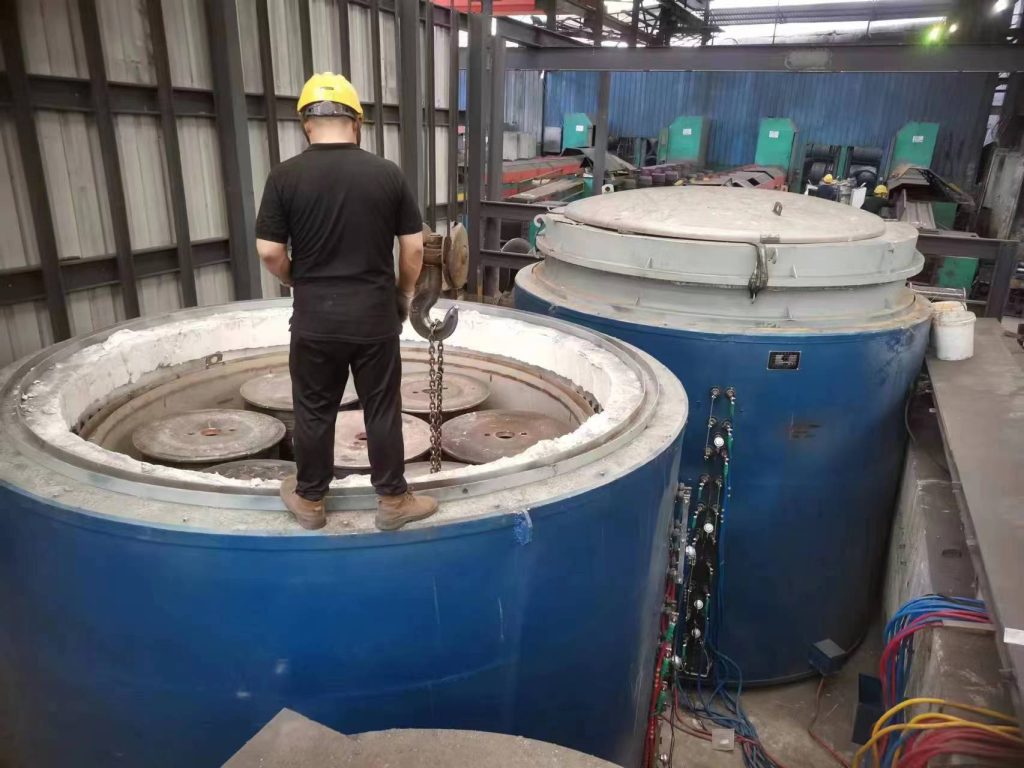
A Bell-Type Annealing Furnace is a batch heat treatment system designed primarily for annealing steel coils under a controlled protective atmosphere.
It is called “bell-type” because of its movable, bell-shaped heating cover that is placed over a stationary base containing the load.
Key characteristics include:
- Removable heating and cooling bells
- Protective inner cover for atmosphere sealing
- Multiple bases sharing heating units
- Excellent temperature uniformity
This modular design makes it highly efficient for coil-based production.
III. Main Components of a Bell-Type Annealing Furnace
A typical system consists of the following components:
3.1 Base (Hearth)
The base supports stacked steel coils. It is designed to withstand high temperatures and heavy loads while ensuring stable positioning.
3.2 Inner Cover (Protective Atmosphere Hood)
The inner cover is sealed to create a controlled atmosphere environment. Hydrogen or nitrogen-hydrogen mixtures are commonly used to:
- Prevent oxidation
- Avoid decarburization
- Ensure bright surface finish
3.3 Heating Bell
The heating bell is the movable outer heating chamber.
Our furnace structure is welded from sections of steel and steel plates. The furnace cover is manually operated, ensuring structural strength and operational reliability.
The furnace cover is welded into a circular shape. The center section is constructed entirely of extruded refractory aluminum silicate fiber blankets, providing:
- Excellent thermal insulation
- Superior sealing performance
- Reduced heat loss
The heating element uses high-temperature resistance bands, offering:
- Extended service life
- Strong resistance to breakage
- Stable heating performance
3.4 Cooling Bell
After the soaking stage, the heating bell is removed and replaced with a cooling bell to achieve controlled cooling under protective atmosphere.
3.5 Control System
Modern systems include:
- Multi-zone temperature control
- Atmosphere pressure monitoring
- Programmable heating curves
- Safety interlocks
IV. Working Principle of a Bell-Type Annealing Furnace
Understanding how it works helps explain why it delivers such consistent results.
4.1 Loading and Sealing
Steel coils are placed on the base.
The inner cover is installed and sealed to create an airtight environment.
4.2 Heating Stage
The heating bell is lowered over the base.
- Controlled temperature ramp-up
- Circulation fans ensure uniform convection
- Multi-zone heating eliminates hot and cold spots
4.3 Soaking Stage
The material is held at target temperature to allow:
- Grain recrystallization
- Stress relief
- Metallurgical transformation
Protective atmosphere prevents oxidation and decarburization.
4.4 Cooling Stage
The heating bell is removed.
A cooling bell is installed to regulate cooling speed, ensuring mechanical properties meet specifications.
V. Types of Bell-Type Annealing Furnaces
5.1 Gas-Fired Bell-Type Annealing Furnace
- Uses combustion heating
- Suitable for large-scale production
- Lower electricity demand
- Requires combustion system management
5.2 Electric Bell-Type Annealing Furnace
- Electric resistance heating
- Cleaner operation
- More precise temperature control
- Ideal for high-grade steel and stainless applications
5.3 Hydrogen Annealing Furnaces
- Designed for bright annealing
- Strict gas purity control
- Enhanced safety systems
- Required for high surface quality products
VI. Typical Applications
Bell-type annealing furnaces are widely used for:
- Cold-rolled steel coils
- Silicon steel
- Stainless steel strip
- Wire rod coils
- Automotive and appliance-grade steel
For long rod-shaped workpieces such as turbine shafts and rotors, vertical heating systems like the Pit-Type Annealing Furnace are more suitable, as they prevent bending and deformation during heat treatment.
Our pit-type system features:
- Pit-shaped shell structure
- High-alumina refractory brick insulation
- Aluminum silicate fiber lining
- Electric furnace body with temperature-controlled cabinet
- Optional inert gas heating
It is ideal for coiled wire, long shafts, rods, and pipes, ensuring minimal oxidation and no decarburization.
VII. Key Technical Advantages
7.1 Excellent Temperature Uniformity
- Multi-zone control
- Forced convection circulation
- Stable heating elements
- Optimized thermal insulation
Uniformity directly impacts mechanical properties and reduces rejection rates.
7.2 Superior Surface Quality
Protective atmosphere ensures:
- Clean surface finish
- No scale formation
- No decarburization
This is critical for automotive and high-end appliance steel.
7.3 Energy Efficiency
- High-performance aluminum silicate fiber insulation
- Reusable heating bells across multiple bases
- Reduced heat loss design
Energy cost reduction significantly improves long-term profitability.
7.4 Flexible Production Scheduling
Multiple bases can share heating bells, allowing:
- Higher utilization rate
- Reduced idle time
- Better production planning
VIII. Cost Considerations and Investment Return
8.1 Initial Investment (CAPEX)
Key cost factors include:
- Number of bases and heating bells
- Automation level
- Protective atmosphere system
- Control system complexity
Bell-type systems typically require higher initial investment compared to basic batch furnaces, but they offer superior production flexibility.
8.2 Operating Costs (OPEX)
Main components:
- Energy consumption
- Protective gas consumption
- Maintenance of heating elements
- Refractory and insulation upkeep
High-temperature resistance bands extend service life and reduce replacement frequency.
8.3 Long-Term ROI
A properly configured Bell-Type Annealing Furnace delivers:
- Improved product quality
- Reduced scrap rate
- Higher production efficiency
- Stable metallurgical performance
Over time, improved yield and reduced rework significantly enhance return on investment.
IX. Bell-Type vs. Other Annealing Furnaces
9.1 Compared with Pit-Type Annealing Furnace
| Aspect | Bell-Type | Pit-Type |
|---|---|---|
| Structure | Movable bell over base | Vertical pit structure |
| Suitable for | Steel coils | Long shafts, rods |
| Production flexibility | High | Moderate |
| Surface quality control | Excellent | Good |
9.2 Compared with Continuous Annealing Line
| Aspect | Bell-Type | Continuous Line |
|---|---|---|
| Process type | Batch | Continuous |
| Investment scale | Moderate | Very high |
| Flexibility | High | Limited |
| Product suitability | Multi-grade coils | High-volume standardized products |
X. Key Factors When Selecting a Bell-Type Annealing Furnace
When choosing the right system, consider:
- Required production capacity
- Coil dimensions and weight
- Required atmosphere type (nitrogen, hydrogen)
- Automation and digital control level
- Safety standards and certifications
- Future expansion plans
Selecting the correct configuration ensures both process stability and long-term cost control.
Conclusion
A Bell-Type Annealing Furnace is a highly efficient batch heat treatment solution designed for steel coil processing under protective atmosphere.
Its modular design, excellent temperature uniformity, superior surface protection, and flexible production scheduling make it a preferred choice for:
- Cold rolling mills
- Wire processing plants
- Silicon steel production
- Automotive steel manufacturers
For manufacturers seeking consistent metallurgical quality, improved surface finish, and long-term operational stability, a properly engineered bell-type system offers strong technical and economic advantages.
If you are evaluating annealing solutions for your plant, understanding your production goals, product types, and investment strategy is the first step toward selecting the right furnace configuration.