
One Power Supply with Two Furnace Bodies
High-Efficiency Intermediate Frequency Steel Melting Solution
In steel melting and casting production, electrical efficiency, equipment utilization rate, and production continuity directly determine operating costs and output capacity. Traditional single-furnace systems often suffer from idle time during pouring or temperature holding, leading to wasted power capacity and reduced production efficiency.
The Steel Shell Intermediate Frequency Steel Melting Furnace (One Power – Two Furnace Bodies) is designed to solve these issues by using one intermediate frequency power supply to drive two independent furnace bodies, enabling flexible power allocation, uninterrupted smelting, and optimized electrical investment.
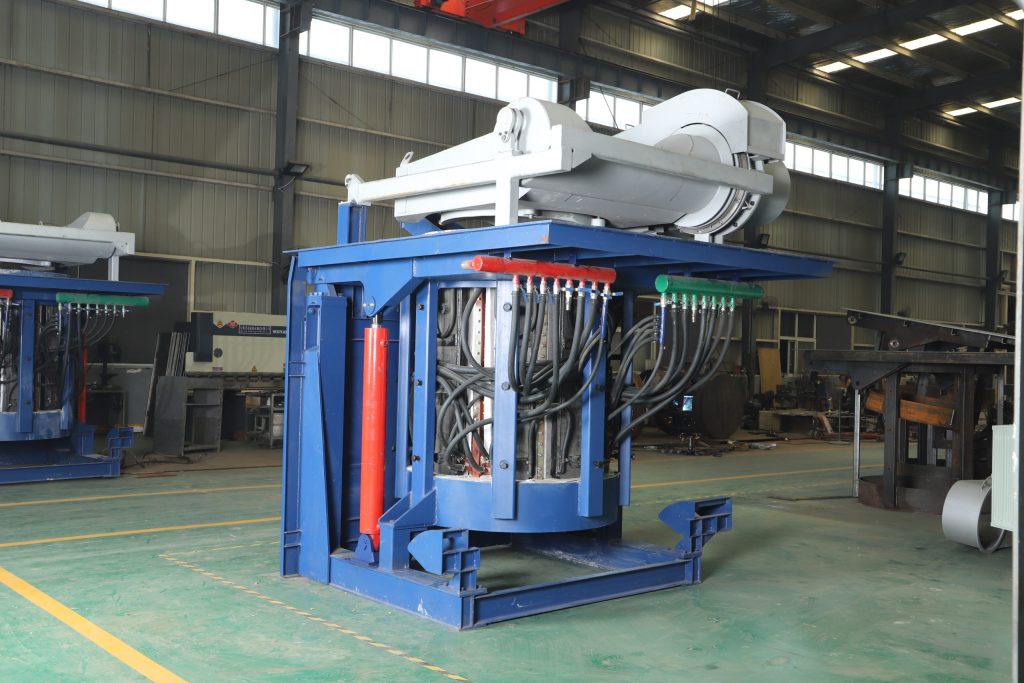
System Configuration Overview
This equipment adopts a steel shell furnace structure combined with an intermediate frequency power supply system.
A single IF power supply unit supplies power to two furnace bodies independently, allowing different operating states to be executed at the same time.
Typical Operating Modes
- Furnace A: Steel melting
- Furnace B: Pouring or molten steel holding
- Both furnaces: Preheating and smelting simultaneously
The IF power output can be arbitrarily distributed between the two furnace bodies according to process requirements, ensuring maximum utilization of the power system.
Working Principle and Process Logic
The one power–two furnace bodies intermediate frequency melting furnace uses electromagnetic induction heating to melt steel efficiently.
Power Distribution Logic
- One intermediate frequency power supply
- Two independent furnace bodies
- Power output is adjustable and distributable in real time
This allows:
- One furnace to melt steel continuously
- The second furnace to maintain molten steel at an accurate and stable temperature
- Seamless switching between melting, holding, and pouring processes
As a result, uninterrupted smelting is achieved, eliminating waiting time between batches.
Core Technical Advantages
1. Electrical System Optimization
This system significantly reduces electrical infrastructure requirements:
- One transformer saved, simplifying power distribution design
- Total installed capacity reduced by approximately 20%
- Optimized power utilization lowers long-term electricity costs
Electrical Performance Summary
| Parameter | Performance |
|---|---|
| Power Supply Type | Intermediate Frequency |
| Transformer Requirement | Reduced (one transformer saved) |
| Installed Capacity | Reduced by ~20% |
| Power Factor | ≥95% |
| Grid Harmonics | Fully compliant with standards |
| Grid Impact | No interference |
High power factor operation improves energy efficiency and reduces reactive power losses, contributing to a stable and grid-friendly operation.
2. High Power Factor and Harmonic Control
- Equipment power factor reaches 95%
- Higher harmonics meet power grid standards
- No interference with surrounding electrical equipment
This is particularly important for factories with strict power quality requirements or limited grid capacity.
3. Dual Furnace Simultaneous Operation Capability
Unlike conventional single-furnace systems, this solution supports:
- Simultaneous preheating and smelting of two furnaces
- One IF power supply operating two furnaces at the same time
- Flexible adjustment of power allocation
This ensures that:
- Production rhythm is not interrupted
- Furnace utilization rate is maximized
- Melting and holding processes are seamlessly connected
4. Reliable Full-Load Starting Performance
The system is designed for industrial stability and continuous operation:
- 100% full-load starting success rate
- Supports two electric furnaces for mass production simultaneously
- Stable operation under long-term high-load conditions
This reliability is critical for steel plants running continuous or multi-shift production schedules.
Operational Simplicity and Process Stability
The equipment is designed with simple and convenient operation in mind:
- Clear operating logic for melting, holding, and pouring
- Reduced operator intervention during power switching
- Accurate temperature maintenance during holding
Operational Benefits
| Aspect | Benefit |
|---|---|
| Operation Mode | Simple and intuitive |
| Furnace Switching | Smooth and uninterrupted |
| Temperature Control | Accurate and stable |
| Production Rhythm | Continuous and predictable |
Continuous Smelting and Temperature Control
The system allows molten steel to be:
- Maintained at a stable temperature
- Raised to an accurate temperature as required
- Held without interrupting ongoing melting operations
This capability is essential for improving casting quality and reducing temperature fluctuation during pouring.
Customer Value and Practical Benefits
Choosing the Steel Shell One Power–Two Furnace Bodies Steel Melting Furnace delivers measurable value to steel producers:
1. Reduced Capital Investment
- Lower transformer and electrical infrastructure costs
- Reduced installed power capacity
- Optimized use of existing power resources
2. Improved Production Efficiency
- No idle time between melting and pouring
- Higher furnace utilization rate
- Suitable for batch production and continuous casting
3. Lower Operating Costs
- High power factor reduces electricity losses
- Compliant harmonic performance avoids grid penalties
- Stable operation reduces maintenance and downtime
4. Scalable and Flexible Production
- Power allocation adapts to different production loads
- Supports mass production with dual furnaces
- Ideal for capacity expansion and process upgrading
Typical Application Scenarios
This system is particularly suitable for:
- Steel foundries with continuous pouring requirements
- Workshops aiming to reduce electrical investment
- Facilities seeking stable, uninterrupted steel melting
- Production lines requiring precise temperature holding
Conclusion
The Steel Shell Intermediate Frequency Steel Melting Furnace with One Power Supply and Two Furnace Bodies integrates electrical efficiency, operational flexibility, and production stability into a single system.
By saving transformer investment, reducing installed capacity by 20%, achieving a 95% power factor, and enabling uninterrupted smelting, this equipment provides a highly efficient and cost-effective steel melting solution for modern industrial production.