
In today’s competitive steel manufacturing industry, achieving high efficiency, superior product quality, and cost-effectiveness is more important than ever. The Wire Rod and Section Bar Continuous Casting and Rolling Production Line represents the next generation of steel production technology, integrating continuous casting and advanced rolling processes into a single, streamlined system. By combining precision engineering, energy-efficient design, and automated operations, this production line not only enhances manufacturing efficiency but also maximizes material utilization and ensures high-quality end products.
Overview of Continuous Casting and Rolling
Traditional steel production relies heavily on batch casting and multi-stage rolling, which can lead to high energy consumption, material waste, and longer production cycles. In contrast, this production line uses continuous casting blanks directly fed into a continuous rolling mill, creating a seamless production flow from molten steel to finished wire rods or section bars.
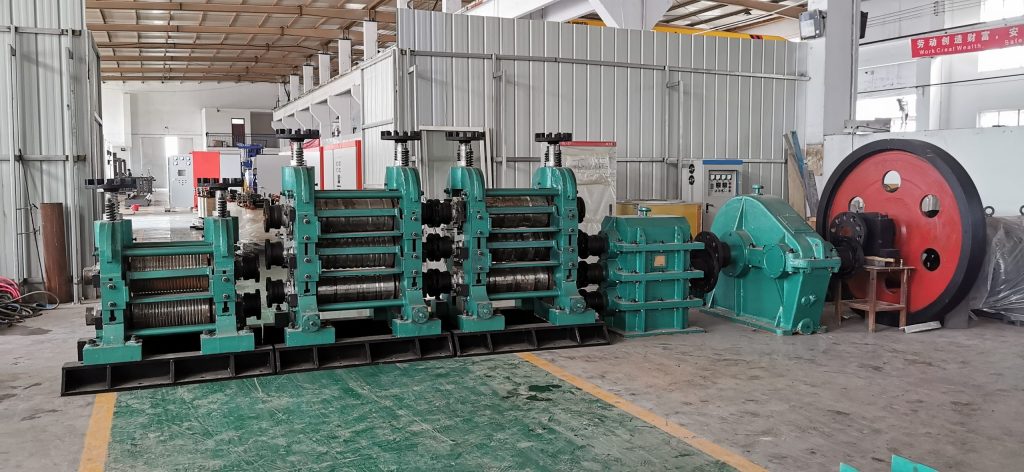
The continuous rolling mill is the core of this system. Its main feature is multi-frame rolling in the same direction, ensuring that the metal is simultaneously deformed in several frames. This guarantees uniform cross-sectional shapes, precise dimensions, and consistent mechanical properties, resulting in products that meet the highest industrial standards.
By eliminating unnecessary intermediate handling, reducing manual labor, and optimizing material flow, the production line achieves significant operational efficiency improvements compared to traditional methods.
Key Technical Advantages
The Wire Rod and Section Bar Production Line provides multiple advantages that directly impact production efficiency, cost savings, and product quality.
| Advantage | Technical Explanation | Customer Benefit |
|---|---|---|
| Energy Efficiency | Continuous casting eliminates reheating and reduces intermediate processing steps. | Lower energy consumption and operational costs; environmentally friendly production. |
| Material Savings | High-precision rolling reduces metal loss and improves forming accuracy. | Increased yield, reduced scrap, and cost-effective use of raw materials. |
| Simplified Production Process | Continuous workflow minimizes transport systems and plant footprint. | Lower infrastructure investment and reduced operational complexity. |
| Shorter Production Cycle | Continuous operation eliminates delays from batch processing. | Higher throughput, faster delivery, and increased profitability. |
| Enhanced Product Quality | Uniform deformation ensures consistent cross-section, superior mechanical properties, and smooth surface finish. | High-quality end products suitable for demanding applications such as automotive, construction, and manufacturing. |
| Labor Reduction | Automated casting and rolling minimize manual intervention. | Reduced labor intensity, improved safety, and lower human error. |
| Flexible Production | Adjustable rolling parameters allow for various wire rod diameters and section bar sizes. | Meets diverse market demands with a single production line. |
Detailed Production Process
1. Continuous Casting
Molten steel is poured into a continuous casting machine, forming billets, blooms, or rods. Compared to traditional ingot casting, continuous casting produces:
- Consistent shapes with minimal defects
- Reduced material waste and energy consumption
- Improved downstream rolling performance
By using continuous casting blanks, manufacturers achieve higher metal utilization and create a foundation for precise rolling, ensuring excellent product quality.
2. Continuous Rolling
The cast blanks enter the continuous rolling mill, where they pass through multiple rolling frames simultaneously. Key technical features include:
- High-speed rolling for increased throughput
- Precision deformation control for accurate cross-sections
- Reduced rolling passes to save energy and reduce material fatigue
- Uniform mechanical properties across the entire product length
This integrated approach ensures that each billet, rod, or bar meets strict quality standards, including dimensional accuracy, surface finish, and internal structure.
3. Cooling and Finishing
After rolling, the wire rods or section bars undergo:
- Controlled cooling to maintain material properties
- Straightening for precise geometry
- Cutting to required lengths
- Quality inspection to ensure compliance with specifications
This step guarantees that products are ready for immediate shipment or further processing, minimizing delays and maintaining consistent quality for customers.
Why Choose This Production Line
Investing in a Wire Rod and Section Bar Continuous Casting and Rolling Production Line brings significant technical and business benefits:
- Operational Efficiency: Streamlined processes reduce downtime and labor costs, while automation ensures consistent output.
- Cost Savings: Reduced energy consumption, lower material waste, and minimized infrastructure needs translate to substantial operational savings.
- Superior Product Quality: Uniform cross-section, excellent mechanical properties, and smooth surfaces ensure products meet the most stringent standards.
- Space Optimization: Compact plant layout with fewer transport systems allows better utilization of floor space.
- Environmental Compliance: Energy-efficient design reduces emissions and carbon footprint.
- Flexibility: Adjustable rolling parameters support multiple wire rod diameters and section bar sizes, meeting diverse customer requirements.
Applications
This production line is ideal for industries that require high-quality steel products with precise dimensions and consistent mechanical properties, including:
- Construction: Reinforcement bars, structural beams, and section bars
- Automotive: High-strength rods for chassis, suspension, and components
- Manufacturing: Tools, machinery parts, and industrial components
- Energy & Infrastructure: Electrical rods, pipelines, and specialized section bars
By providing reliable and versatile production, this line helps manufacturers expand their market reach and meet high-demand industrial standards.
Summary
The Wire Rod and Section Bar Continuous Casting and Rolling Production Line is more than just a machine—it is a strategic investment for modern steel manufacturers. By combining continuous casting technology with advanced rolling mills, this production line delivers:
- Energy and material savings through efficient continuous processing
- Shorter production cycles, boosting throughput and profitability
- High-quality, uniform products for demanding applications
- Simplified operations, reduced labor intensity, and lower production costs
- Environmentally responsible production, in line with modern industrial standards
Adopting this production line ensures that steel manufacturers remain competitive, sustainable, and ready for future market challenges. With its blend of innovation, efficiency, and reliability, it sets a new benchmark for modern steel production.