
Introduction
In modern steel production, billet reheating furnace technology plays a critical role in ensuring stable rolling performance and final product quality. Traditional heating methods such as coal-fired or oil-fired furnaces often suffer from high energy consumption, uneven heating, and excessive oxidation loss.
With the increasing demand for energy efficiency and environmental compliance, induction-based billet reheating furnaces are becoming the preferred solution for rolling mills and metal processing plants.
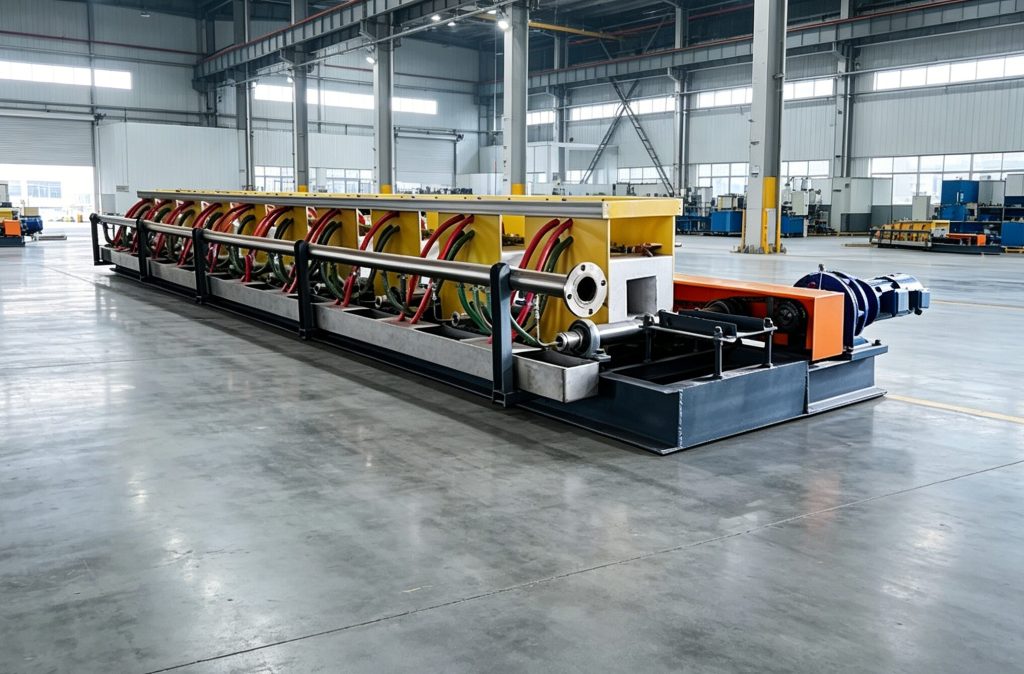
What Is a Billet Reheating Furnace?
A billet reheating furnace is industrial equipment designed to heat steel billets to the required rolling temperature before deformation processes such as hot rolling or forging.
Typically, billets coming from a continuous casting machine already retain significant internal heat:
- Surface temperature: 750–850°C
- Core temperature: 950–1000°C
This means:
Up to 1/3 of the billet does not require reheating, allowing substantial energy savings when using advanced heating technology.
How Does an Induction Billet Reheating Furnace Work?
Unlike conventional combustion furnaces, induction systems heat billets through electromagnetic induction.
Key principle:
- Alternating current generates a magnetic field
- Eddy currents are induced inside the billet
- Internal resistance produces heat directly inside the material
This results in:
- Faster heating
- Minimal surface oxidation
- Precise temperature control
Key Advantages of Induction Billet Reheating Furnace
1. Fast Heating & High Efficiency
- Rapid temperature rise
- Significantly shorter heating cycles
- Energy efficiency improved by 20–40% compared to traditional furnaces
2. No Preheating Required
- Instant start-up
- Reduced downtime
- Lower operational complexity
3. Precise Temperature Control
- Adjustable heating length, speed, and temperature
- Small temperature difference between core and surface
- Improved metallurgical consistency
4. Low Oxidation Loss
- Reduced scale formation
- Better surface quality
- Higher material yield
5. Flexible Operation
- Simple feeding and discharging
- High degree of automation
- Adaptable to different billet sizes and production requirements
6. Energy Saving & Environmental Protection
- Lower energy consumption than coal or oil furnaces
- Reduced emissions
- Compact footprint
Technical Characteristics & Working Process
| Parameter | Specification |
|---|---|
| Billet Surface Temperature | 750–850°C |
| Billet Core Temperature | 950–1000°C |
| Heating Method | Induction Heating |
| Frequency Selection | Adjustable based on billet size |
| Heating Control | Precise control of length, speed, temperature |
| Automation Level | High |
| Energy Efficiency | High (optimized design) |
| Oxidation Loss | Low |
Comparison: Induction vs Traditional Reheating Furnace
| Feature | Induction Furnace | Coal/Oil Furnace |
|---|---|---|
| Heating Speed | Fast | Slow |
| Energy Consumption | Low | High |
| Oxidation Loss | Minimal | High |
| Temperature Control | Precise | Difficult |
| Environmental Impact | Low | High |
| Maintenance Cost | Low | High |
For modern rolling mills, switching to induction billet reheating furnace can reduce overall production costs while improving product quality.
Application Scenarios
Billet reheating furnaces are widely used in:
- Steel rolling mills
- Forging plants
- Continuous casting production lines
- Aluminum and non-ferrous metal processing
Especially suitable for:
- Medium and small rolling production lines
- Energy-saving upgrade projects
How to Choose the Right Billet Reheating Furnace
When selecting equipment, consider:
- Billet size and cross-section
- Required production capacity
- Heating temperature range
- Energy consumption targets
- Automation requirements
A customized inductor design can significantly improve heating efficiency and reduce maintenance costs.
FAQ – Billet Reheating Furnace
Q1: What is the ideal temperature for billet reheating?
A: Typically between 1100°C–1250°C, depending on the steel grade and rolling process.
Q2: Why choose induction over gas or coal furnaces?
A: Induction furnaces offer higher efficiency, lower oxidation loss, and better temperature control, making them more suitable for modern production.
Q3: Does billet size affect heating efficiency?
A: Yes. Different billet cross-sections require different frequencies to achieve optimal heating performance.
Q4: Is maintenance complicated?
A: No. Induction systems have low maintenance requirements, especially with customized inductor design.
Q5: Can this system reduce production costs?
A: Yes. Lower energy consumption, reduced material loss, and higher efficiency all contribute to lower overall operating costs.
Conclusion
The billet reheating furnace is no longer just a heating device—it is a key factor in determining production efficiency, energy consumption, and product quality.
For steel manufacturers looking to upgrade their operations, an induction billet reheating furnace offers a reliable, efficient, and environmentally friendly solution.