
A car bottom furnace is the right starting point when a heat-treatment load is too large, too heavy, or too awkward to place through a conventional front door. The load is built up on a moving hearth—often called a car or trolley—outside the hot chamber, then moved into position for the cycle. That is a different handling method, not merely a larger box.
For plants evaluating MFMelt heat-treatment equipment, the useful question is simple: can the furnace handle the real load, fixture, process route, and shop-floor movement plan? The answer depends on workpiece envelope, load distribution, process temperature, heating method, uniformity requirement, cycle time, and available floor space. This guide explains where a car-bottom layout fits, where it does not, and what to put in an RFQ before asking for a proposal.
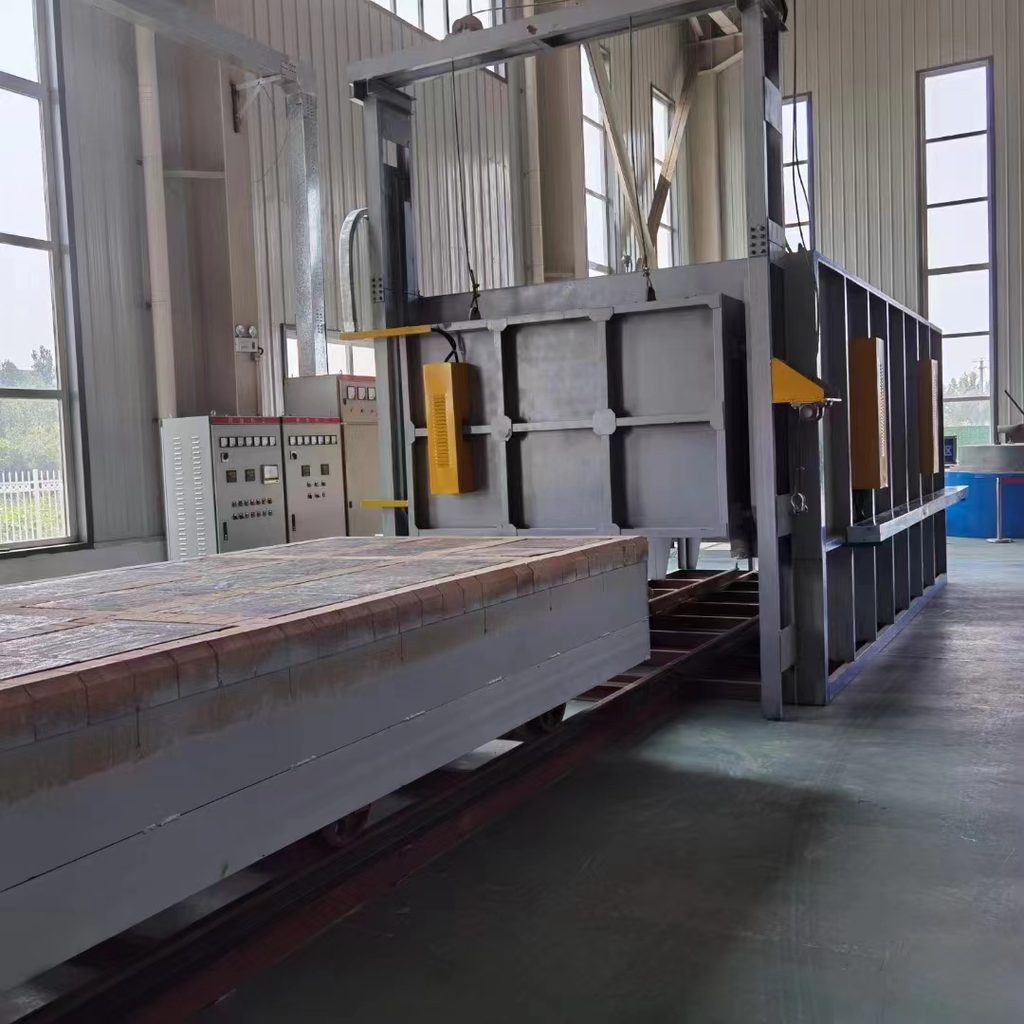
What is a car bottom furnace?
A car bottom furnace is a batch furnace with a movable hearth that carries a load into and out of a fixed furnace chamber. The car may run on rails or another guided mechanism. Loading can therefore take place outside the hot chamber using the handling method appropriate to the plant, such as a crane, forklift, or dedicated loading fixture.
The key benefit is not simply “more capacity.” It is controlled handling of bulky loads. For large fabrications, forgings, castings, rolls, dies, or assemblies, loading inside a fixed chamber can be slow and can create a risk of contact with the lining or door area. A movable car changes the loading sequence: position and secure the work outside, move it into the chamber, run the programmed cycle, and return the load for unloading.
A car bottom furnace can be electrically heated, gas fired, or engineered around another approved heat source. The actual design may use different door arrangements, insulation systems, circulation fans, control zones, and load-handling configurations. These are configuration decisions, not universal features. When comparing suppliers, request a written description of the offered configuration rather than assuming that every trolley furnace includes the same equipment.
Where car bottom furnaces are used
Car bottom furnace applications generally involve large, heavy, or irregular workpieces that need a controlled batch heat-treatment cycle. In the MFMelt product range, the relevant starting point is the heat treatment equipment category, which includes a car-bottom annealing furnace alongside other heat-treatment equipment. Industry references describe car-bottom layouts for annealing, tempering, stress relieving, normalizing, and forging preheating. The actual process window must be confirmed against the material specification, workpiece geometry, and the offered furnace design.
Large fabricated and welded components
Large welded structures can require stress relief after fabrication. A rail-mounted car can make it easier to load an assembly whose length, width, or shape is difficult to handle through a standard door. The selection question is not only whether the part fits inside the chamber. The buyer should also evaluate how the load is supported, how its mass is distributed across the car, how it expands during heating, and whether the requested temperature uniformity can be achieved around the actual load.
Forgings, castings, and heavy machine parts
Forgings, castings, rolls, shafts, and heavy mechanical parts may need annealing, tempering, normalizing, or another heat-treatment cycle. A car bottom design can be useful when overhead handling is already part of the production flow. It allows the plant to stage parts and fixtures outside the furnace, reducing the need to maneuver heavy loads close to a hot chamber opening.
The processing route must still be defined by the component specification. A furnace supplier should not select a cycle based only on a part name. Material grade, section thickness, required properties, allowable distortion, load arrangement, and post-process inspection requirements all affect the correct thermal recipe.
Preheating and production support
Some facilities use car-mounted furnace systems for preheating tools, dies, or heavy loads before forging, forming, coating, or another downstream process. Here, production planning matters as much as furnace temperature. The RFQ should state the required throughput, number of loads per shift, loading and unloading time, and the bottleneck process that the furnace must support.
Do not assume that a furnace described as suitable for preheating is automatically suitable for annealing, stress relieving, or hardening. Those processes can require different temperature ranges, uniformity, atmosphere conditions, cooling controls, and documentation. The buyer should define the process first and select the furnace configuration second.
Car bottom furnace versus other furnace layouts
A car bottom furnace should be selected for the handling and thermal-process problem it solves, not because the name sounds more industrial. The following comparison is a planning tool. It does not replace an engineering review of a particular component or process.
| Layout | Best starting use case | Loading approach | Main selection question | Typical limitation |
|---|---|---|---|---|
| Car bottom furnace | Large, heavy, long, or irregular batch loads | Load is prepared on a moving car outside the chamber | Can the car, rails, seals, and chamber support the real load and process? | Requires space for car travel, loading, and safety access |
| Fixed-hearth box furnace | Smaller or more regular batch loads | Front-loading through a fixed opening | Does the load fit and can it be placed without damaging the lining? | Less convenient for oversized or awkward loads |
| Pit furnace | Long vertical workpieces or loads suited to vertical processing | Load is lowered into a pit-style chamber | Does vertical loading protect the part and suit the facility layout? | Requires an appropriate pit, lifting plan, and vertical clearance |
| Bell-type furnace | Coils, wire, or other loads suited to a removable cover arrangement | Load is placed on a base and covered by the furnace bell | Does the product geometry and process require this layout? | Not a substitute for a car design handling large fabricated loads |
The main comparison is therefore about workpiece geometry, handling route, and process control. A car bottom furnace can reduce handling complexity for the right load, but it requires sufficient floor space, a dependable movement system, appropriate seals, a safe loading plan, and a chamber sized around the actual fixtures as well as the workpiece.
How to select a car bottom furnace
A useful specification begins with the process and the load. “We need a large furnace” is not enough information for a supplier to propose a reliable system. The following factors should be reviewed together.
1. Define the workpiece envelope and load distribution
Give the supplier the maximum length, width, height, individual weight, total batch weight, center of gravity, and support points. Include drawings and photos when possible. A car designed for a nominal weight still needs to distribute that load safely through its deck, wheels, rails, drive system, and structural frame.
Also identify fixtures, baskets, trays, bases, or support beams. These can change both the effective dimensions and the heating behavior of the load. For example, a heavy fixture may absorb heat and affect the time required to achieve uniform temperature. The quoted usable chamber dimensions should be checked against the complete loaded assembly, not against the bare component alone.
2. Define the heat-treatment process before choosing the heat source
State the intended process: annealing, tempering, normalizing, stress relieving, preheating, aging, or another defined operation. Then specify the temperature range, setpoint tolerance, required uniformity, heating rate, hold time, cooling route, and any required records.
Gas-fired and electrically heated systems are both used in industrial furnace design, but the correct option depends on the plant’s available utilities, process requirements, emissions controls, operating pattern, and maintenance capability. There is no universal “best” energy source. Ask suppliers to explain how their proposed heating arrangement, zone control, circulation, and sensor placement support the required process—not just the peak temperature.
3. Review temperature uniformity and control evidence
Temperature uniformity is a process requirement, not a marketing adjective. The furnace needs to be evaluated with the intended load arrangement in mind. Chamber geometry, heating-element or burner arrangement, air circulation, insulation, door and car sealing, and the thermal mass of the load can all influence the result.
In an RFQ, specify the required uniformity standard or customer requirement, the survey method expected, thermocouple locations, data-recording needs, and the acceptance condition. If the buyer has no formal requirement, this should be identified as an engineering item to resolve before ordering. Do not publish or accept a generic uniformity value without knowing how it was measured and under what load condition.
4. Specify car, door, and material-handling requirements
The moving car is central to the system. Request details about the car structure, insulation or refractory design, rail arrangement, drive type, travel controls, stopping accuracy, interlocks, emergency procedures, and maintenance access. If the load enters on a crane, forklift, or transfer table, describe that route and any clearance constraints.
Door design also affects operations. Consider opening method, opening clearance, sealing strategy, heat exposure during loading, and the relationship between door operation and car movement. The supplier should explain how the chosen door and car arrangement suits the plant layout. A layout drawing is more useful than an unqualified statement that loading is “easy.”
5. Separate options from confirmed capability
Features such as atmosphere control, quench systems, multiple cars, multiple doors, data acquisition, remote monitoring, or specialized cooling may be available on some car bottom furnace designs. They must not be assumed on a specific machine.
For each option, ask whether it is included, optional, excluded, or requires a separate engineering review. This protects both the buyer and the supplier from a proposal that looks complete on a brochure but does not meet the actual process scope.
A practical RFQ checklist
An RFQ that includes the following information gives an engineering team a better basis for selecting a car bottom furnace and for identifying missing assumptions early.
| Information to provide | Why it matters |
|---|---|
| Workpiece drawings, photos, material grade, and quantity | Defines chamber size, fixtures, heating behavior, and process route |
| Maximum loaded dimensions and total batch weight | Determines usable furnace envelope, car structure, and handling design |
| Center of gravity and support points | Helps evaluate deck loading, rail loads, and fixture requirements |
| Required process and temperature profile | Defines heating method, controls, instrumentation, and cycle design |
| Uniformity, recordkeeping, and acceptance requirements | Sets the basis for surveys, sensors, documentation, and verification |
| Heating source and available utilities | Identifies gas, electrical, ventilation, cooling, and control constraints |
| Loading method and plant layout | Determines crane, forklift, door, car travel, foundation, and clearance needs |
| Target production schedule | Connects cycle time, staging, loading time, and number of cars to throughput |
| Safety, emissions, and local compliance requirements | Ensures the proposal addresses the site rather than only the furnace shell |
| Preferred optional equipment | Clarifies whether automation, atmosphere, cooling, quench, or data systems are required |
A quotation should then distinguish the base scope, optional scope, customer-supplied utilities, installation work, commissioning, training, acceptance testing, and excluded items. This is more useful than comparing only the quoted furnace price.
How a car-bottom annealing furnace page should support this guide
This guide answers the selection question. The car-bottom annealing furnace page should answer the configuration and inquiry question. MFMelt currently describes that product as a cycle-operated electric furnace for annealing and tempering work including forgings, high-manganese steel, rolls, steel balls, stainless steel, and mechanical parts. It identifies the furnace shell, lining, trolley, heating elements, door, and control cabinet as key assemblies.
Before a buyer treats that description as a final specification, the project team should confirm the exact model, usable dimensions, rated load, heating method, temperature range, control configuration, car movement arrangement, included equipment, and options. These details are application-specific; this article does not assign generic ratings to an MFMelt unit. For the wider process background, see the existing annealing process guide, which explains why material, section size, heating, soaking, and cooling conditions matter.
This split gives each page a distinct job. A reader comparing furnace layouts can stay here. A reader with a part drawing and a production target can use the product page and move into a technical discussion. If MFMelt offers several car-bottom configurations, the product content should compare the genuine differences—rather than publishing near-identical pages with the same broad claims.
Send your project details to MFMelt
A meaningful furnace discussion starts with the workpiece, not with a generic request for a price. If you are planning an annealing, tempering, stress-relief, or preheating project, send the part drawing or photos, loaded dimensions, batch weight, material grade, target thermal cycle, expected throughput, preferred heating source, and any site restrictions. That lets the engineering team identify questions about handling, car travel, chamber clearance, controls, and utilities before a proposal is built around assumptions.
Use the MFMelt contact page to share those project details. If some information is not yet fixed, say so. A clear “to be confirmed” is more useful than an invented temperature, capacity, or uniformity requirement. It gives the discussion a factual starting point and helps keep the eventual equipment recommendation tied to the actual load and process.
For example, a request that says “large steel fabrication, stress relief required” still leaves critical questions unanswered: the loaded envelope, total mass, support points, heating profile, and available crane clearance may each change the equipment concept. Including those facts at the first contact helps avoid a generic quotation and gives both sides a traceable basis for the next technical review.
Frequently asked questions
What is a car bottom furnace used for?
A car bottom furnace is used for batch heat treatment when the load is large, heavy, long, or awkward to load through a conventional fixed-hearth chamber. Typical uses can include annealing, tempering, stress relieving, normalizing, and preheating, provided the actual furnace configuration and process requirements are compatible.
How is a car bottom furnace different from a box furnace?
The main difference is the movable hearth. A car bottom furnace carries the load into and out of the chamber on a car or trolley, while a conventional box furnace usually has a fixed hearth and is loaded through a front opening. The better choice depends on load geometry, weight, handling equipment, plant layout, and process requirements.
What information is needed to size a car bottom furnace?
At minimum, provide the loaded dimensions, batch weight, center of gravity, material, process temperature profile, uniformity requirement, heating source, loading method, throughput target, and installation constraints. Engineering drawings and photos help determine whether the proposed car and chamber arrangement can safely handle the real load.
Can a car bottom furnace use gas or electric heating?
Industrial car bottom furnace designs can use gas-fired or electric heating arrangements. The suitable choice depends on the requested process, available utilities, control requirements, site constraints, emissions controls, maintenance capability, and total operating plan. The heating method should be selected as part of the engineered proposal.
Are the temperature and load ratings the same for every trolley furnace?
No. Temperature range, useful chamber size, load rating, uniformity capability, heating arrangement, cycle time, and optional equipment depend on the specific furnace design and application. Buyers should request model-specific documentation and acceptance criteria rather than relying on a generic range from an unrelated system.