
Introduction
In 2026, the global manufacturing landscape is defined by rising energy costs, strict carbon emission regulations, and growing demand for high-quality metal production. For businesses involved in aluminum and non-ferrous metal melting, one of the most critical decisions remains: induction furnace or gas furnace?
While both technologies have evolved significantly over the years, their suitability depends heavily on production scale, energy costs, regulatory requirements, and long-term operational goals. This guide provides a head-to-head comparison tailored to the 2026 industrial environment, helping buyers make a data-driven choice.
How Induction and Gas Furnaces Work
Before diving into the comparison, it helps to understand the fundamental operating principles.
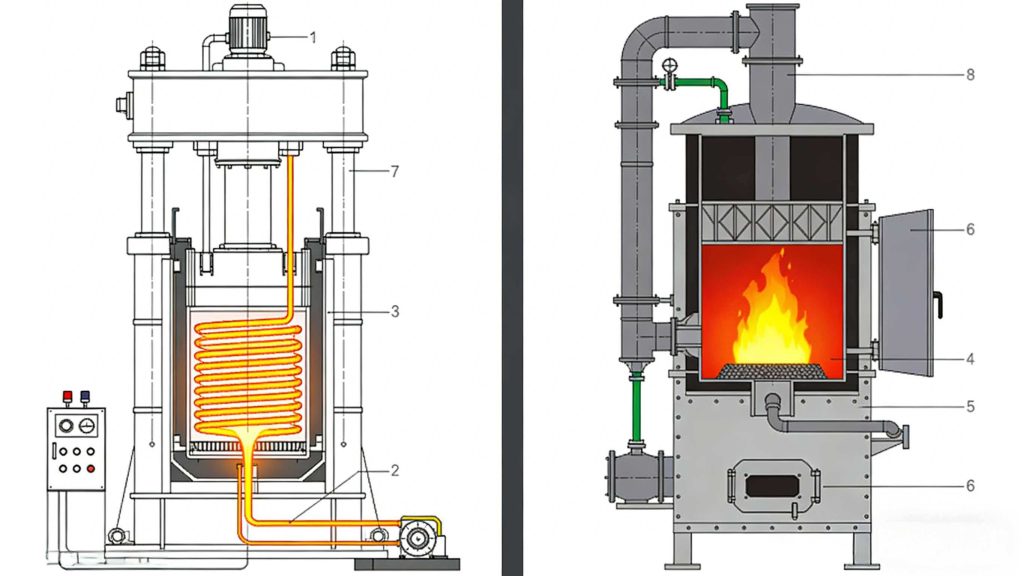
Induction Furnace
Induction furnaces use electromagnetic induction to generate heat directly within the metal itself. An alternating current passes through a copper coil, creating a magnetic field that induces eddy currents in the charge material, rapidly raising its temperature.
- No open flame
- High energy transfer efficiency
- Clean melting process
Gas Furnace
Gas furnaces rely on combustion of natural gas, LPG, or diesel to produce heat. The heat is transferred to the metal through radiation and convection.
- Mature, widely adopted technology
- High throughput for large batches
- Dependent on fuel supply and combustion efficiency
Induction Furnace vs Gas Furnace: Head-to-Head Comparison (2026)
1. Energy Efficiency & Operating Cost
Induction Furnace
- Thermal efficiency typically ranges from 65% to 75%
- Less heat loss to the surrounding environment
- Stable energy costs where electricity grids are transitioning to renewable sources
- Favorable in regions with green energy incentives
Gas Furnace
- Average efficiency between 30% and 45%
- Significant heat loss through exhaust and furnace walls
- Vulnerable to global fuel price volatility
- Lower per-unit energy cost only in areas with heavily subsidized natural gas
2026 Verdict: Induction furnaces offer superior long-term energy efficiency.
2. Metal Quality & Melt Yield
Induction Furnace
- Minimal oxidation and dross formation
- Excellent melt homogeneity
- Ideal for high-purity aluminum, alloys, and precision casting
- Higher metal recovery rate
Gas Furnace
- Higher risk of oxidation and contamination
- Suitable for general-purpose melting and less strict quality requirements
- Dross removal increases operational complexity
2026 Verdict: Induction melting dominates in quality-sensitive industries.
3. Upfront Investment & Maintenance
Induction Furnace
- Higher initial capital expenditure
- Requires stable power supply and electrical infrastructure
- Lower routine maintenance (no burners, no fuel lines)
- Longer service life with proper care
Gas Furnace
- Lower upfront cost
- Simpler installation
- Higher maintenance: burners, refractory, flue systems, and filters
- More frequent part replacements
2026 Verdict: Gas furnaces win on initial cost; induction wins on total cost of ownership (TCO).
4. Environmental & Regulatory Compliance (2026 Standards)
Induction Furnace
- Zero on-site emissions
- Low noise pollution
- Aligns with ESG goals, carbon neutrality targets, and strict emission laws
- Easier permitting in regulated regions
Gas Furnace
- Produces flue gas, requiring exhaust treatment
- Subject to tightening emission limits worldwide
- May face additional carbon taxes or regulatory restrictions after 2025
2026 Verdict: Induction furnaces are far more future-proof for compliance.
5. Production Speed & Flexibility
Induction Furnace
- Fast melting cycles
- Precise and stable temperature control
- Excellent for small-to-medium batches and flexible production
Gas Furnace
- High-volume continuous melting capability
- Better suited for large foundries and heavy industrial operations
2026 Verdict: Choice depends on production scale and flexibility needs.
Which Should You Choose in 2026?
Choose an Induction Furnace If:
- You produce high-purity aluminum or precision alloys
- Energy efficiency and low emissions are priorities
- You want lower long-term maintenance and TCO
- Your production requires flexibility and frequent alloy changes
- Your region enforces strict environmental regulations
Choose a Gas Furnace If:
- You operate large-scale, high-volume continuous melting
- Natural gas prices are extremely low and stable in your area
- Your upfront budget is limited
- Metal purity requirements are relatively low
- You have existing fuel infrastructure and skilled maintenance teams
2026 Trends Shaping the Industry
Several key trends will influence furnace selection in 2026 and beyond:
- Increased adoption of IoT and smart monitoring systems in both technologies
- Stronger global push for decarbonization in manufacturing
- Growth of hybrid melting systems that combine induction and gas advantages
- Higher government incentives for electric and induction-based equipment
Conclusion
There is no universal “best” choice between induction and gas furnaces in 2026. The right option depends on your production profile, energy costs, regulatory environment, and long-term business goals.
However, the overall industry shift clearly favors induction melting for its efficiency, cleanliness, and alignment with modern sustainability standards. For businesses planning long-term growth, induction furnaces represent a more future-proof investment.
If you need help evaluating your specific operation, feel free to contact our engineering team for a personalized assessment.