
I. Why Small Rolling Mills Are Important in Metal Processing
1.1 Growing Demand for Flexible Rolling Solutions
In modern metal processing, manufacturers increasingly require flexible, efficient, and cost-effective rolling equipment. Many steel plants and metal processing companies no longer operate only large continuous rolling lines. Instead, they often produce multiple product types in smaller batches, which requires more adaptable equipment.
Several factors are driving this trend:
- Increasing demand for small-batch steel and non-ferrous metal production
- Expansion of regional metal processing plants
- Growth of scrap-based recycling steel plants
- The need for lower investment and faster project return
Traditional large rolling lines offer high output but require massive capital investment, large factory areas, and long changeover times. In contrast, small rolling mills provide a much more flexible solution.
They allow manufacturers to produce products such as:
- Steel reinforcing bars (rebar)
- Wire rods
- Aluminum rods
- Copper strips
Because of their compact design and lower energy consumption, small rolling mills are widely used by small and medium metal plants, recycling facilities, and specialized product manufacturers.
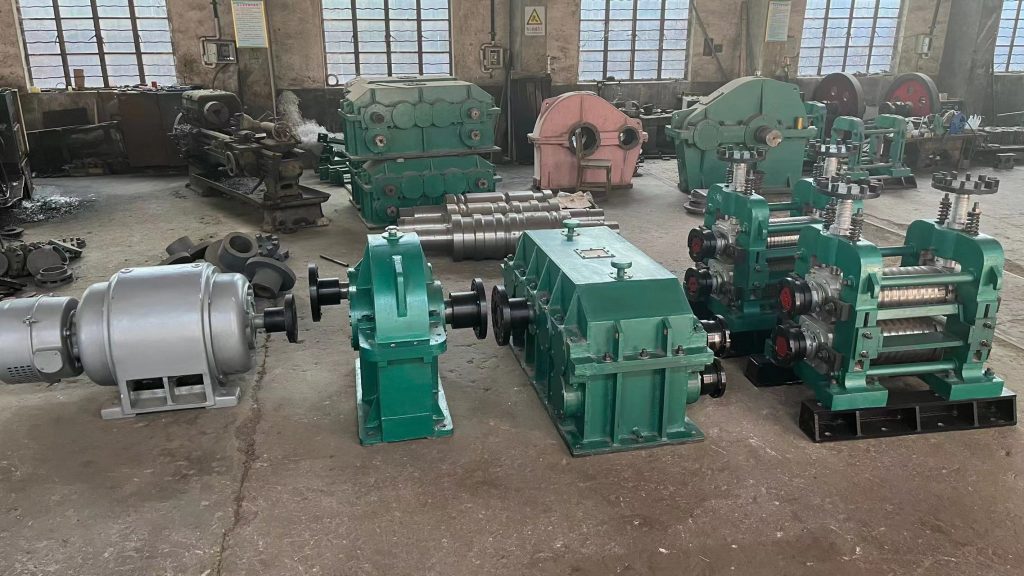
II. What Is a Small Rolling Mill?
A small rolling mill is a compact metal forming system that reduces the thickness or cross-section of metal billets by passing them through rotating rolls under high pressure.
Compared with large industrial rolling lines, a small rolling mill features:
- Lower production capacity
- Reduced investment cost
- Smaller plant footprint
- Higher production flexibility
Typical product applications include:
- Steel bars and rebars for construction
- Carbon steel and stainless steel wire rods
- Aluminum rods used in electrical cables
- Copper strips used in electrical components
A small rolling mill is particularly suitable for companies that require frequent product changes, lower output volumes, or flexible manufacturing schedules.
III. Working Principle of a Small Rolling Mill
3.1 Basic Rolling Process
The rolling process is a plastic deformation process in which heated metal is compressed between rotating rolls. As the billet passes through the rolls, its thickness decreases while its length increases.
The main production steps typically include:
- Billet Heating
Steel billets are heated in a reheating furnace to approximately 900–1200°C, ensuring the material becomes sufficiently plastic for rolling. - Descaling
Oxide scales formed during heating are removed using high-pressure water systems. - Rough Rolling
The billet is first reduced in size in the roughing stands. - Intermediate Rolling
Further size reduction and shape adjustment occur. - Finishing Rolling
The final product dimension and surface quality are achieved. - Cooling and Cutting
The rolled material is cooled, straightened, and cut into the required lengths.
During the rolling process, the metal maintains its volume while undergoing plastic deformation, resulting in improved mechanical properties.
3.2 Rolling Force and Deformation Mechanism
The performance of a rolling mill depends on several key parameters:
- Rolling force
- Reduction ratio
- Roll diameter
- Rolling speed
- Motor torque
The rolling mill motor drives the roll system through a gearbox and transmission shaft, generating the torque needed to compress and shape the metal billet.
Proper matching of these parameters ensures stable rolling, accurate dimensions, and consistent product quality.
IV. Structure of a Small Rolling Mill
A typical small rolling mill consists of several major subsystems.
4.1 Rolling Mill Stand
The rolling mill stand is the core mechanical structure. It includes:
- Housing frame
- Work rolls
- Roll bearings
- Screw-down adjustment system
This structure ensures high rigidity and stable rolling pressure.
4.2 Transmission System
The transmission system provides the mechanical power required for rolling.
Key components include:
- Main motor
- Gearbox
- Universal coupling
- Drive shafts
These components transmit torque from the motor to the rolling stands.
4.3 Heating Furnace
Before rolling, metal billets must be heated to a suitable temperature.
Common furnace types include:
- Gas-fired reheating furnaces
- Induction heating furnaces
Proper heating ensures uniform deformation and improved product quality.
4.4 Cooling System
Cooling systems protect equipment and control product temperature. They include:
- Roll cooling systems
- Water spray cooling units
- Cooling beds
These systems prevent overheating and help maintain stable rolling conditions.
4.5 Control System
Modern rolling mills are typically equipped with PLC-based automation systems that provide:
- Speed synchronization
- Thickness control
- Production monitoring
- Fault diagnostics
Automation greatly improves precision, stability, and productivity.
4.6 Auxiliary Equipment
Additional equipment in a rolling line may include:
- Roller tables
- Flying shears
- Cooling beds
- Coilers
These systems support continuous production and material handling.
V. Typical Technical Parameters of a Small Rolling Mill
Industrial buyers often evaluate rolling equipment based on technical specifications and energy efficiency indicators.
Typical parameters include:
| Parameter | Typical Range |
|---|---|
| Production capacity | 0.5 – 5 tons/hour |
| Total motor power | 50 – 500 kW |
| Rolling speed | 1 – 10 m/s |
| Roll diameter | 150 – 400 mm |
| Rolling force | 100 – 1000 kN |
| Rolling temperature | 600 – 1200°C |
| Energy consumption | 80 – 110 kWh/ton |
| Product diameter range | 8 – 32 mm |
These parameters may vary depending on product type, mill configuration, and plant requirements.
VI. Innovative Rolling Technology in Our Small Rolling Mill
Our newly developed small rolling mill integrates advanced rolling technology to significantly improve both product quality and production efficiency.
High Strength and Superior Ductility
The system ensures that finished steel bars maintain excellent tensile strength while significantly improving elongation at break. This effectively overcomes the low ductility problems commonly seen in traditional cold-rolled steel bars.
As a result, the final products exhibit:
- Higher tensile strength
- Improved elongation
- Better mechanical performance
- Increased reliability in construction applications
Passive Single-Roll Drag Rolling Technology
One of the key innovations of our rolling mill is the passive one-roll-and-drag rolling structure.
This technology enables secondary rolling within the same process, which solves a common challenge in rolling systems: speed matching between rolling stages.
Compared with traditional four-roll rolling methods, this new structure offers several advantages:
- Simplified rolling mechanism
- Improved rolling stability
- Better synchronization of rolling speed
- Higher production efficiency
The innovative design significantly enhances the technical performance of small rolling mills.
Precision Automatic Control
Through advanced automatic control algorithms, the rolling mill can precisely regulate rolling speed and pressure.
This ensures:
- Accurate product dimensions
- Smooth product appearance
- Excellent surface quality
The result is consistent finished steel quality and reduced production variability.
VII. Common Applications of Small Rolling Mills
Small rolling mills are widely used across various metal processing industries.
Steel Rebar Production
Construction steel bars are one of the most common products produced by small rolling mills, including:
- Standard construction rebar
- TMT bars
Wire Rod Manufacturing
Small rolling lines can also produce:
- Carbon steel wire rods
- Stainless steel wire
These materials are widely used in fasteners, springs, and industrial components.
Non-Ferrous Metal Rolling
In addition to steel, small rolling mills can process non-ferrous metals such as:
- Aluminum rods
- Copper strips
These materials are widely used in electrical and electronic industries.
Scrap-Based Steel Plants
Many recycling steel plants use small rolling mills to convert scrap metal into finished products.
Typical process flow:
Scrap → Billet → Rolling → Finished Product
This approach reduces production cost while improving resource efficiency.
VIII. Energy Efficiency and Performance Comparison
Small rolling mills provide several advantages compared with traditional large rolling lines.
| Indicator | Traditional Large Rolling Line | Small Rolling Mill |
|---|---|---|
| Investment cost | Very high | Lower |
| Production flexibility | Low | High |
| Changeover time | 4–6 hours | <1 hour |
| Minimum economic batch | ~80 tons | ~15 tons |
| Energy consumption | 120–150 kWh/ton | 80–110 kWh/ton |
| Plant area | ~1200 m² | 300–600 m² |
These advantages make small rolling mills especially attractive for flexible production environments.
IX. Real Industrial Application Case
Case Study: Small Rebar Rolling Line
A steel plant in Southeast Asia installed a small rebar rolling mill to expand its production capacity.
Equipment configuration:
- 6-stand rolling mill
- Billet size: 100 × 100 mm
- Capacity: 3 tons/hour
- Product range: 10–25 mm rebar
Performance results:
| Indicator | Value |
|---|---|
| Production capacity | 3 t/h |
| Power consumption | 90 kWh/ton |
| Product tolerance | ±0.1 mm |
| Equipment uptime | 98% |
After installation, the customer achieved:
- 18% reduction in production costs
- Payback period of less than two years
X. Advantages of Our Small Rolling Mill
Energy-Efficient Drive System
Our rolling mills use high-efficiency motors and frequency inverter control, significantly reducing electricity consumption.
Heavy-Duty Mill Stand
The rolling stands feature high rigidity and durable construction, which helps reduce vibration and extend roll life.
Intelligent Automation
The integrated PLC system provides:
- Automatic speed synchronization
- Real-time monitoring
- Stable process control
Compact Plant Layout
The equipment requires minimal installation space, making it suitable for both new plants and factory upgrades.
XI. Industry Experience and Important Considerations
When selecting a small rolling mill, several factors should be carefully considered.
Selecting the Right Capacity
Capacity selection should be based on:
- Raw material availability
- Market demand
- Investment budget
Proper Furnace Design
The reheating furnace plays a critical role in rolling efficiency, as billet heating often accounts for 70–80% of total energy consumption.
Roll Material Selection
High-performance roll materials improve durability and product quality.
Common materials include:
- High-speed steel rolls
- Tungsten carbide rolls
Preventive Maintenance
Regular maintenance ensures stable equipment operation.
A typical recommendation is routine inspection every 500 operating hours.
XII. Contact Us for Small Rolling Mill Solutions
If you are planning to build or upgrade a small rolling mill production line, choosing the right equipment configuration is essential for ensuring long-term production efficiency and product quality.
Our engineering team provides complete rolling mill solutions, including:
- Rolling mill equipment design
- Customized production line configuration
- Plant layout planning
- Energy-efficient heating furnace solutions
- Automation and control systems
- Installation, commissioning, and technical training
With years of experience in metal processing equipment and rolling mill technology, we help customers design reliable production lines tailored to their capacity requirements, product types, and investment budgets.
Whether you are producing:
- Steel rebar
- Wire rods
- Aluminum rods
- Copper strips
we can provide professional technical support and optimized equipment solutions.
Our engineers will help you determine:
- Suitable rolling mill capacity
- Optimal equipment configuration
- Energy consumption estimates
- Complete production line layout
Start improving your metal production efficiency with a high-performance small rolling mill solution.